

Latest information on Spanish
Keiko Fujimori was 19 years old when she made her international debut as First Lady of Peru at the 1994 event.
At the first Summit of the Americas, hosted by US President Bill Clinton, the young woman, dressed in black, appeared shy and nervous in front of the cameras, cradled in the arms of her father, then-President Alberto Fujimori.
Keiko Fujimori took over the role after her mother, the late Susana Higuchi, separated from her father after publicly accusing the government of corruption in its handling of international donations. This marked the beginning of Fujimori’s political career.
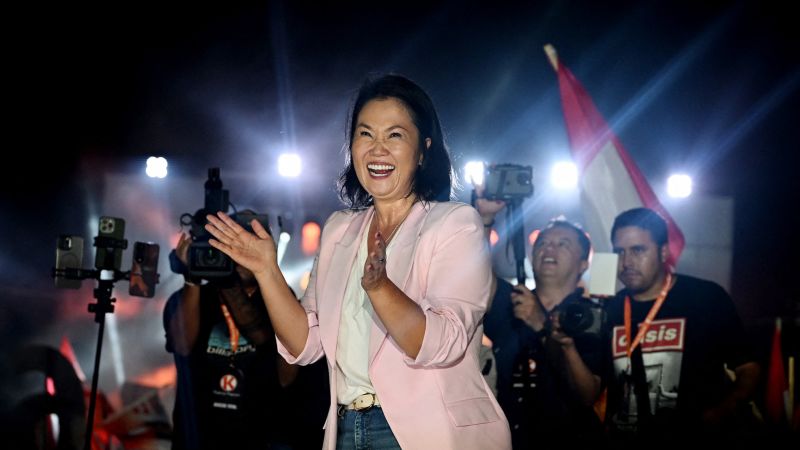
This Sunday, the 51-year-old eldest daughter of the late Peruvian president will make her fourth bid for the presidency in a run-off despite three consecutive defeats in 2011, 2016 and 2021.
She is running against left-wing candidate Roberto Sanchez, who some pollsters are predicting to have a slight lead, and may be well-positioned to win this time.
Fujimori claims he offers the best option to restore security to Peruvians and save a country that has had eight presidents in the past decade and is constantly plagued by a political and institutional crisis exacerbated by corruption scandals, crime and insecurity.
“We need order – order in which we live, order in which we invest, order in which we work,” the conservative candidate reiterated in a presidential debate with Mr. Sánchez, from the Juntos por el Peru (Together for Peru) party.

“I know this election is not about me, but about the type and direction of government we want over the next five years. Either we want chaos and anarchy, or we want to restore order and work for the future of this country,” Fujimori added.
The Fujimorism heir entered the House of Representatives in 2000, founded the Fuerza Popular (Popular Force) party, and spent 13 months in prison for allegedly taking money from the Odebrecht construction company to fund her presidential campaign while under investigation for corruption, charges she has repeatedly denied.
In January 2025, the court declared the case against her invalid. Fujimori claims to have endured 10 years of political persecution.
Following the dramatic 2021 run-off election against former President Pedro Castillo, marred by allegations of voter fraud, Fujimori was forced to admit mistakes in his political career in order to win over voters.
“I know that I have made mistakes throughout my political career. I have learned from them, but I have also come back stronger,” he told the Peruvian people at the end of the last presidential debate.
During this election campaign, right-wing candidates have sought to project a more modest and moderate image, taking less extreme positions. “It’s true that we were confrontational, and we fixed that,” she said in an interview.

Julio Carrion, a political science and international relations professor at the University of Delaware, told CNN that Fujimori is making “a more calculated effort to shed the image of someone who was just trying to fight communism and everything else.”
“She framed her campaign as either fighting communism or defending democracy, and that position was a fundamental mistake in 2021,” a Peruvian political expert explained to CNN, referring to the 2021 run-off with leftist Castillo.
As some expected after the first round of the 2026 election, Fujimori did not immediately join in the accusations of voter fraud promoted by Popular Renewal candidate Rafael López Arriaga.
Father’s legacy and anti-Fujimori sentiments
Alberto Fujimori’s complicated legacy has divided Peru for decades, energizing anti-Fujimori votes during previous election campaigns, and he was seen as a continuation of an authoritarian regime that posed a threat to independent democratic institutions.
Alberto Fujimori served as president from 1990 to 2000. His government brought the country back from the brink of economic collapse and defeated the Shining Path and MRTA terrorist organizations in a domestic conflict that left more than 60,000 people dead, according to the Truth and Reconciliation Commission.
However, his regime was plagued by allegations of human rights abuses and corruption, for which he was convicted decades later. He faced four legal proceedings, including one in 2009 when he was sentenced to 25 years in prison for aggravated murder and assault in the Barrios Altos and La Cantuta cases. The former president died in 2024 after several legal battles and public controversy over securing a pardon due to his health.

Under the slogan “Keiko no va” (meaning “Keiko will not pass”), civil society, student and human rights groups marched in downtown Lima last Saturday to reject her candidacy.
But among younger generations, especially those born after the former president was ousted in 2000, anti-Fujimori votes have not yet proven to be that significant, Carrion points out.
Another factor that could give Keiko Fujimori an advantage this time around is that her opponent, Roberto Sanchez, appears to have tried, but failed, to emulate the image projected by former President Castillo (including his famous hat). “He lacks the appeal of a clear identity. He doesn’t have the image of a fresh, national candidate that Castillo had in 2021,” Carrion explained.
But for Fujimori’s critics, whether she wins or loses, she also bears responsibility for the political instability and corruption the country has experienced in recent years.
As leader of Fuerza Popular, the current majority party in parliament, Fujimori is accused of governing the country through his caucuses, undermining the autonomy of the executive branch, interfering with independent institutions, pushing legislation that protects special interests, such as so-called pro-crime laws, and orchestrating the impeachment of former presidents and the patronage of others.
According to a Human Rights Watch (HRW) report, “rather than strengthening public institutions,” lawmakers are weakening the legal framework and the independence of judges and prosecutors, facilitating the expansion of organized crime. According to HRW, most lawmakers have been driven by “the pursuit of personal gain and self-interest.”

“Her party and she have something to do with what happened in Peru in the last three or four years…so that’s a burden that she has to carry,” Carrion said. “Roberto Sánchez’s problem was that he could not highlight this weakness of Keiko Fujimori because he was a congressman, because in some cases his party voted in favor of Fujimori in favor of certain laws – in some cases, but not always.”
In an interview with CNN, Fujimori denied that he and his party were responsible for Peru’s turmoil and political crisis. She offered some self-criticism regarding her role in relation to former President Pedro Pablo Kuczynski, who resigned in 2018.
“We were very at odds with the Pedro Pablo Kuczynski government, but we were not obstructionists, because we gave the government broad powers to make the most important laws and, above all, reforms…Unfortunately, they didn’t know how to use it,” she told CNN last week.
Other candidates have also been accused of dysfunction and corruption in Peruvian politics during this election cycle, and voters are becoming increasingly wary. This was reflected in the results of the first round, where no candidate on the list of 35 candidates received more than 20% of the votes.
The latest polls show that with a second round of voting taking place on Sunday and mandatory voting in the country, many Peruvians are still undecided, while others say they will choose what they consider to be the “lesser evil” or call for their ballots to be spoiled.

Those who decided to support Fujimori in her fourth bid say they are ready and positioned this time to assemble a government team to restore the investor confidence she so desperately needs.
“There may be doubts and even disagreements about Mr. Fujimori, but he is committed to respecting the constitution, governing for terms set by law, proposing a market economy, attracting private investment, respecting freedoms, and working on the huge social challenges and social debt agenda that are absolutely at stake in Peru,” said Rafael Belaunde, who ran against Mr. Fujimori in the first round with the centre-right. The Libertad People’s Party (People’s Freedom Party) told CNN.
Belaunde claims that he decided to support the Fuerza Popular leader and join her technical team, observing that Fujimori is stronger than it was five years ago and considering what he calls “the danger that Sánchez poses to the economy”.
More than 30 years after starting his career as a politician, Fujimori may have a chance to become the country’s ninth president in a decade.
