

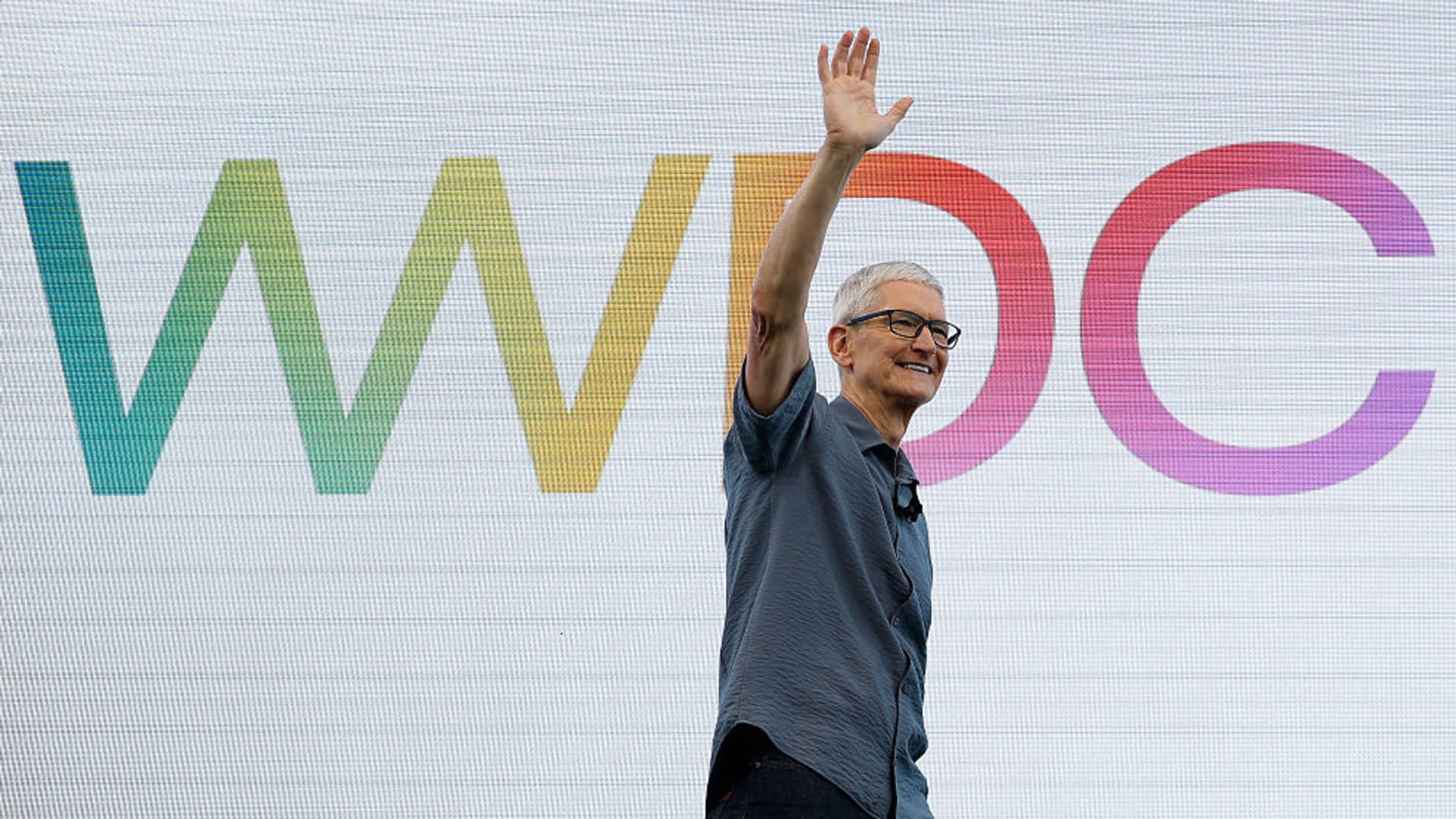
Earnings season may be coming to an end, but Monday brings yet another high-stakes event for one of our “own it, don’t trade it” stocks as stocks hover near all-time highs. That’s when Apple kicks off its annual Worldwide Developers Conference, or WWDC for short. When it comes to Apple and what investors in a stock at this level are interested in, it’s all about Apple Intelligence, the company’s AI suite. After repeated delays, hiccups, and strategic reboots, Apple is finally introducing a new, more personalized Siri. Powered by Google’s Gemini AI model, the digital assistant is expected to have conversation-like interactions and the ability to integrate with apps and services. Apple stock has risen more than 20% since the end of March. Since the stock soared more than 3% on April 30th following near-perfect results, it was up another 12.5% as of Tuesday’s all-time high of $315. It’s almost Friday. That’s what high expectations are all about, and as we learned this week after the results of CrowdStrike and Broadcom (both beat and raise quarterly results), high expectations that aren’t met are met with a sell-off. In Apple’s case, we think outgoing CEO Tim Cook and his gang will do better this time around. This year’s WWDC is expected to be Cook’s last major event at the helm. John Ternus, senior vice president of hardware engineering, is scheduled to take over on September 1st, which typically comes before Apple’s new iPhone launch. We suspect Mr. Cook has no intention of doing anything other than thriving. He confirmed in the company’s latest earnings call that a more personalized Siri will indeed arrive this year. In addition to the Gemini-powered version of Siri (remember, Apple deepened its relationship with Alphabet’s Google to enhance its AI capabilities), I’m interested to see how Apple gives users the ability to interact with other large-scale language models (LLMs), and how it’s worked to enhance its own apps as well as those of third-party developers. We probably won’t get too many details on how Apple will monetize these new features (aside from perhaps new subscriptions), but we expect the Street to provide plenty of insight into the monetization path. Bernstein analysts on Friday opined that Apple may charge fees for third-party services provided by Apple Intelligence. They speculated that apps like Uber could be integrated into Apple’s calendar. This is certainly an interesting idea and also raises questions. Does Apple want app developers with competing services to bid for priority in Apple Intelligence, similar to advertisers bidding to appear on Google Search?Subscriptions to a more powerful version of Siri could easily be a new revenue stream, but the Apple One bundle of first-party services would also be enhanced. And we know that anything that can make services more profitable will make them more profitable, because the margins on services are much higher than on hardware. Security has always been an important issue, especially for Apple. As such, we expect to see a lot of attention on how Apple plans to address the security of the LLMs it provides access to. We explore a two-pronged approach. First, how does Apple process AI queries that have heavy compute requirements and need to be sent to the cloud for processing? Second, how could Apple take advantage of on-device capabilities that are inherently more secure and have less latency? Bottom line Apple is riding high on this year’s WWDC, with its stock trading near all-time highs. Expectations are high. Fortunately, we think Apple will overcome this situation and give us another reason to own the name for the long term. If this new Siri surprises investors as well as consumers, Apple could benefit by monetizing its own devices and services. More AI capabilities could also accelerate the pace of upgrades and drive a shift in sales mix toward high-end devices with more computing power, which will become increasingly valuable in the age of artificial intelligence. (Jim Cramer’s charitable trust is long AAPL, GOOGL. See here for a complete list of stocks.) As a subscriber to Jim Cramer’s CNBC Investment Club, you will receive trade alerts before Jim makes a trade. After Jim sends a trade alert, he waits 45 minutes before buying or selling stocks in his charitable trust’s portfolio. If Jim talks about a stock on CNBC TV, he will issue a trade alert and then wait 72 hours before executing the trade. The above investment club information is subject to our Terms of Use and Privacy Policy, along with our disclaimer. No fiduciary duties or obligations exist or arise from your receipt of information provided in connection with the Investment Club. No specific results or benefits are guaranteed.
