

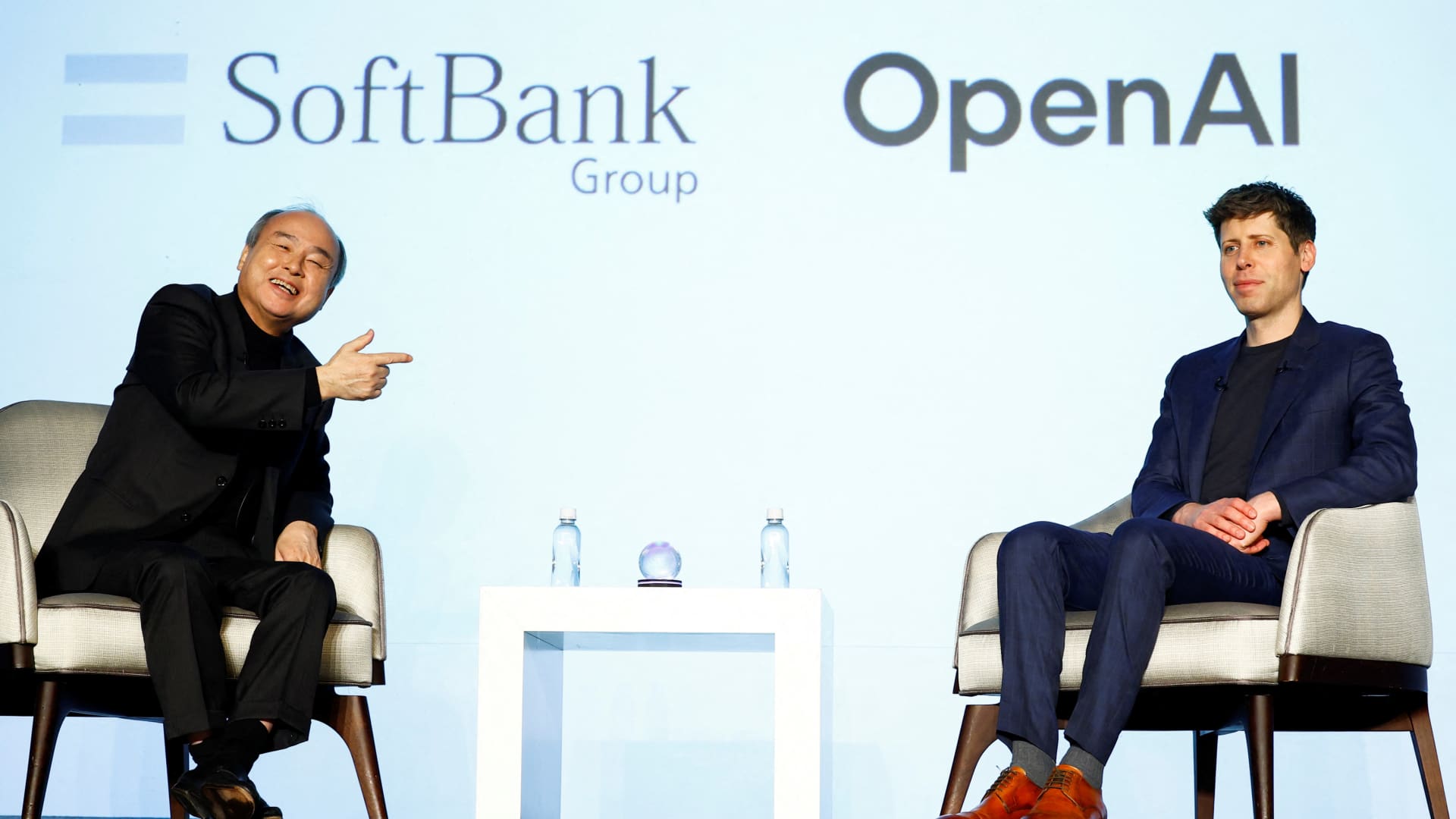
On February 3, 2025, SoftBank CEO Masayoshi Son and OpenAI CEO Sam Altman attended an event to promote AI for business.
Kim Kyung Hoon | Reuters
OpenAI’s next model is being designed by another model as a sign that AI will reach “superintelligence.” Softbank CEO Masayoshi Son told CNBC.
The billionaire’s comments came amid Anthropic’s warning that it may need to slow down its AI development to deal with the impact of the rapid pace of improvement.
Son runs SoftBank, one of the world’s largest technology investors and one of OpenAI’s largest shareholders. In an interview with CNBC on Monday, Son said he spoke with OpenAI CEO Sam Altman and the company’s engineers and was told that AI’s “models are designing future models.”
“So the same thing will happen with all the other major models,” Son said, adding that engineers are no longer smart enough to design the next model.
“When that happens, the model will generate the next model… and it will be exponentially smarter than all of us. It’s superintelligence,” Son told CNBC.

An OpenAI spokesperson declined to comment on unreleased models, but highlighted areas where the company is already leveraging AI in model development.
OpenAI said in February that the GPT‑5.3‑Codex was “the first model it helped create.” The team behind Codex, OpenAI’s coding tool, “used early versions to debug their own training, manage their own deployments, and diagnose test results and assessments.”
“Artificial superintelligence”
Son’s comments are part of a broader conversation about “artificial superintelligence” (ASI), a term he described in 2024 as AI 10,000 times smarter than humans. At the time, Son said ASI would be here in 10 years.
But he told CNBC on Monday that when he announced that timeline about two years ago, “we tried to be conservative because people would be shocked.”
“In my mind, I thought it would come within four years instead of 10. Now I’m saying it will come within the next two years,” Son said.
SoftBank’s CEO said he now uses OpenAI’s ChatGPT for two to three hours a day because the AI is smarter than him in “most subjects.”
Over the next few years, Son said, AI will become smarter than humans in about 70% to 80% of subjects, and for subjects where AI exceeds human intelligence, “it could become 10 times smarter than the average human.”
Son has been bullish on AI for several years, positioning SoftBank in the middle of the boom through his ownership of chip designers. arm In addition to investing in OpenAI, the company is also investing in fields such as robotics and autonomous driving.
He told CNBC that the AI revolution is 50 times bigger than the dot-com revolution of the 2000s.

warning to humanity
The dangers of more advanced AI systems were brought into the spotlight Thursday when Anthropic published a blog post about “recursive self-improvement” (RSI). This is a trend in which AI systems are “able to design and develop their own successor systems fully autonomously.”
Anthropic said it would see positive results, but warned that “fully recursive self-improvement may also increase the risk that humans will lose control of the AI system.”
The company, which develops an AI chatbot called Claude, said it would “probably be a good thing” for AI research institutes to work together to slow the development of the technology.
It’s unclear whether Son mentioned RSI when talking about OpenAI’s model improvements. But in June, an OpenAI research paper said there were “early signs” of RSI in today’s systems.
“This is expected to increase competitive pressures among developers and nations, and create governance challenges that existing institutions are ill-equipped to address. As RSI emerges, society will need ways to shape the trajectory of AI development and ensure that AI serves humanity’s interests,” the paper states.
