

Covertura in Spanish
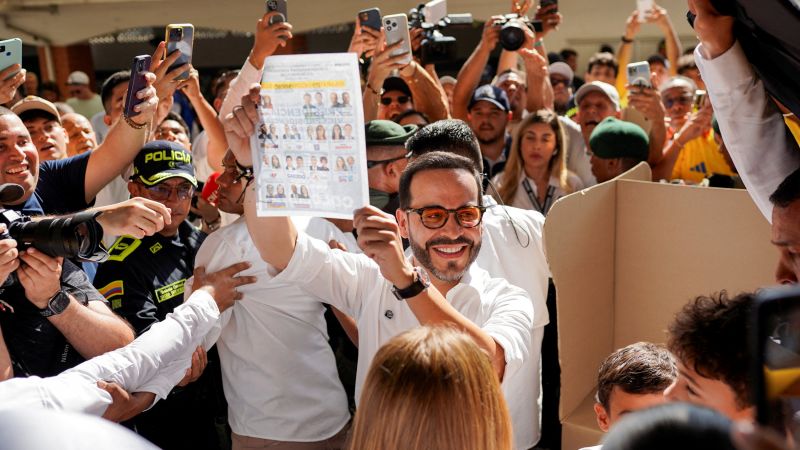
Right-wing outsider candidate Abelardo de la Espriela, who did surprisingly well, will face left-wing senatorial candidate Iván Cepeda in the run-off for Colombia’s presidency, setting the stage for a battle over the country’s political future and the direction of its relations with key international partners, including the United States.
With more than 98% of votes counted, Mr. de la Espriela won the most votes with 43.73%, but he fell short of the absolute majority needed for an outright victory in the first round. Cepeda, who represents the left-wing Historical Accord Coalition, came in second place with 40.91%. According to provisional results released by the National Civil Registry, Democratic centrist candidate Paloma Valencia was far behind in the first round with 6.91%. The 46-year-old heads the Democratic Center Party, founded by former President Alvaro Uribe, and is the party’s first female presidential candidate.
The run-off election, scheduled for June 21, is expected to be a highly polarized race, with two starkly contrasting political visions at stake.

Who are the candidates heading to the run-off?
Abelardo de la Espriela, 47, is a lawyer and political outsider who has emerged as one of the coalition’s strongest challengers, speaking favorably of U.S. President Donald Trump and being tough on crime, drawing comparisons from supporters and critics to leaders such as El Salvador’s Nayib Boucle.
Operating on a platform centered on security, law and order, and economic liberalization, the self-described conservative nationalist promises a more confrontational approach to organized crime, stronger security ties with the United States and Israel, lower taxes, and more oil exploration. He also promised to reverse what he called the Petro regime’s failures.
Senator Iván Cepeda (63) participated in the election campaign as the standard bearer for Petro’s coalition government, the Historical Accord. Cepeda, a longtime left-wing politician and human rights activist, called for the continuation of many of Petro’s policies, including the government’s “total peace” strategy aimed at negotiating with armed groups.
The son of assassinated politician Manuel Cepeda Vargas, he has been active in human rights activism for many years and was a key participant in peace negotiations involving guerrilla groups.
His campaign focused on social inclusion, human rights, land reform, and what he described as a “democratic revolution” to deepen the changes begun under the Petro regime.
Cepeda framed the election as a choice between maintaining progressive reforms or returning to a traditional political model.
The election is widely seen as a verdict on the turbulent presidency of Gustavo Petro, who took power in 2022, and the future direction of Colombia’s political and economic model.
Government supporters argue that Petro’s government expanded social protection and pushed through reforms despite institutional resistance. Critics say the government has failed to deliver on key promises, particularly in the areas of health and security, while economic growth remains weak.
The election campaign also takes place amid growing concerns about political violence and armed conflict, making security one of the most important issues for voters. In the decade since the historic agreement between the Revolutionary Armed Forces of Colombia (Farc) guerrillas and the government, violence between rebels and government has ceased in the country, but criminal gang activity has increased.
Presidential candidate Miguel Uribe Turbay was shot at a campaign rally in June and was hospitalized for several weeks after undergoing multiple surgeries. He died from his injuries on August 11th.
Petro’s flagship policy of “total peace” — a strategy of simultaneously negotiating ceasefires with multiple guerrilla groups and criminal organizations — was the sharpest line of the campaign. Supporters said it was an incomplete but necessary effort to end decades of armed conflict. Opponents said it empowered illegal actors and made Colombia less safe.
The outcome will determine not only Colombia’s domestic policy, but also its relations with the United States and neighboring Venezuela, both of which were recurring themes throughout the campaign.

The election could shape the relationship between the United States and Colombia, one of its closest security and economic partners. Relations between Petro and Trump have often been strained, particularly over immigration, counter-drug policy and regional diplomacy, but the two governments have moved to stabilize relations in recent months.
Petro publicly clashed with President Trump over deportation flights in early 2025, briefly threatening full tariffs before leading to a rapid détente. The episode spooked markets and highlighted how exposed Colombia remains to changes in U.S. policy, particularly regarding trade and counter-drug financing.
Petro then visited the White House in February 2026 and agreed to significant concessions on drug interdiction and cooperation against criminal networks.
The drug trade remains a central axis of bilateral relations. Colombia remains the world’s largest producer of cocaine, and anti-drug pressure from the United States, regardless of party, is likely to weigh heavily on the new leader. Trump has publicly intervened in other Latin American elections, but has yet to publicly comment on the Colombian race.
Leading candidates have offered different visions of the relationship. Cepeda has advocated for a more independent foreign policy and greater Latin American integration, while right-wing candidates Abelardo de la Espriela and Paloma Valencia have advocated closer cooperation with the United States on security and economic issues.
Given Colombia’s strategic role in efforts to combat drug trafficking and manage migration flows across the hemisphere, the outcome of next month’s runoff is likely to be closely watched in Washington.
