

Saisombun Province, Laos —
Weakened by hunger, the survivors of a cave in Laos huddled in damp darkness for 11 days, clinging to hope as a wall of water blocked their exit.
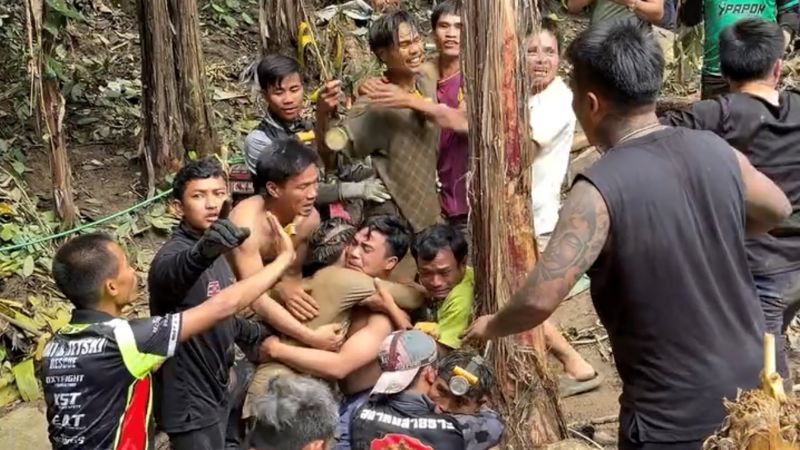
When they finally noticed that the water was starting to recede, they somehow mustered up the strength to attempt a daring escape, completely unaided. Rescue teams on the ground were shocked when they appeared at the cave entrance on Saturday.
Their courage was born of fear, survivors told CNN in exclusive interviews.
Through narrow and dangerous tunnels, some so wet and cold that they wore wetsuits, and others so tight that they lacked oxygen, the men made their way from the room they were trapped in to the mouth of the cave, a distance of 260 meters (about 850 feet), a distance equivalent to the height of a 78-story building.
One of the members of the group who entered the cave in search of gold was guided to safety the day before by a multinational team of cave experts using diving equipment. The remaining four were left to wait until the situation was safe enough.
“I was scared because I was alone there,” 23-year-old barber Mee Singfamalai told CNN from Long Tien Hospital, where she was being treated for a high fever.
“We had been there for so long that the water had dried up. It was too cold inside so we decided to crawl out,” Mee said.
In some parts of the cave the water was at least 1 meter deep.
“Sometimes we had to dive, and sometimes we had to crawl. We crawled slowly. The passage was just as big as a person’s height.”
Rescuers first reached the group of five on Wednesday, a full week after they entered the cave and were trapped by heavy rains in the jungle outside during the humid Laotian summer.
Exhausted and surviving on water, they slept as much as they could and prayed for help.
“We hugged each other and slept. There were four or five of us,” he said. “It was very helpful, because I didn’t have a blanket.”
And they clung to the hope of being reunited with their loved ones to stave off hunger.
“I always believed that I would survive. I had to get home somehow to see my sisters and mother,” Mee said. “When I went outside and saw people cheering for us, it felt like I was given new life. I was overwhelmed. Suddenly there was hope.”
The grueling ordeal was Mi’s first time entering the cave, located at the foot of a mining project near the village of Long Tien, several hours away from the nearest city and through muddy roads during the rainy season.
The informal mining economy has expanded across Laos in recent years, particularly in remote limestone and river basin regions where formal livelihoods are scarce and enforcement is limited.
Having previously found gold elsewhere, Mi and his friends decide to try their luck in the cave in hopes of making money.

“We are villagers. We go into the mountains to make a living. We heard there was gold, so we went to look for it. Then the cave flooded and we couldn’t go back.”
Mee said she was grateful to “all the people who helped me survive.”
To save the men, a large-scale rescue operation was underway, bringing together divers from all over the world, including large pumps to drain water from the cave, and heavy machinery to secure temporary roads to remote areas.
When asked if he intended to enter the cave again, Mee replied, “Never.”
“If you want to take me by force, you’ll have no choice but to give me the death penalty,” he added.
None of the villagers had any diving experience, but they were faced with the hellish reality of trying to escape from a flooded underground labyrinth.
Another survivor, Lam, who made it to safety, said being released from the cave was “like being given a second chance at life.”
“Poverty is horrible. That’s why we fought so hard to survive and keep moving forward,” he said in a social media post.
After emerging from the cave, Mi’s first meal was congee, a delicious Asian porridge. As he is recovering in the hospital, he is still only able to eat soft foods.
Two other men in the group were also injured and are suffering from pain and inflammation on their right side, Mee said, adding that their condition had improved with medication.

Rescue divers respond after trapped villagers escape from cave in Laos

Back at the mine site, rescue efforts remain incomplete.
Two villagers who are believed to have entered the cave before the five rescued people are still missing, and they remain on guard at the rescue base with their families.
Mee’s group did not see the men and believes they entered from another part of the cave.
The rescue diving team, some of whom brought valuable experience from a dramatic cave rescue in neighboring Thailand in 2018, was asked to return to the cave site on Sunday morning and prepare for a potential mission to explore deep into the cave system for the pair.

A map created by the survivors provides important information about the layout of the cave and reveals another room where the two may have taken refuge.
Australian diver Josh Richards told CNN: “As far as we know, there is a significant air pocket about 100 meters further out, which is a pretty dangerous passage.”
The “narrower and more uncomfortable” passage goes beyond what divers have traveled before and is “the only place divers can still stay,” Richards said.
Plans for divers to re-enter the chamber have not yet been confirmed.
However, the ongoing work remains dangerous as overnight rain causes water levels in the cave to rise again.
“So we might push on… and see if we can explore the rest of the tunnels.”
