

Eastern Ukraine —
There’s a whoosh, a whirlwind of dust, a pause while the grainy image recalibrates, and a devastating explosion.
Tens of miles away, underground, Avdiivka and Bakhmut, veterans of Ukraine’s most brutal urban warfare, are at the helm of a new kind of killing. They can’t feel it, smell it, or see it up close. The entire mission, which involves directing six bombings against three Russian forward targets in eastern Ukraine, does not involve Ukrainian troops on the ground, instead the battles are directed from a gamer’s chair, observed from a reconnaissance drone in the sky, and carried out on a dedicated live stream.
After months of suffering from a talent crisis and uncertain support from the United States, Ukraine has made remarkable progress. Much of its war effort is now carried out unmanned, with robots, drones and remotely piloted tanks giving it an advantage over a vulnerable but suddenly tense and nervous Russian invader. In April, President Volodymyr Zelenskiy claimed to have captured Russian positions for the first time purely by robots and drones, adding that drones had carried out 22,000 missions since January.
Now streaming: Ukraine’s robot army puts Russian forces at a disadvantage. Upgrade to see the full report
Under the orange glow of computer processor fans and subtle overhead lighting, survival is the mother of invention. The troops here learned from Russian prisoners of war that the enemy called these robots (each carrying a large amount of explosives on a four-wheeled chassis) “Silent Death.” They can only hear the approach if they are 10 meters away, i.e. within the blast radius.
The first robot tripped over a piece of aluminum, its wheels frantically gaining traction and trying to avoid the obstacle. Eventually, observation drones sailing around the crater and above will see the white heat of a small mushroom cloud flare up, the heat signature of the initial explosion. The second one follows. The first salvo of the attack is intended to distract Russian forces and allow the other four robots to penetrate behind enemy lines.
The calculation here is simple. The 3rd Assault Brigade’s “NC13” unit calculated that over 164 attacks would require 2,300 soldiers to achieve the same effect as a robot attack. They would have expected to lose half their troops (casualties) in this attack. That means the unmanned evasive bomb you see on the screen in front of you is a technological advance that saved a thousand Ukrainians.

“I couldn’t even imagine it at the time,” said Barr, the unit’s deputy commander, recalling the grueling urban battles in Donbas. “However, I understand that if such equipment had been available at the time…many more of our comrades would have survived.”
For the unit’s commander, Mykola “Makar” Zinkevich, the new world is not enough. “Back then, war was somehow a masculine thing, where what mattered was your skills: how well trained you were, how disciplined you were. Now, technology decides everything. There’s no going back.” It’s simply a matter of who can adapt and evolve faster in a world of unmanned remote killing.
Ukraine’s approach was born out of a human resources crisis, with its small population decimated by the devastating toll of four years of Russian aggression. But Kiev was an early adopter of drones, and the mass industrialization of their precision and power is starting to take a decisive toll on Moscow.
Ukraine’s current policy is to kill or injure 35,000 Russians every month, which it achieved this year. Its goal is to force the Kremlin to recruit unsavory and unpopular personnel from urban centers and the middle class. Estimates released by British intelligence agency GCHQ on Wednesday, citing new information, put the total death toll in Russia at 500,000.

This new war will feature new heroes. One person here is 22-year-old Gora. She quickly corrects herself when she says she’s just a “software engineer.”
“I’m an embedded hardware and software engineer,” she asserts, triggering a live stream from the control hub to the body shop where the robots are repaired and built. Gola, who was 18 when the war began, was tired of losing sleep over Russian drone attacks in eastern Kiev and knew his IT talents would lead to a new front line.
“It’s not the vehicle that’s the key. It’s the mind and how you plan it. How you connect the communication between vehicles and between operators,” she said.
Challenges will also evolve. “Salamander 6 has been spoofed,” the operator said to the commander. “We plot a rough course and navigate without GPS.” Managing location data is paramount on the battlefield, sometimes by scouring drone footage recorded during the day or the best route through pockmarked farmland to find your way.
Two other robots approached an indistinct tree line, followed by a devastating explosion. The force announced that Russian military positions had been previously discovered there. The fifth robot was less effective, rolling sideways in the trenches, and the sixth was intercepted by Russian troops.
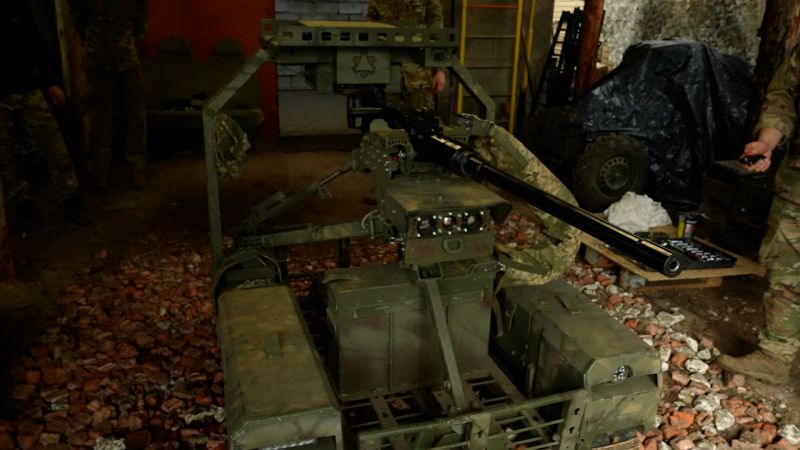
On the ground, even the most basic tasks of infantry are being replaced by robots. Cyber’s team works quickly under the net and attaches a massive Browning machine gun to the tank’s tracks. This vehicle is equipped with numerous cameras that capture targets with wide lenses. Remove dry mud from tracks and blow away dust. This machine hides in the leaves for days waiting for prey. They don’t need water or food, and their legs don’t twitch. Cyber said the only limitation that needs to be resupplied is ammunition. Once 400 rounds are expended, you must return to base. “When we deployed the robots against the enemy, they simply panicked. They were crawling, pinning themselves to the ground, and simply didn’t know what to do.”

Cybert’s unit has five such machines, but they are used sparingly, and is preparing another, faster robot capable of traveling 16 miles per hour to carry Kalashnikov small arms into battle. The speed and scope of Ukraine’s automation is staggering. In a matter of months, driverless vehicles went from being a rare curio on the front lines to being the norm. Robots rescue injured people and supply front-line troops.
With Russian drone attacks everywhere, even reloading resupply robots can be dangerous. The 93rd Brigade is running through the town of Druzhivka, delivering ammunition, food and water to robotic supply units hiding under trees. The town itself is still heavily populated, but the precision and penetration of Russian drones prevent Ukrainian forces from integrating into civilian life.
One package is delivered to a nondescript farmhouse, where five boxes of ammunition are strapped to a robot. A remote pilot takes over from a bunker several miles away, trudging along a small dirt road between the fences of two huts, past curious locals, and begins the 10-hour journey to the front line, and the plane takes off breathing.
These shipments are urgently needed as Ukraine’s front-line forces are often stretched to their limits. A few hours later, I encountered two devastating signs that Kiev was really having trouble finding enough men of military age.
Crow and Creepy, the call signs for two soldiers of the 24th Mechanized Brigade, spent 344 and 334 days non-stop, respectively, in front-line trenches. Crow’s slight wobble and long gaze testify to his ordeal, which ended at dawn this morning as he began a 20-mile, 12-hour walk to safety. “My children and my wife were the only ones who supported me, otherwise I would have lost my mind a long time ago,” he said.
He plans to return home soon, but he will be one day late for his nine-year-old son’s birthday. However, he has not yet spoken to his wife since taking office. “I was recording a message to her on the radio and sending it to her,” he said.
Creepy, he complements his pungent scent with an air of invincibility. In what he recalls as one of the worst days of combat, drone attacks were constant, draining even the ability to quickly build defenses. “I couldn’t keep up with filling the bags with soil and arranging them,” he says. “We ran out of bags. We used everything at hand to cover ourselves so we wouldn’t get hit and killed.”
As the two drink soda for the first time in almost a year and talk wistfully about clean clothes, another first-person drone is heard over the city of Kramatorsk, causing local residents to scatter. Machines are ubiquitous and are redefining this war.
