

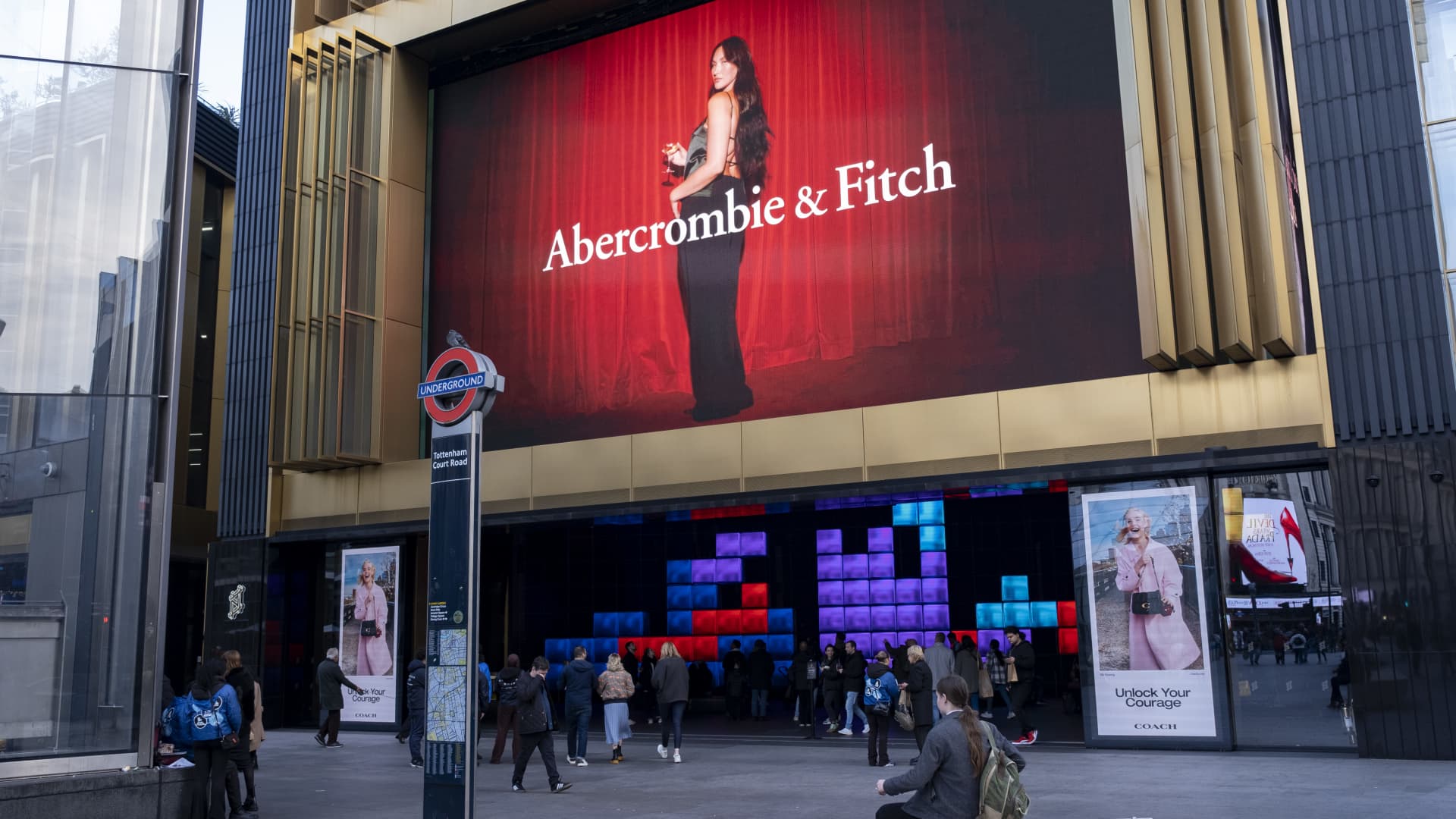
Abercrombie & Fitch The company said its first-quarter results on Wednesday were mixed and were lower than expected as the Middle East conflict “directly impacted” sales.
Despite the challenges, the company’s stock rose about 12% in afternoon trading as it handily beat Wall Street’s profit expectations.
Abercrombie’s sales in Europe, the Middle East and Africa region fell 10% in the quarter, due to a slowdown in demand for the brand’s Hollister flag as the conflict escalated, Finance Director Robert Ball said on a conference call with analysts.
Overall, company-wide net sales growth in the first quarter was down more than 0.5 percentage points compared to retailers’ expectations, he said.
“We’re focusing on the things we can control, like inventory levels and marketing investments, and being able to react in real time to what’s going on,” CEO Fran Horowitz added on the conference call. “Despite these EMEA headwinds, we expect gross sales growth in the second quarter and full year 2026, which would mark our fourth consecutive year of net sales growth.”
Abercrombie expects to report earnings per share of $1.80 to $2 for the quarter, well below expectations of $2.54, according to LSEG.
The company’s outlook for the current quarter was worse than analysts expected, but it reaffirmed its full-year outlook. Abercrombie expects net sales to increase 3% to 5% for the current fiscal year and earnings per share of $10.20 to $11.
Abercrombie’s overall sales increased 2% despite weakness in EMEA, which accounts for about 15% of companywide sales. Still, that growth was driven not by intrinsic consumer demand, but rather by new store openings and favorable exchange rates, Ball said.
Here’s how the apparel company’s fiscal first quarter performance compared to Wall Street expectations, based on a survey of analysts by LSEG.
Earnings per share: $1.47 vs. $1.28 expected Revenue: $1.11 billion vs. $1.12 billion expected
The company reported net income of $67.13 million, or $1.47 per share, for the three months ended May 2, compared with $80.41 million, or $1.59 per share, in the year-ago period.
Sales were $1.11 billion, an increase of about 2% from $1.1 billion in the same period last year.
Asked about his outlook for the current quarter and what he expects to change in the second half of the year, Ball cited ease of comparison with last year’s results and lower marketing spending, rather than an expected improvement in demand.
“It’s a balanced story here. Tariffs and freight will only be a slight headwind year-over-year by the end of the year,” Ball said. Ball said that apart from the challenges it faces in the Middle East and EMEA region, the company is experiencing moderate growth in average retail unit prices, which has funded investments and maintained operating margins of 12-12.5%.
Unlike many of its peers, Abercrombie has factored in recent tariff cuts, which helped its financial outlook after the U.S. Supreme Court ruled that President Donald Trump’s so-called reciprocal tariffs were illegal.
The company now expects the tariffs to impact profitability in fiscal 2026 by 0.2 percentage points, compared to its previous forecast of about 0.7 percentage points. It said it had applied for about $100 million in tariff refunds, but did not factor that potential inflow into its outlook.
