

BEIJING, CHINA – MAY 15: US President Donald Trump meets with Chinese President Xi Jinping as he departs from a visit to Zhongnanhai Gardens in Beijing, China on May 15, 2026.
Evan Vucci | Getty Images
Although the meetings between Chinese President Xi Jinping and the presidents of the United States and Russia took place just a few days apart, the style and content of the talks were starkly contrasting.
The meeting between Xi and President Donald Trump was filled with pomp and pageantry, reflecting Beijing’s eagerness to showcase China’s power, strength and history during the White House leader’s state visit. But the meeting between the Chinese prime minister and his Russian counterpart and “friend” Vladimir Putin was much more relaxed, with the two leaders reaffirming their already close strategic and geopolitical ties.
But one major notable difference between the two talks is that Taiwan was a linchpin in one meeting and completely absent in the other.
The issue of the status of the Chinese-claimed island was a central and thorny issue in Xi’s meeting with President Trump, but the thorny issue was ignored in his meeting with President Putin.
Max Hess, founder of political risk consultancy Enmetena Advisory, told CNBC on Wednesday that “President Xi does not want the Taiwan issue and China’s claim that Taiwan is legitimately its territory to be confused with Russia’s restitutionism, claims and war on Ukrainian territory.”
“That would make China look much more belligerent,” Hess said, adding, “China has recognized Ukraine and its borders many times in the past, but it has never recognized Taiwan’s independence.”
President Trump’s Taiwan flashpoint
During President Trump’s visit to China last week, Taiwan was seen as a crucial issue in the talks.
President Xi said that if the Taiwan “issue,” which he described as “the most important issue in China-US relations,” is mishandled, the relationship between the two superpowers would be plunged into a “major crisis.”
He went further, warning Trump that U.S. intervention in Taiwan could become a flashpoint for direct “conflict and even conflict” between the two countries. He also appears to link the economic stability of both countries to this issue.
The Chinese government considers the democratically autonomous island of Taiwan to be part of its territory and the center of its national sovereignty. The island’s ruling party rejects that claim.
Although the United States recognizes China’s views, it maintains strong ties with Taipei and has previously pledged to provide Taiwan with the means to defend itself.
Analysts say Xi’s remarks were primarily aimed at persuading the Trump administration to postpone or cancel pending U.S. arms sales to Taiwan.
“Chinese leaders see these arms sales as a major irritant,” Melanie Hart, senior director of the Atlantic Council’s Global China Hub, wrote in an online analysis.
It is unclear whether China’s warning struck a nerve with the White House. President Trump said last week that he refused to answer directly to President Xi when asked if the United States would protect Taiwan from Chinese attack.
In contrast, President Putin’s meeting
Meetings between Xi and Putin in recent days have been more informal, with the Kremlin keen to emphasize that the two-day visit is just part of regular contacts and communications between Moscow and China.
A few hours before landing, President Putin said, “I am happy to be able to visit Beijing again at the invitation of my long-time good friend Xi Jinping.”
“Regular mutual visits and Russia-China top-level talks are an important and essential part of joint efforts to promote overall relations between our two countries and unleash truly limitless potential,” he said in comments reported by TASS news agency.
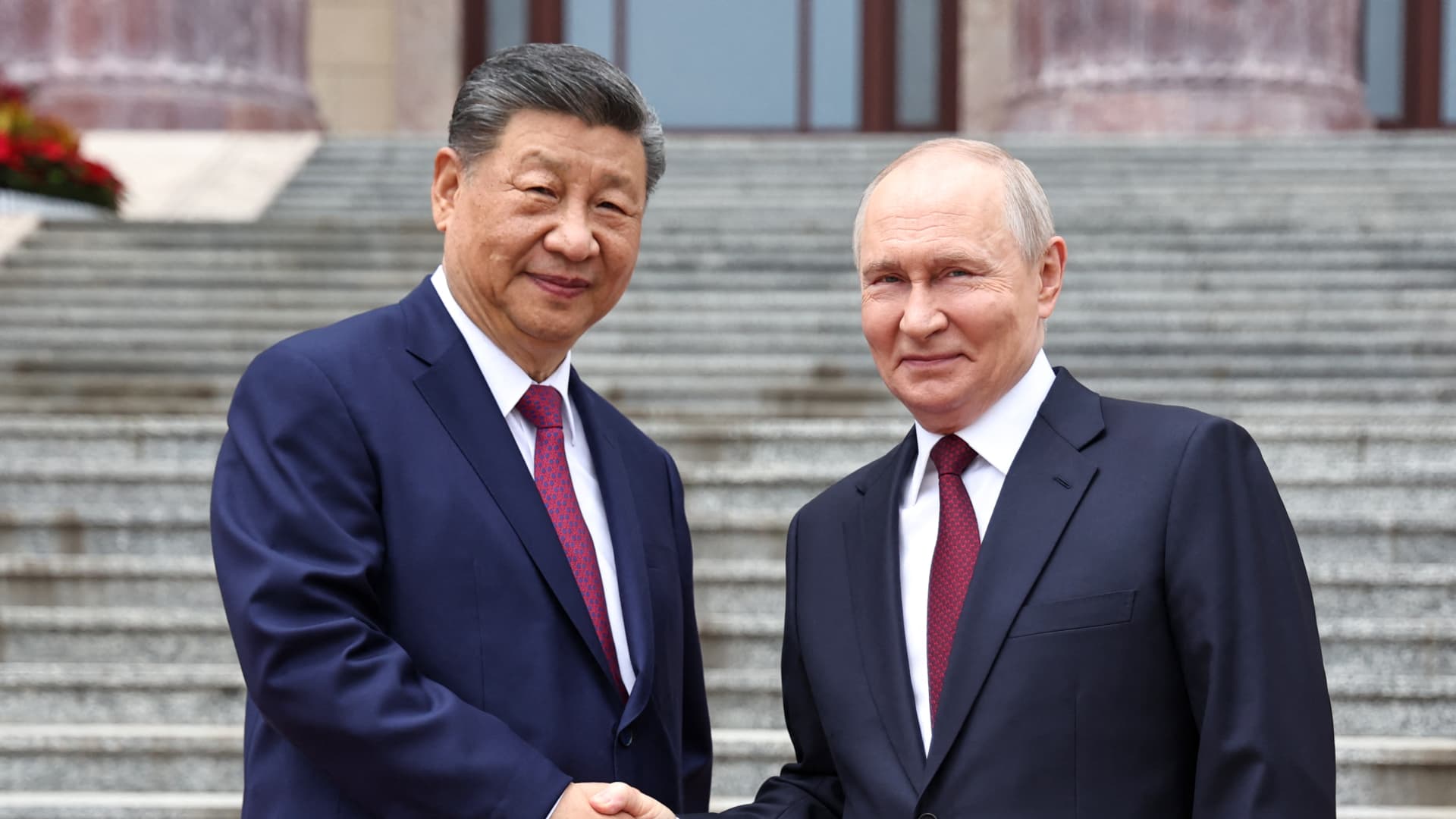
This pool photo distributed by Russia’s state agency Sputnik shows Russian President Vladimir Putin (Republican) and Chinese President Xi Jinping shaking hands during a welcoming ceremony at the Great Hall of the People in Beijing on May 20, 2026.
Alexander Kazakov AFP | Getty Images
Russia and China are seen as ideologically aligned on many geopolitical issues, and the two countries share a traditional antipathy and distrust of the West and the U.S. government.
The two countries have supported each other’s foreign policies, especially regarding territorial issues. China essentially acquiesced in Russia’s invasion of Ukraine, refused to condemn the conflict, and tolerated the global uncertainty and supply disruptions the war had caused. Both countries have supported Iran in the conflict between the United States and the Islamic Republic.
In a joint statement released by Mr. Xi and Mr. Putin on Wednesday, the two leaders championed “deepening political mutual trust and strategic cooperation” in multiple areas, from energy and economy to trade.
According to a statement released by Xinhua News Agency, the leaders “exchanged views on major international and regional issues, including the situation in the Middle East.” The two countries also issued a joint statement advocating a “multipolar world and a new type of international relations.”
However, there was no mention of Taiwan.
“That’s not going to happen, because China has all the power in this relationship,” Hess said.
“Mr. Xi has no interest in that and would almost certainly be furious if President Putin or any other Russian official mentioned it in that context,” Hess said.
Andrius Tursa, a Central and Eastern Europe advisor at risk consulting firm Teneo, also told CNBC on Wednesday that he was not surprised that Taiwan was not on the agenda between Mr. Xi and Mr. Putin, at least publicly.
“The Xi-Putin summit mainly focused on bilateral relations. Regarding the international situation, there are several more pressing issues, such as the war in Ukraine and the Middle East. Moreover, Russia has always adhered to the ‘one China’ policy, which recognizes China’s claims to Taiwan, and there are no disagreements regarding Taiwan,” he pointed out.
