

moscow —
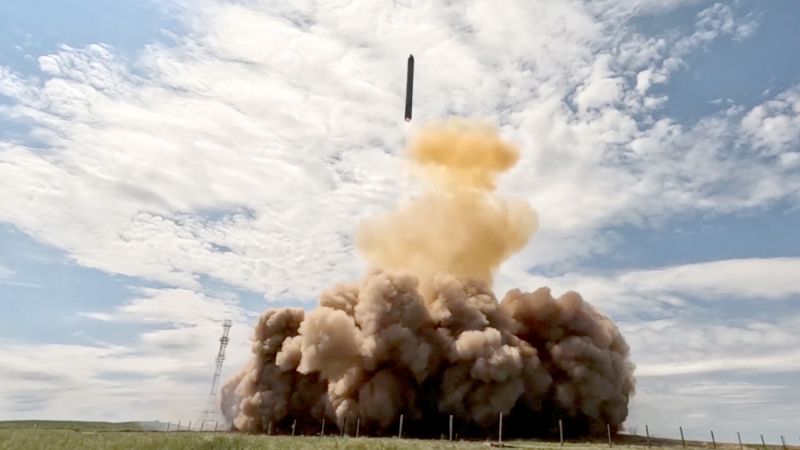
Russian President Vladimir Putin has claimed that what he called the world’s most powerful missile system, dubbed “Satan II” by NATO, will be ready for “combat missions” by the end of the year after Tuesday’s successful test.
The Sarmat intercontinental ballistic missile has an expected range of more than 10,000 kilometers (6,200 miles) and can reportedly carry up to 16 individually targeted nuclear warheads, according to the U.S.-based nonprofit Missile Defense Advocacy Alliance. President Putin claims the missile has a range of more than 35,000 kilometers (21,750 miles).
“The total payload yield is more than four times larger than existing Western counterparts,” Putin said.
By comparison, the U.S. LGM-30 Minuteman ICBM has a range of approximately 11,000 kilometers (6,835 miles) and is designed to carry three warheads, but only one is deployed.
Russian state television broadcast footage of Russian Strategic Missile Forces commander Sergei Karakayev reporting to President Putin about the “successful” test launch.

According to the Center for Strategic and International Studies (CSIS), the silo-launched Sarmat is a long-awaited replacement for Russia’s SS-18 intercontinental ballistic missile (SS-18 ICBM), which was first deployed under Soviet rule in the 1970s and was codenamed “Satan” by NATO.
The RS-28 Sarmat, which the alliance calls Satan II, has been in development since 2011, but has encountered testing difficulties that have delayed initial plans for a 2018 deployment, CSIS said.
After a failed test in September 2024, satellite images showed a crater about 200 feet wide at the launch site of the Plesetsk Cosmodrome in northwestern Russia’s Arkhangelsk region.
Russian telegram channel Astra, labeled a foreign agent by authorities, expressed skepticism, noting that Putin has spoken at least 10 times since 2021 about the imminent preparation of nuclear-capable missiles.
According to the report, the Sarmat missile is liquid-fueled and must be refueled immediately before launch, which is a disadvantage compared to solid-fueled missiles.
According to the International Campaign to Abolish Nuclear Weapons, Russia has the world’s largest stockpile of nuclear warheads, more than 5,500. According to the group, the United States has just over 5,000 warheads.
The timing of the Sarmat test was notable, coming just after a quiet Victory Day parade on May 9th.
The parade, which commemorates the Soviet Union’s role in defeating Nazi Germany in World War II, was the smallest since 2008, when President Vladimir Putin made it an annual event. For the first time in almost 20 years, no military equipment was on display. Russian authorities scaled back the event due to security concerns following Ukraine’s attacks deep in Russian territory, particularly on oil refineries.
But President Putin told reporters that the parade was held without weapons being shown because Russian forces “should focus on the decisive defeat of the enemy” in what Russia calls a “special military operation” in Ukraine.
Forgoing the traditional show of force, giant screens in Moscow’s Red Square showed a series of pre-produced videos that state media said were filmed from the front lines.

On Monday, the Kremlin also released footage of Putin driving one of his former school teachers, Vera Gurevich, directly to her hotel lobby, giving her a bouquet of flowers and a passionate hug, before taking her to dinner in the Kremlin. According to the Kremlin, President Putin invited Gurevich to participate in Moscow’s Victory Day parade and spend several days in the capital.
The Kremlin rejected a European intelligence report obtained by CNN and other news organizations. The report says the Kremlin has dramatically increased personal security around Putin and reduced the number of locations he regularly visits.
Brad Rendon reported from Seoul.
