

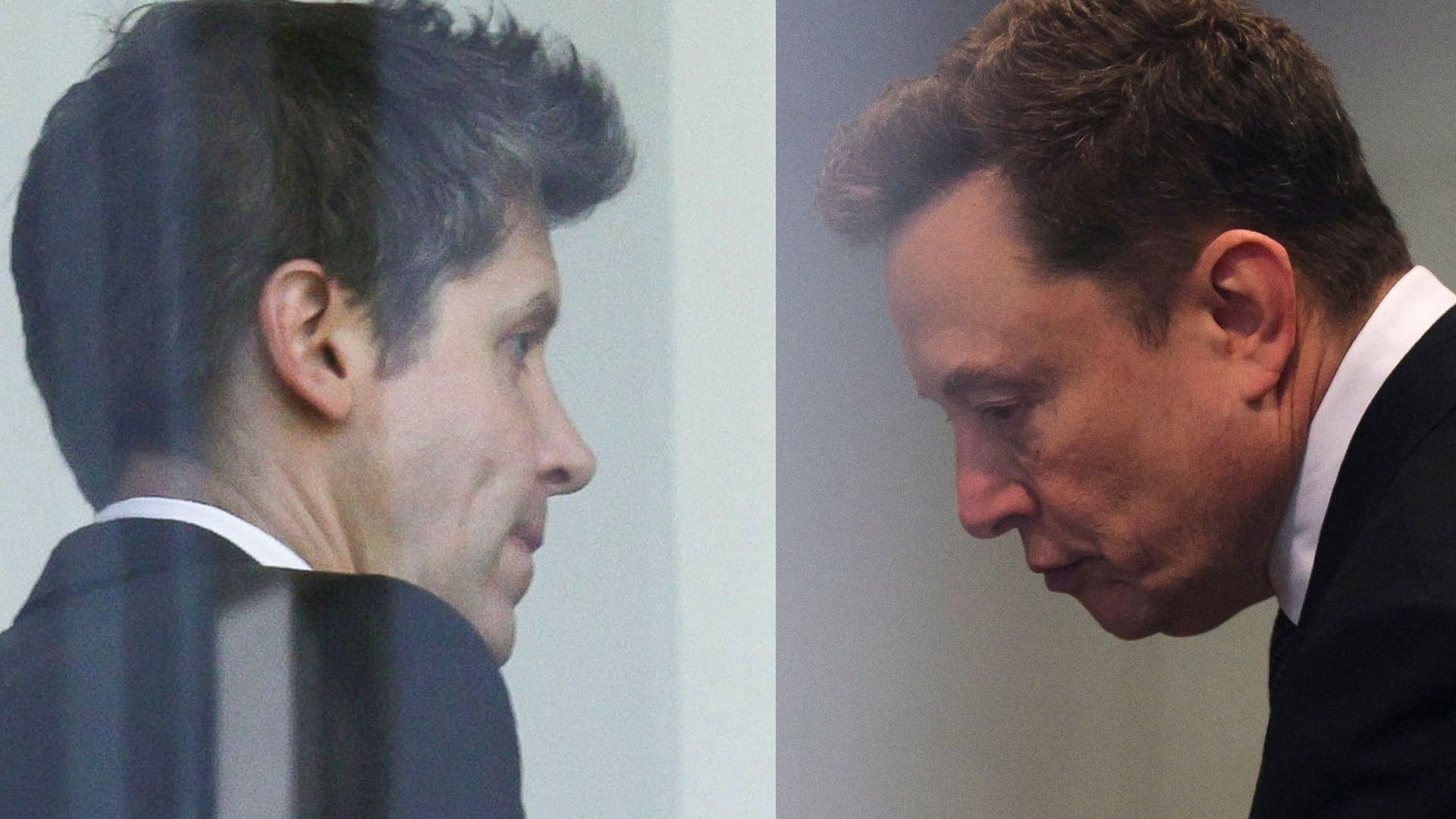
The combined photo shows OpenAI CEO Sam Altman (left) on April 28, 2026, and Elon Musk on April 29, 2026, during the trial of Elon Musk’s lawsuit over OpenAI’s commercial conversion in federal court in Oakland, California.
Manuel Orbegoso | Reuters
OpenAI CEO Sam Altman testified in the Musk v. Altman trial on Tuesday, seeking to clarify his central argument to the jury. “He didn’t steal charity, but Elon Musk abandoned charity.”
Mr. Altman, wearing a blue suit and tie, testified for about four hours from the witness stand in federal court in Oakland, California. He said Musk, who co-founded OpenAI with him in 2015, failed to keep his promises and ultimately abandoned the young startup as it charted an uncertain future.
“We were kind of left for dead,” Altman testified.
In 2024, Mr. Musk sued OpenAI, Mr. Altman, and the company’s president, Greg Brockman, accusing them of backtracking on their commitment to keep the artificial intelligence company a nonprofit and follow philanthropy. He claimed that approximately $38 million donated to OpenAI was used for unauthorized commercial purposes.
Mr. Altman testified Tuesday that he had not made any promises to Mr. Musk about OpenAI’s corporate structure.
Tense negotiations between co-founders
OpenAI CEO Sam Altman is cross-examined by Elon Musk’s lawyer Steve Moro during Musk’s lawsuit over the commercialization of OpenAI in federal court in Oakland, California, on May 12, 2026 (courtroom sketch).
vicky behringer reuter
Much of the trial, which began late last month, centered on a series of controversial negotiations between Musk, Altman, Brockman and another OpenAI co-founder, Ilya Sutskeva, between 2017 and 2018.
Executives agreed that they needed to raise more money for computing resources and discussed the possibility of various corporate structures, including for-profit options, that could support this.
Negotiations ultimately broke down without a clear resolution, and Musk resigned from OpenAI’s board in February 2018.
Mr. Altman testified that Mr. Musk’s resignation had OpenAI employees worried about how the company would be financed, with some worried that Mr. Musk would seek “revenge.” But Altman said Musk’s departure was also a “morale booster” for some researchers who had been “demoralized” by Musk’s business strategies.
“I don’t think Mr. Musk understood how to run a good lab,” Altman said.
Musk continued to communicate with Altman, Brockman and Sutskever in 2018, several months after officially stepping down from the startup’s board. He said the company had no chance of success.
“Barring dramatic changes in execution and resources, the probability of OpenAI being associated with DeepMind/Google is 0%, not 1%, and I hope not,” Musk wrote in an email in December of that year. “Raising hundreds of millions is not enough. This needs billions of dollars a year right away, or forget about it.”
Altman said Tuesday that Musk’s comments were “burned into my memory.”
OpenAI established a for-profit subsidiary after Musk left office, which is now valued by private investors at more than $850 billion.
Mr. Musk testified in April that OpenAI’s commercial subsidiary had become a “tail wagging the dog” and repeatedly accused Mr. Altman and Mr. Brockman of “trying to steal charity.” Mr. Altman rejected that idea, testifying that what Mr. Musk was really concerned about was control.
Altman said that, at least initially, Musk felt very strongly about having complete control over OpenAI. He said part of the reason is because Musk doesn’t trust other people’s decisions, and that Musk “decided a long time ago” that he would only work on companies he controlled.
“I felt very uncomfortable with it,” Altman said.
Musk testified in April that he initially sought majority control of OpenAI, but that his stake in the company would have diluted over time. He also said he wasn’t completely opposed to OpenAI having a for-profit subsidiary, but that the shadow it cast on nonprofits was an issue.
During negotiations, Musk said that OpenAI and teslahis electric car maker as a way to integrate more capital into the company. He offered Mr. Altman a seat on Tesla’s board of directors and tried to persuade him to make the move.
Altman said he didn’t think that was appropriate and feared the nonprofit would be effectively destroyed in the process.
“Tesla is a car company and doesn’t have an OpenAI mission,” Altman said. “I don’t think we had the ability to ensure that the mission was accomplished.”
Musk’s lawyers tried to paint Altman as untrustworthy
Lawyer Stephen Moro, who represents Elon Musk, arrives at the federal courthouse in Oakland, California, on Thursday, April 30, 2026.
David Paul Morris | Bloomberg | Getty Images
Musk’s lawyer, Stephen Moro, cross-examined Altman and tried to paint the OpenAI chief as untrustworthy and dishonest. He opened the question by asking whether Mr. Altman was “completely trustworthy.”
“I believe that,” Altman said.
“But you don’t know if you can be completely trusted?” Moro answered.
“I’m revising my answer to yes,” Altman said.
Moro asked Altman about the many people who have raised concerns about his actions over the years, including Dario Amodei, a former OpenAI employee who founded the company’s biggest rival, Anthropic. Mr. Moro said Mr. Amodei accused Mr. Altman of misrepresenting the terms of the investment.
“Dario has accused me of a lot of things,” Altman testified.
Moro also pressed Altman on some board members who temporarily removed him from his role at OpenAI in 2023. The board said at the time that Altman had not been “consistently candid” in his communications with them.
Mr. Altman spoke at length about his firing during his testimony. He said he was “completely caught off guard” by the board’s decision and was upset, angry and hurt during the tumultuous few days before returning to OpenAI.
He said he didn’t receive much of an explanation as to why he was fired, other than to claim that the board had not been candid with the board.
“I’ve poured the last few years of my life into this,” Altman said. “I was watching it being destroyed.”
Closing arguments in the trial are scheduled for Thursday, and the nine-member jury could begin deliberations at that time. The jury in this case is an advisory body, and the final outcome will ultimately rest with Judge Yvonne Gonzalez Rogers.
WATCH: Altman says Musk thought OpenAI would fail

