

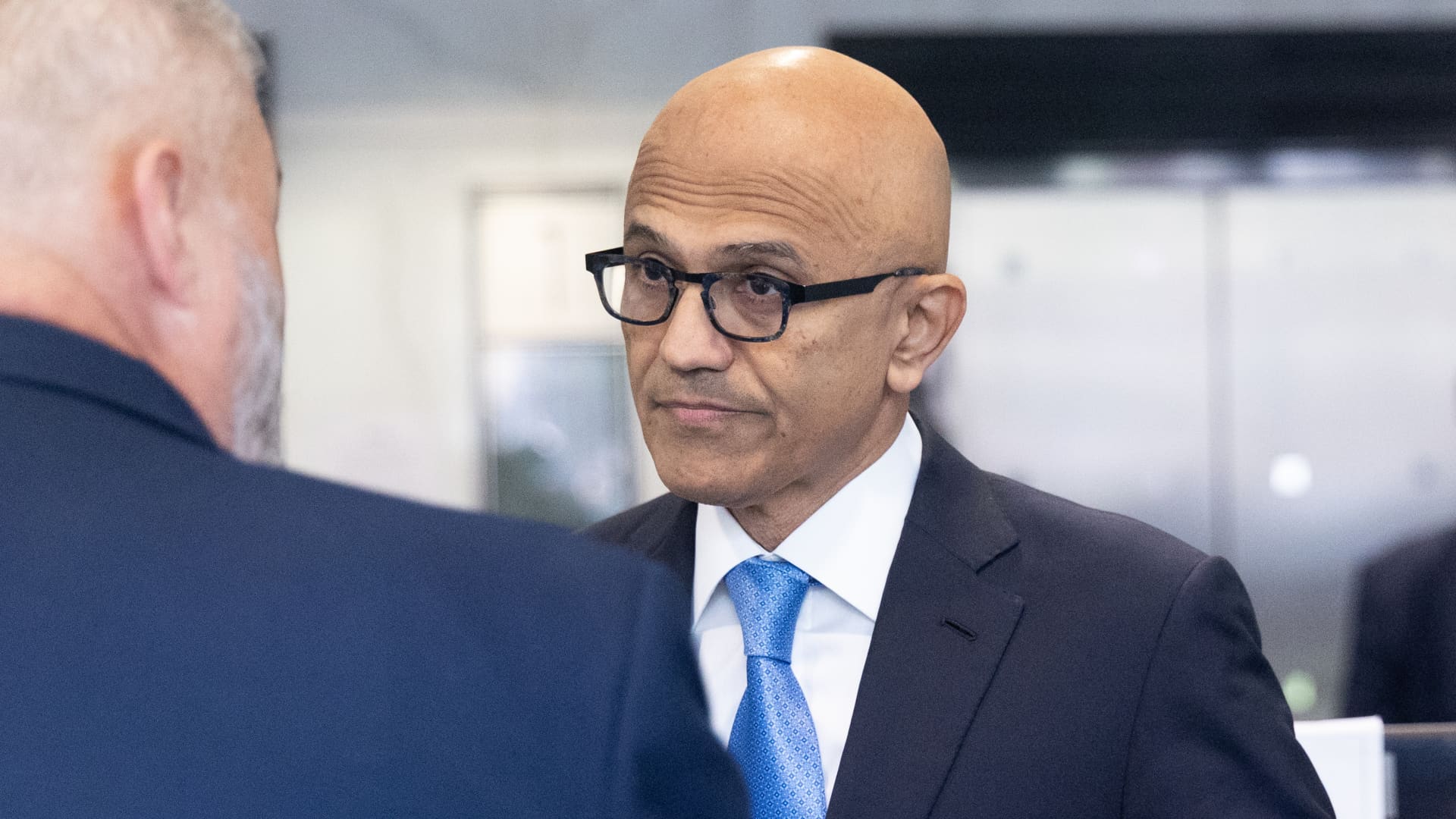

microsoft CEO Satya Nadella took the stand Monday in the Musk v. Altman trial and testified that Elon Musk never contacted him with concerns that Microsoft’s investment in OpenAI violated any special conditions or commitments.
Mr. Nadella, wearing a navy suit and blue tie, finished testifying in federal court in Oakland, California, after hours of questioning. He answered questions about the early days of Microsoft and OpenAI’s strategic partnership, his understanding of the company’s relationship, and his role in the tumultuous days that saw Sam Altman temporarily ousted as OpenAI’s CEO.
Altman’s testimony is scheduled to begin Tuesday, his attorney said.
In 2024, Mr. Musk sued OpenAI, Mr. Altman, and the company’s president, Greg Brockman, alleging that the artificial intelligence company backtracked on its pledge to protect non-profit organizations and conduct philanthropic work. Musk is accusing Microsoft of aiding and abetting OpenAI’s alleged charitable trust violations, and Microsoft is named as a defendant in the suit.
Microsoft has been one of OpenAI’s main backers since 2019, a few years before the company broke into the mainstream with its ChatGPT chatbot in late 2022. Microsoft’s $13 billion-plus investment in OpenAI has surfaced repeatedly during the trial period, including $1 billion in 2019, $2 billion in 2021, and $10 billion in 2023.
Nadella said he was “very proud” that Microsoft took a risk and invested in OpenAI when “no one else was willing to bet on it.”
Testifying late last month, Musk said Microsoft’s $10 billion investment was a key turning point in his belief that OpenAI was violating its nonprofit mission. He testified that the scale of the investment bothered him and prompted him to launch a legal investigation into OpenAI.
“I was worried that they were really trying to steal the charity,” Musk said from the stand.
Nadella said on stage that he did not believe Microsoft’s investment in OpenAI was a donation, and that there was a clear commercial element to the two companies’ partnership from the beginning.
He said that early in the partnership, Microsoft gave OpenAI deep discounts on computing resources, and Microsoft believed it could reap marketing benefits by doing so.
In a separate video deposition played Monday morning, Michael Wetter, Microsoft’s head of corporate development, said the company has recognized about $9.5 billion in revenue to date through its partnership with OpenAI.
Musk co-founded OpenAI in 2015 with Altman, Brockman and a handful of other executives and researchers. After many disagreements over the direction of OpenAI, including his failed partnership with an automaker. teslaMusk left the OpenAI board in 2018 to start a competing AI startup, xAI, which merged with SpaceX earlier this year.
OpenAI created a commercial subsidiary in the months after Musk left office, making it easier to raise outside funding. Since then, investors including Microsoft have poured billions into OpenAI’s commercial arm, swelling the company’s valuation to more than $850 billion.
In November 2023, Altman was temporarily terminated from his role at OpenAI after the board determined that he “was not consistently candid in his communications.” After several days of intense negotiations, he returned a few days later.
Nadella said he was “quite surprised” by the board’s decision and that his priority was to find ways to maintain continuity for Microsoft’s customers. Immediately after Altman’s firing, Nadella said he tried to learn more about what happened, adding that jealousy and a lack of communication may have played a role.
In a conversation with OpenAI board members after his firing, Nadella said he was simply trying to understand the wording of OpenAI’s statement that Altman “was not consistently candid” during his communications with the board.
Nadella said those words “were just not good enough, because this person is the CEO of a company that we’re invested in and that we’re deeply affiliated with, so I felt like he could have explained to me what was going on and what the details were behind it.”
Nadella said there must have been some jealousy or miscommunication that justified forcing Altman out. He said he asked board members for a deeper opinion after the comments about candor, but received none.
“As far as I was concerned, it was kind of an amateur city,” Nadella testified.
In October, OpenAI completed a capital restructuring that strengthened its structure as a nonprofit organization that holds equity in for-profit businesses. As part of that announcement, Microsoft revealed that it owns about a 27% stake in OpenAI’s commercial arm, valued at about $135 billion.
Courtroom sketch of Microsoft CEO Satya Nadella being questioned by Microsoft lawyer Jay Jurata during Elon Musk’s lawsuit over the commercialization of OpenAI at a federal courthouse in Oakland, California, on May 11, 2026.
vicky behringer reuter
The relationship between OpenAI and Microsoft has shown signs of strain in recent months, even as the two companies continue to tout themselves as strategic and core to their businesses. Late last month, on the same day jury selection began in Musk v. Altman, the two companies announced a revised partnership agreement that caps revenue-sharing payments and allows OpenAI to serve customers of any cloud provider.
OpenAI said in a release that the agreement aims to “simplify the way we partner and collaborate.”
Musk testified that he was not entirely opposed to OpenAI having a for-profit arm, but said it would be “wagging the dog’s tail.” He repeatedly accused Mr. Altman and Mr. Brockman of lining their own pockets with philanthropy while also reaping the positive connections that come from running a nonprofit organization.
“Microsoft has its own motivations, and it’s going to be different than a charity’s motivations,” Musk said from the stand. “Kudos to Microsoft. Do you really want Microsoft to control your digital superintelligence?”
In a video deposition released in court last week, former OpenAI director Tasha McCauley recalled discussions with Nadella and other board members following the 2023 decision to remove Altman as OpenAI’s CEO.
“As far as I can remember, Sathya wanted things to go back to the way they were,” McCauley said. Board members didn’t think it was the right move, she said.
But Nadella said in court testimony Monday that he never asked the board to reinstate Altman as OpenAI CEO.
A courtroom sketch of OpenAI co-founder Ilya Sutskever being questioned by Elon Musk’s lawyer Stephen Moro during Musk’s lawsuit over the commercialization of OpenAI in federal court in Oakland, California, on May 11, 2026.
vicky behringer reuter
Musk’s lawyer, Stephen Moro, showed Nadella screenshots of text messages he exchanged with Microsoft technology chief Kevin Scott about potential candidates to join OpenAI’s board.
Among those whose names came up in the conversation were: coinbase Chief Operating Officer Emily Choi, former Eventbrite CEO Julia Hertz, former Gates Foundation CEO Sue Desmond Hellman, former Klein Perkins Caufield & Byers Investor Bing Gordon, former Xerox CEO Ursula Burns, former LinkedIn CEO Jeff Weiner; alphabet Directed by Diane Greene.
In 2015, Google acquired Mr. Green’s company, Bebop, and Mr. Green took over Google’s cloud division. In 2019, she left the Google and Alphabet boards.
Nadella said “no” in a text message regarding Green taking a seat on the OpenAI board. He said Monday that he objected because Greene was at Google at the time or had been at Google until recently.
“I thought there would be a conflict because of the major competition with Google,” he said.
Nadella said that when he became CEO of Microsoft in 2014, Google had become Microsoft’s main competitor in the AI space after acquiring the AI research institute DeepMind.
OpenAI announced that it will appoint Desmond-Hellmann to its board of directors in March 2024.
“I’ve known her for a while,” Nadella said.
Moro also asked about an email Nadella sent to several Microsoft executives regarding favorable terms for the company’s partnership with OpenAI in 2022.
“I don’t want to be IBM, and OpenAI doesn’t want to be Microsoft,” Nadella wrote.
In 1980, IBM entered into a non-exclusive agreement to distribute Microsoft’s DOS operating system to IBM personal computers. This agreement allowed Microsoft to do business with several other PC manufacturers around DOS, and helped popularize the software. Microsoft then expanded its role in information technology by selling licenses for its Windows operating system to device manufacturers.
“Eventually, Microsoft became a much more prominent and important company than IBM, right?” Moro asked.
“That’s right,” Nadella said.
As of Monday’s market close, Microsoft’s market cap was $3 trillion, while IBM’s was $210 billion.
OpenAI co-founder Sutskever takes the stand
After Nadella finished testifying, former OpenAI co-founder and prominent AI researcher Ilya Satskeva was called to the stand. Mr. Sutskever, wearing a blue button-down shirt, answered questions about his decision to join the company, his interactions with Mr. Musk and his involvement in Mr. Altman’s ouster.
Sutskever previously worked at Google and testified that the company offered to pay him as much as $6 million a year to prevent him from leaving for OpenAI. He was one of the employees who ultimately raised concerns about Altman’s actions to the board, in part because he said he felt a “great sense of ownership” in the startup.
“I just cherished it and didn’t want it to be destroyed,” Sutskever said.
Brett Taylor, chairman of the OpenAI board of directors, followed Sutskever on the stand. He explained to the jury the structure of OpenAI and also talked about the “devastating” period when Altman was removed as chief executive.
Taylor did not complete his testimony before the end of Monday’s trial and is scheduled to return to the stand at 8:30 a.m. Pacific Time on Tuesday.
—CNBC’s Lora Kolodny contributed to this report.
WATCH: The Musk vs. OpenAI case is underway – here’s what’s going on

