

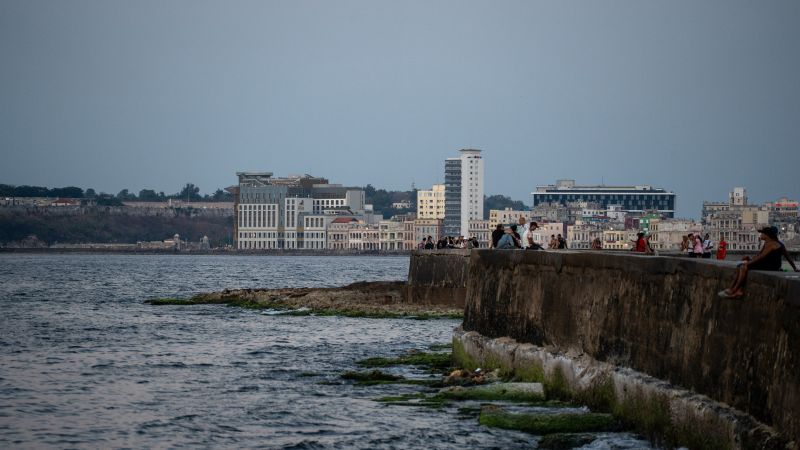
CNN’s analysis of publicly available aviation data shows a sharp increase in U.S. military intelligence flights off the coast of Cuba.
Since Feb. 4, the U.S. Navy and Air Force have conducted at least 25 similar flights using manned aircraft and unmanned aircraft, most of them near the country’s two largest cities, Havana and Santiago de Cuba, and some within 60 miles of the coast, according to Flightradar 24.
Most flights were by P-8A Poseidon maritime patrol aircraft designed for surveillance and reconnaissance, but some were by RC-135V Rivet Joints, which specialized in signals intelligence gathering. Several MQ-4C Triton high-altitude reconnaissance drones are also in use.
These flights are notable not only for their proximity to the coast, within range of intelligence gathering, but also for the suddenness of their appearance (prior to February, such publicly visible flights in this region were extremely rare) and their timing.
President Trump has become noticeably more vocal about Cuba, including reposting on Truth Social a comment by Fox News contributor Mark Thiessen that President Trump would visit “Free Havana” before leaving office. Just days after posting this, President Trump ordered an oil blockade of the island.
Fast forward to today, and President Trump has imposed an expanded sanctions regime on Cuba, claiming that Cuba is a “threat” to U.S. national security. (Cuban officials, meanwhile, dismiss any suggestion that the communist-run government poses any danger to the United States. They say they are open to negotiations, but have also vowed to wage a long guerrilla war against U.S. forces if attacked.)
The Department of Defense declined to comment on these findings. CNN has also contacted the Cuban government.
A similar pattern in which increased rhetoric by the Trump administration coincided with an increase in public surveillance flights occurred prior to U.S. military operations in both Venezuela and Iran.
In the case of Venezuela, President Trump on September 2 announced the first US attack on a suspected drug ship in the Caribbean, specifically alleging ties to Venezuela’s then-President Nicolas Maduro and accusing him of “mass murder, drug trafficking, sex trafficking, acts of violence and terrorism.”

Publicly visible surveillance flights began off the coast of Venezuela a week later and continued for several days in October and November until U.S. special forces captured President Maduro at his mansion in Caracas.
A similar trend played out in Iran, where much larger intelligence-gathering aircraft and unmanned drones openly monitored Iran’s southern coastline ahead of the joint US-Israeli attack. The P-8A Poseidon, RC-135V Rivet Joint, and MQ-4C Triton, all spotted near Cuba in recent weeks, are among the aircraft active in the Iranian conflict.
Since early 2025, dozens of the same U.S. spy planes have operated around war zones in Ukraine and near geopolitical hotspots along the Korean peninsula and Russia’s western border. Bulk data aggregated by adsb.exused shows flights in these and other regions have been operating consistently for months.
However, the increase in flights observed off the coast of Cuba is new and a departure from where these aircraft have historically been deployed.


All flights mentioned above were tracked using public open source flight tracking dashboards such as Flightradar24 and ADS-B Exchange.
And in some cases, these flights are shared widely across social media, including X, Discord, and other platforms.
This is despite the fact that the aircraft involved can hide their presence (if they so choose) by turning off their location beacons, raising the question of whether the United States is intentionally alerting adversaries to the presence of these aircraft.
Whether or not this signal was explicitly intended by the U.S. military or government, the message is likely to be disturbing to Cuban officials, to say the least.
CNN’s Natasha Bertrand and Patrick Oppmann contributed to this report.
How was this article reported?
For Cuba, we polled FlightRadar24’s API every 10 minutes for active intelligence gathering flights over a four-month period ending April 28, 2026. We identified surveillance aircraft by ICAO type code and searched for P8, R135, Q4, E3TF, E8, U2, and Q9 operating in the area of interest. The team then manually scrutinized potential flights off the coast of the island, eliminating those that showed no signs of intelligence-gathering activity and were passing through the search area. To visualize flight paths around Cuba, we revisited the API to get more detailed data showing each aircraft’s path. For Venezuela, we replaced the FlightRadar24 API search methodology with a study period from September 3, 2025 to January 3, 2026 (the date of Maduro’s attack). For Iran, we used the same methodology for the study period from October 28, 2025 to February 28, 2026 (the start of the attack on Iran).
