

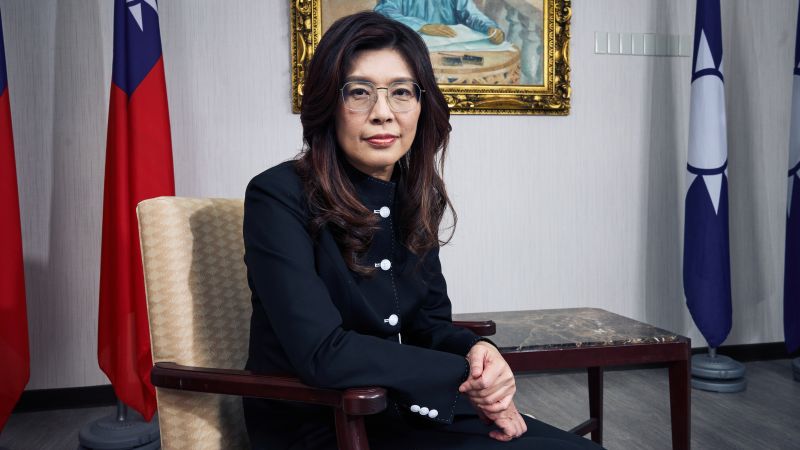

Taipei, Taiwan —
As Washington pressures Taiwan to spend heavily on defense against a potential Chinese attack, one of Taiwan’s most outspoken politicians is advocating the opposite approach: less confrontation and more dialogue.
Fresh off a meeting with Chinese President Xi Jinping in Beijing and days before a similar meeting with US President Donald Trump, the leader of Taiwan’s main opposition party told CNN that weapons alone cannot keep Taiwan safe.
“Taiwan does not want to become a second Ukraine,” warned Nationalist Party Chairman Cheng Liyun.
Her comments came in an interview hours before Taiwan’s opposition-dominated legislature passed a watered-down version of President Lai Ching-de’s proposed defense package, cutting the roughly $40 billion plan by about a third after months of political deadlock.
The approved package preserves billions of dollars in U.S. arms purchases. But at a time when the Trump administration is pressuring allies across Asia to take more responsibility for deterring China, it would cut funding for parts of Taiwan’s domestic defense buildup, including parts of Taiwan’s growing drone industry.
For months, U.S. officials and military analysts have questioned whether Taiwan’s opposition intends to block an urgently needed military buildup, even as Beijing ramps up military pressure over the island’s democracy, which Beijing claims as its own.
But the Kuomintang “is a firm supporter of Taiwan’s national defense,” Chen said.
“Much of the $40 billion budget is very vague,” she added. “It’s impossible to approve an entire package with a blank slate.”
In a commentary published in local media, Matt Pottinger, a former deputy national security adviser in the first Trump administration, called on Taiwan’s opponents to “seriously think about” why they are cutting funding for drones. “These are cheap and effective capabilities that superpowers have a hard time defending,” he wrote.
President Trump and President Xi are expected to meet in the Chinese capital, and the debate is likely to discuss Taiwan, which is always high on Beijing’s agenda at bilateral summits.
Chen spoke to CNN in Taipei, a stone’s throw from a towering statue of former Kuomintang leader Chiang Kai-shek. Chiang Kai-shek was defeated by communist forces in China’s civil war 80 years ago and retreated to Taipei, sowing tensions across the Taiwan Strait ever since. Beijing sees US support for Taiwan as a major obstacle and has vowed to “reunify” Taiwan and the mainland by force if necessary.
Chen argued that Taiwan should not be forced to choose between the United States and China.
“Being friendly toward the United States does not necessarily mean being hostile toward China,” she said.

Just a few weeks ago, Mr. Cheng had traveled to Beijing for a rare and carefully planned meeting with Mr. Xi, the first high-level meeting between China’s ruling Communist Party and Taiwan’s main opposition party in a decade.
Few could have imagined that Mr. Chung, once an ardent student activist who denounced the Kuomintang’s “tyranny” and supported Taiwanese independence, would one day become the leader of the very party he denounced, much less that he would come face-to-face with Mr. Xi in Beijing.
She has now openly embraced the “One China” framework, which Beijing claims is the basis for all cross-strait political dialogue.
“It may seem that I have a common language with Xi Jinping,” Chen said. “But there are so many differences on both sides of the Strait that it is important to find common ground. I believe this is the only way we can avoid war.”
Critics have accused Chung of parroting Beijing’s talking points at a critical time for Taiwan’s democracy, and his warnings against “external interference”, particularly in the Taiwan Strait, are interpreted by many as criticism of Taipei’s closest partners, the United States and Japan.
Taiwanese security officials have privately warned ahead of the Trump-Xi summit that Beijing is using Mr. Chung’s efforts to create the impression that Taiwan is politically divided and weakly aligned with the United States. Taiwanese officials said Chinese military planes and naval vessels continued to fly around the island while Mr. Chung met with Mr. Xi.
“If Taiwan pursues independence, they have certainly indicated that they will use military force,” Chen said.
Still, she insists that involvement eases tensions.
“Once the Kuomintang returns to power, military conflicts and activities will decrease, and the possibility of war will be completely avoided,” he said.
Mr. Chung’s rapid rise to power completely changed Taiwan’s political landscape. Tall, outspoken and unusually outspoken by local standards, she cuts an unconventional figure within one of Asia’s oldest political parties. She openly jokes that she rarely wears heels, not to avoid towering over her male colleagues, but because “I don’t know how to walk in heels.”
Her career trajectory has also fueled speculation that she might run for Taiwan’s presidential election in 2028, but she continues to avoid the question.
“My job now is to work hard and spare no effort to ensure that the Kuomintang wins this year’s local elections, and then prepare for the Kuomintang to return to power in 2028,” Chen said.
“I think the next two to three years will be a very defining moment in Taiwan’s fate.”
