

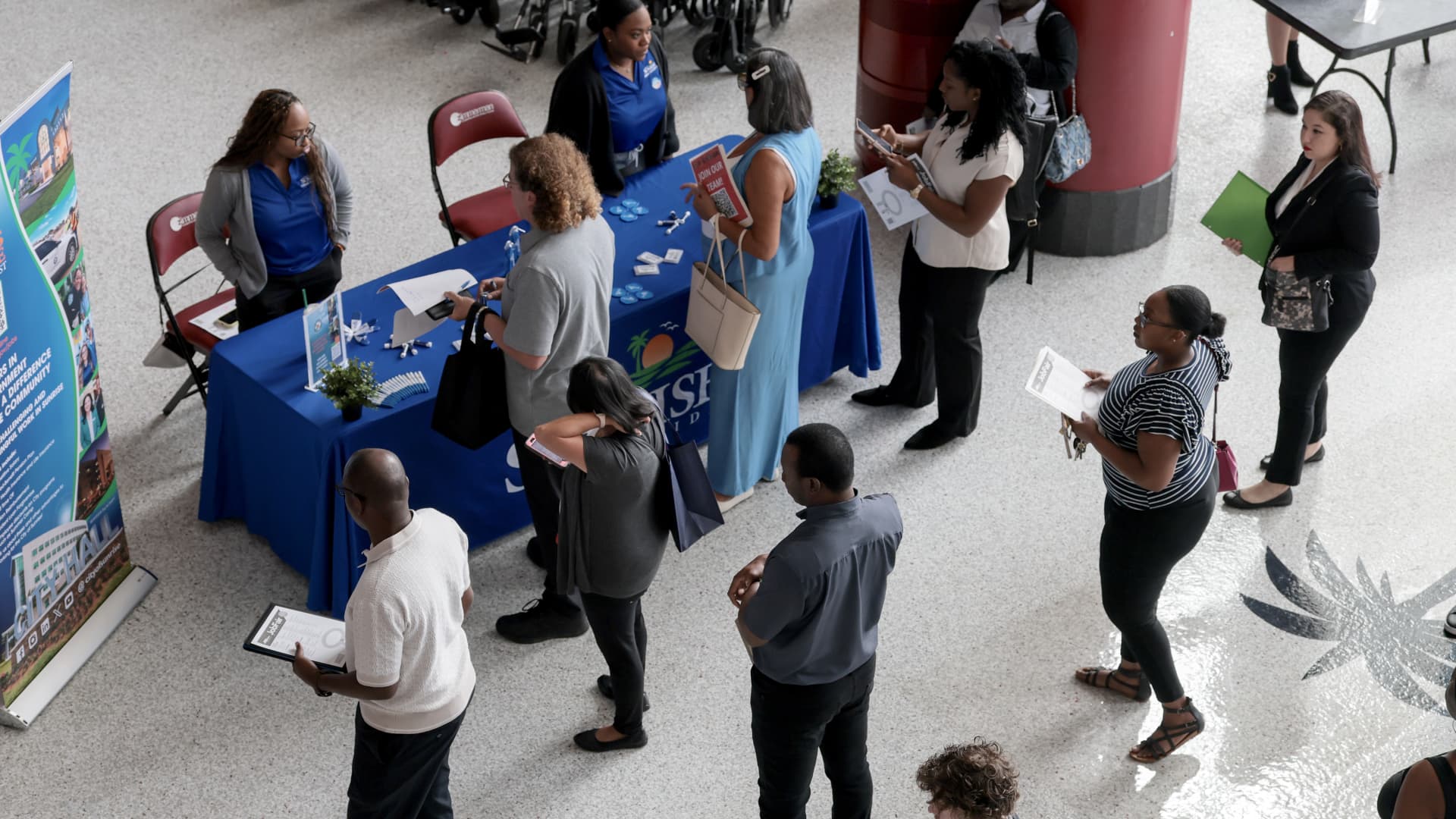

Although the sluggish U.S. labor market showed some signs of a potential slowdown this year, job creation exceeded subdued expectations, the Bureau of Labor Statistics reported Friday.
Nonfarm payrolls rose by a seasonally adjusted 115,000 jobs in the month, down from an unusually strong March of 185,000, but above the Dow Jones consensus estimate of 55,000.
The unemployment rate remains at 4.3%, further proof that the labor market is reaching the point where only moderate job creation is needed to stabilize the unemployment rate, given little growth in the labor force.
Average hourly wages, another closely watched indicator of the health of the labor market, were weaker than expected, rising 0.2% on a monthly basis and 3.6% on an annual basis, compared to estimates of 0.3% and 3.8%, respectively.
However, the month also saw a further decline in the workforce and a decline in technology jobs amid the low-employment and low-employment environment that has prevailed since early 2025.
Chicago Fed President Austan Goolsby said in an interview on CNBC that the report shows the labor market has been “more or less stable for a year, year and a half.” “I would characterize us as stable, but not in good shape. … The unemployment rate is stable, the employment rate is stable, the layoff rate is stable, the vacancy rate is stable. So I don’t think there’s a lot of evidence yet that the job market is collapsing.”
Stocks started slightly positive, but Treasury yields have fallen.
Scott Clemons, chief investment strategist at Brown Brothers Harriman, said the report “demonstrates the fundamental resilience of this economy and labor market despite all the arrows thrown at it: the Middle East, unemployment, inflation and outrageous concerns about the Federal Reserve.”
“New trends are not established in one month,” he added. “There’s been a lot of month-to-month volatility in the job market over the past year. I don’t know if that’s completely resolved. If we have a couple more solid months of job growth, things will get a little easier.”
Following recent trends, the healthcare sector led the way with 37,000 new jobs, but several other sectors also saw increases.

Transportation and warehousing increased by 30,000 jobs, retail by 22,000, and social assistance by 17,000.
On the negative side, the information services sector lost 13,000 jobs. This is part of an ongoing trend that has seen the sector lose 342,000 jobs since November 2022, coinciding with the rise of artificial intelligence. This equates to a loss of 11% of jobs during this period.
The broader measure, which includes disengaged workers and those in part-time work for financial reasons, rose 0.2 percentage points to 8.2%. The household survey, which the bureau uses to calculate the unemployment rate, showed the participation rate fell to 61.8%, the lowest since October 2021, with 226,000 fewer workers.
The sharp rise in the so-called real unemployment rate is mainly due to the sharp increase in the number of people employed part-time for economic reasons (often referred to as the unemployed). The level increased by 445,000 to 4.9 million.
Revisions from previous reports were mixed, with March’s number increasing by 7,000, but February’s number falling further, by 23,000 to 156,000. Initial reports put the number of unemployed people in February at 92,000.
“We’re looking through the report to find any issues, but this month has been pretty bulletproof,” said Dan North, senior economist for North America at Allianz. “I have to say that the overall numbers are not impressive. I think the numbers still indicate a softening of the job market, but by no means a collapse.”
The report comes at a sensitive time for the Fed, with an unusual level of disagreement among officials on monetary policy.
Layoffs remain near the lowest levels in decades, but a growing number of economists point to a slowdown in hiring as the main reason for the cooling labor market. Although the hard data is solid, sentiment indicators point to muted employment plans in both manufacturing and services.
The central bank last week voted 8-4 to keep interest rates unchanged, the highest level of “no” votes since 1992. Officials generally agreed on the decision to keep interest rates unchanged, but differed over communication about the future direction of policy rates. Opponents mainly expressed the view that the next move could be higher or lower, depending on how the situation develops.
Policy is also complicated by the Iran war and tariffs. The Federal Reserve is expected to have a new chairman soon, as former Governor Kevin Warsh awaits Senate confirmation.
Markets expect interest rates to remain unchanged for the rest of the year as the economy battles stubborn price increases and a labor market that has shown resilience, although it has moved away from its historically rapid hiring pace.

