

Hello, this is Priyanka Salve writing from Singapore.
Welcome to the latest edition of Inside India. A one-stop destination for stories and developments in the world’s fastest growing large economy.
Rising incomes and an expanding population base have made India an important market for consumer-focused global companies. But now celebrity endorsements and wide distribution are no longer enough to attract customers. Viral videos on social media are influencing consumer choices, and brands are responding.
Read more!
Do you have any thoughts about today’s newsletter? Share them with the team.
big story
Social media influencers are driving big changes in India’s packaged food and beverage industry as they urge consumers to read labels and push big brands to make healthier products or risk being replaced by new entrants.
One of the world’s largest packaged food and beverage companies, pepsicois the latest product to respond to changing customer preferences.
“Currently, more than 50% of our beverage portfolio in India consists of low-sugar to no-sugar products,” said Nitin Bhandari, Vice President and General Manager, Beverages, PepsiCo India, adding that the company aims to “gradually expand low-sugar and no-sugar options to 90% of our beverage portfolio in India.”
Bhandari told CNBC in an email that PepsiCo collects consumer insights through engagement forums and social media, as well as its WhatsApp-based consumer loyalty platform PepGenie.
Over the next five years, India’s per capita income is expected to grow at the highest rate among the top five emerging consumer products markets, including China, Brazil, Mexico and Russia, making India a priority for global consumer products companies, according to Bain & Company.
The report says global companies already dominate across 20 product categories in the world’s fastest-growing major consumer markets, from soft drinks and spirits to savory snacks, detergents and diapers.
However, the opportunities in the Indian market come with pressure to pivot strategies based on consumer preferences. And over the past few years, social media has emerged as an important platform for public advocacy and raised awareness about food safety and mislabeling in India.
Shamik Kumar, a veteran food safety expert who has worked with multinational companies in India, said brand trust from celebrity endorsements has turned into “community-verified trust” thanks to social media influencers.
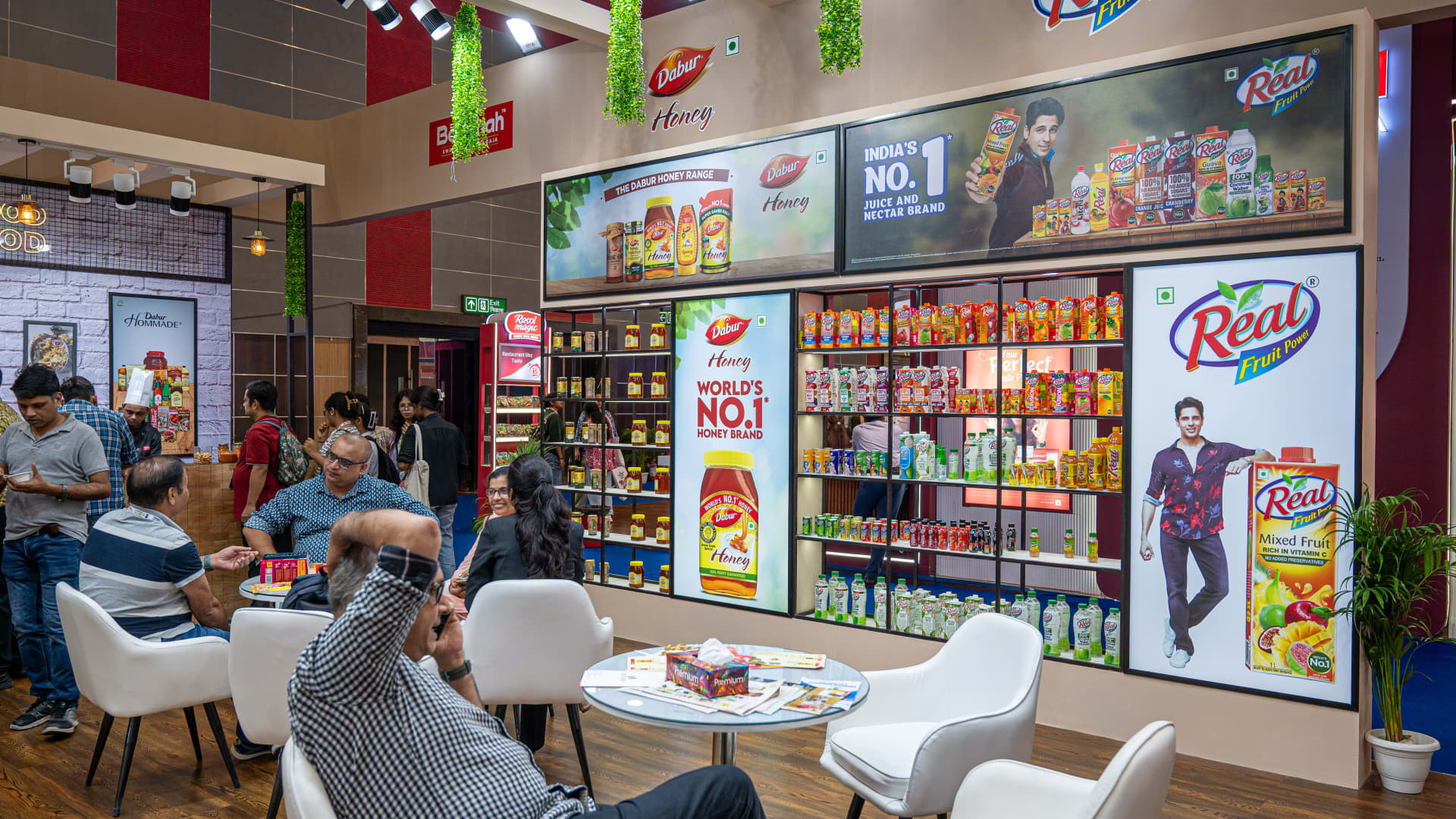
New Delhi, India – 27/09/2025: Exhibition of Dabur Ltd, an Indian multinational consumer goods company that manufactures Ayurvedic products and other fast-moving consumer goods (FMCG).
Sopa Images | Light Rocket | Getty Images
Levant Hymatzynka, a social media influencer known on social media as Food Farmer, who has millions of subscribers and faces backlash from consumer companies, says his content has inspired people to read labels, which in turn has led companies to make higher-quality products.
Over the past few years, several brands, including Mondelez’s Bornvita and Dabur’s Real Fruit Juice, have come under fire for their high sugar content following videos that went viral on social media.
Himmatzynka had to remove the viral Bournvita video, but the company reduced the sugar content of its products after growing public backlash, local media reported.
Darboul told CNBC that the company was already on track to reduce sugar in its juice products starting in 2018, reducing sugar by 21% by 2023.
“We are currently working to reduce sugar by an additional 20% in Real’s core beverage products,” a company spokesperson said in an email. The company is also developing low-sugar and no-sugar products to cater to consumers who are concerned about their sugar intake.
Mondelez did not respond to CNBC’s request for comment.
India’s food safety regulator has also issued a notification banning malt-based drinks such as Bornvita from using the “health drink” branding and food companies from claiming “100% fruit juice” on sugar-sweetened beverages.
Just last month, the issue of high sugar content in drinks reached India’s parliament after several videos on social media pointed out the sugar content in mango-based drinks such as Coca-Cola’s Mother.
In a country where about 100 million people have diabetes and nearly a quarter of them are classified as obese, the call for healthier processed foods resonates with a wide range of people.
Social media-driven brand
The strength of India’s traditional consumer companies lies in their offline reach and large advertising budgets.
But experts say brands are emerging in India as online marketplaces expand their distribution networks across the country and social media marketing levels the playing field to direct-to-consumer, or direct-to-consumer.
As influencers raise awareness, people are reading the back of the pack to check ingredients, potency and effects, said Yash Dholakia, partner at New Delhi-based venture capital firm Sauce.vc, adding that consumers are becoming increasingly aware of what they are paying for. This will boost D2C brands.
“This is a great foundation on which future personal care and food brands will be built,” he said, adding that traditional brands that don’t evolve will be replaced.
Capitalizing on the growing chorus of healthy foods on social media, Dholakia’s company has also invested in D2C startups that focus on healthy foods and “rebuild trust” in food by promoting consumer awareness through social media platforms.
Himatzynka has also launched his own packaged food brand offering “clean label products”. These products have short and simple ingredient lists that are easy for the average consumer to understand and contain no additives.
Several other D2C brands have emerged over the past few years, building on the demand for healthier food and leveraging social media to expand their influence.
Social media content about food safety not only increases awareness but also offers alternatives, and major consumer product companies are taking notice.
need to know
India, the world’s third largest carbon emitter, is burning more coal.
Energy supply disruptions caused by the Iran war and a nationwide heat wave have increased demand for dirty fuel in India. Coal-fired power generation rose to 164.9 gigawatts in April from an average of 160.7 gigawatts last year, according to data shared by S&P Global Energy.
India’s Modi strengthens political dominance with historic victory in state polls
Prime Minister Narendra Modi’s Bharatiya Janata Party won a historic election victory in West Bengal state on Monday, tightening its grip on power as the country grapples with economic challenges and the pressing need for reforms.
Digital lender OnEMI’s IPO is 9.5x oversubscribed
OnEMI Technology Solutions’ IPO issue of 9.2 billion rupees ($97 million) was oversubscribed due to strong interest from institutional investors. The company offers unsecured loans to customers with monthly incomes of less than $1,000. More than 98% of the loans made are unsecured, according to the IPO filing.
very soon
May 12: Consumer price index for April.
May 14: Wholesale price index for April.
