

Hyattsville, Maryland —
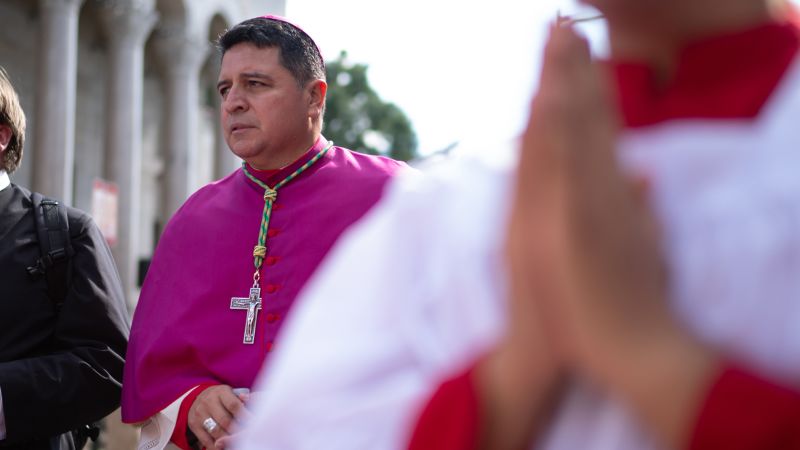
In the heart of deep-red Appalachia, Catholic Church officials will soon be holding services in Spanish accents. But Father Evelio Menjivar Ayala seems unfazed by his new job and the politics swirling around it.
West Virginia is “almost heaven,” Menjivar told CNN. “But there are many challenges that must be addressed if the Kingdom of God is to be there.”
Menjivar, who entered the United States illegally in 1990, has been appointed bishop of the Diocese of Wheeling-Charleston, which covers all of West Virginia, where President Donald Trump won his third consecutive presidential election.
His appointment comes after Leo strongly condemned the “inhumane treatment of immigrants in the United States.” But Menjivar rejects the idea that his appointment is a deliberate provocation against the US president.
“I don’t think the pope is sending a message to President Trump,” Menjivar said. “I think the message he is sending is really that immigrants are not only ready to go wherever we are sent and do our work not just with our own people, but that we are also ready to do our work wherever we are. There are no limits for us as immigrants.”
Menjivar is scheduled to be installed in West Virginia this summer. He spoke to CNN from the Archdiocese of Washington’s Pastoral Center in Hyattsville, Maryland, where he has served as an auxiliary bishop since 2023.

El Salvador-born West Virginia bishop says the timing of his appointment is ‘just a coincidence’ amid feud between President Trump and Pope Leo

More than one-third of Hyattsville’s residents are Hispanic or Latino, a stark difference from Menjivar’s new parish in West Virginia, which has few Catholics or Hispanic residents, something Menjivar acknowledged is a “challenge.” But he believes his appointment will help break down barriers.
“I think he understands, and I think he understands from his own experience, how people open up when they open up to foreigners,” Menjivar said, pointing to Pope Leo’s experience as a Chicago-born missionary to Peru.
“The people of Peru love the Pope because he gave himself completely to them, and that’s what I want to do for the people of West Virginia.”
Menjivar entered the country illegally at the age of 18, fleeing El Salvador’s bloody civil war, stowing away in a car to avoid detection at the border. But he has now been an American citizen for more than 20 years.
As a former illegal immigrant, Bishop told CNN he was deeply distressed to see how families were being separated under President Trump’s immigration policies during his second term.
“The mere fact that someone crossed the border without documents should not determine their entire background as an immigrant,” Menjivar said. “Immigrants cannot be defined by just one part of their journey or experience.”
But Mr. Menjivar’s former immigration status attracted a lot of headlines, especially given West Virginia’s conservative politics. Mr. Menjivar has spoken out against mass deportations, and most coverage of his appointment juxtaposes his elevation to the diocese, his talk on immigration, and his public discussions with Mr. Trump and Pope Leo.
Some in the diocese, including Kathleen M. Jacobs, a West Virginia author and self-described “cradle Catholic,” have vocally questioned whether the appointment is a response to Trump.
“Was the purpose to keep the spotlight on believers,” she wrote in a Charleston Gazette-Mail column, “or was the purpose to keep the spotlight on the politics that permeate every corner of our country?”
“I was concerned about that because I questioned why the appointment came from outside the diocese,” Jacobs later told CNN.
Still, she’s looking forward to seeing what kind of bishop Menjivar will become.

“My hope is that this new bishop will be a quick learner,” Jacobs said. “And he will be immersed in West Virginia’s history, its struggles, and most importantly its people.”
Diocese spokesman Timothy Bishop stressed that Menjivar’s appointment had nothing to do with Trump, but rather with the bishop’s pastoral qualifications.
“He reaches out to people on the margins of society,” Bishop said. “He supports the needs of those less fortunate…That’s what West Virginia needs.”
“You know, sometimes in our state we tend to think that the problems that West Virginia faces are unique to West Virginia, but that’s not the case. The problems that West Virginia faces exist across the country,” Bishop added.
Menjivar told CNN that he believes priests should not campaign for candidates or politicians, but that they can be guides for the faithful.
“Politics is inevitable in life,” he says. “Political issues relate to the realities in which people live. What we cannot do is engage in partisan politics. The church has an opportunity to shine a light on issues and people’s lives. We cannot preach the Gospel in a vacuum.”
Menjivar added that he will not hesitate to speak out if he feels that U.S. immigration policies undermine human dignity.
“I will continue to speak out for the humane treatment of migrants because it is part of my own story,” Menjivar said. “For me, speaking about these things is personal and the story of my people. I will continue to speak out and continue my ministry without forgetting the reality.”
Although he has been an American for 20 years, El Salvador is not far from Menjivar’s thoughts. In the hallway of the pastoral center, he has a statue of St. Oscar Arnulfo Romero, the archbishop of El Salvador who was killed during mass in 1980 during the country’s long civil war.
Menjivar credits the hard-line policies of right-wing President Nayib Boucle in El Salvador, where thousands of people have been detained, for reducing crime levels in his home country from record levels.
