

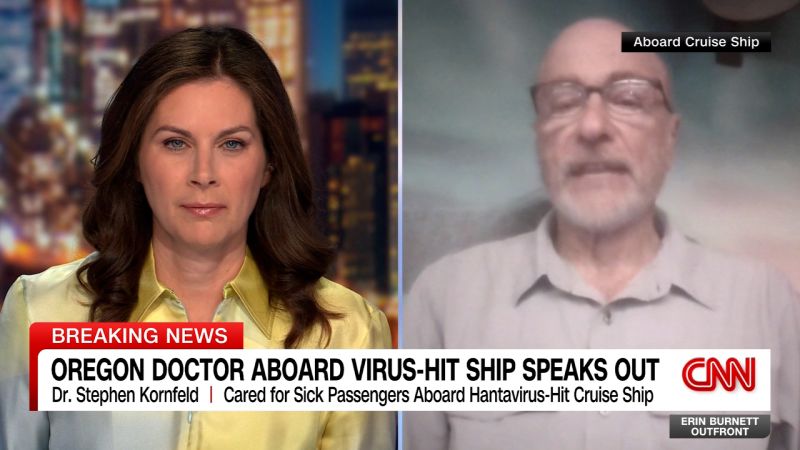
CNN’s Erin Burnett speaks with Dr. Steven Kornfeld, who was on the cruise ship affected by hantavirus.
When Dr. Steven Kornfeld boarded the MV Hondius at the southern tip of Argentina last month, he was expecting a once-in-a-lifetime adventure, exploring vast icy expanses, remote islands and seeing wildlife such as whales, dolphins and penguins up close.
But weeks after their transatlantic vacation, a deadly hantavirus began to spread on the ship, and when the ship’s doctor fell ill, doctors in Oregon began caring for the passengers.
“I kind of fell into the role of being the ship’s doctor,” Kornfeld told CNN from the ship, where he contracted the virus. The ship is currently heading for Tenerife in the Canary Islands, a Spanish archipelago off the southwest coast of Morocco.

The WHO said on Thursday that five cases of hantavirus were confirmed among people on the ship, and several more were suspected, and that more cases were expected.
Britain’s Health and Safety Executive announced on Friday that it had identified a new suspected case among British nationals currently staying in Tristan da Cunha, part of the territory of St Helena on the South Atlantic frontier, where the Hondius had previously stopped.
Three people on board the ship died, including an elderly Dutch couple who are believed to have contracted the virus while sightseeing in Argentina before joining the cruise.
Some 146 passengers and crew, including 17 Americans, are still on board the ship, which spent several days anchored off the coast of West Africa near Praia, Cape Verde state, and is scheduled to arrive in Tenerife on Sunday, where they will disembark and head to their respective countries.
The outbreak has sparked a massive global contact tracing effort as health officials work to identify people who may have been exposed to a rare rodent-borne virus that can cause severe respiratory failure. However, the World Health Organization (WHO) said it does not expect an outbreak similar to the new coronavirus to occur anywhere, stressing there is no evidence of widespread infection risk.

What you need to know about hantavirus

Kornfeld told CNN’s Erin Burnett that he heard one of the passengers on the Hondius was feeling ill and asked the ship’s doctor if he needed help. The passenger, a 70-year-old man from the Netherlands, would die on board the ship on April 11.
“Over 12 to 24 hours, it became clear that many people were getting sick and their symptoms were getting worse,” he said.
The deceased Dutchman’s wife had “non-specific symptoms” and was “very confused and very weak,” Kornfeld said. She was evacuated from the ship and died in a hospital in Johannesburg, South Africa, while attempting to return home.

The other two patients, including the ship’s doctor, “had many of the standard viral symptoms,” Kornfeld said. “I have quite a fever, fatigue, facial flushing, gastrointestinal issues, and some shortness of breath.”
“Neither of us looked seriously ill at the time. But the scary thing about hantavirus is that it can go from serious to severe very quickly.”
The ship’s doctor was taken to a Johannesburg hospital last month and remains in intensive care, but his condition is improving, the WHO said.
Three other passengers on the ship were evacuated to the Netherlands for treatment. One passenger who disembarked early tested positive for hantavirus and is being treated in Zurich.
The outbreak is believed to be related to the Andean strain of hantavirus, a rare but potentially serious virus that can be transmitted between humans through close contact in some cases.
About 30 passengers disembarked the ship late last month before the outbreak was fully understood, complicating efforts to contain the virus.
Health authorities in several countries, including the United States, United Kingdom and Canada, are monitoring Hondius passengers for possible infection. Hantaviruses typically have an incubation period of 1 to 6 weeks before patients begin to show symptoms.

President Donald Trump said Thursday that the hantavirus outbreak “we hope is very much under control” and indicated that his administration would release more information on Friday. “A lot of great people are studying it. It’s going to be fine.”
But Rep. Janelle Bynum of Oregon said in a video posted to X on Thursday that the federal government is “betraying the residents on that ship.”
Bynum said he spoke with his constituency, Kornfeld, and said none of the Americans on the ship received instructions on how to get home safely.
She called on the CDC and Secretary of State Marco Rubio to “develop a real plan” to bring them home.
Kornfeld said he was relieved that the sick passenger was able to get off the ship and was being treated at a hospital.
“What happens with hantavirus is that survival ultimately depends on being able to receive life-saving treatment in a timely manner, which would not be possible on board a ship.”
