


Uber on Wednesday reported lower-than-expected first-quarter revenue, but the ride-hailing giant’s booking outlook for the current quarter exceeded analysts’ expectations.
The stock price rose 8% following the announcement of the financial results.
Here’s how the company performed relative to Wall Street’s expectations, according to estimates compiled by LSEG.
Earnings per share: 13 cents vs. 70 cents expected Revenue: $13.2 billion vs. $13.2 billion expected
Uber announced that its net income decreased by $1.5 billion due to a revaluation of its equity investments. The company announced non-GAAP earnings per share of 72 cents in its Wednesday earnings call. Uber is investing in stocks didi and grabboth based in Asia.
Net income fell to $263 million from $1.78 billion in the year-ago period due to “pre-tax headwinds” from the revaluation. Sales for the quarter increased 14% from $11.5 billion in the same period last year.
Uber’s delivery division, the fastest-growing part of its business, posted revenue of $5.07 billion, up 34% from $3.78 billion a year earlier. This beat the average analyst estimate of $4.89 billion, according to Street accounts.
The company announced strong delivery growth in Australia, Japan and the UK.
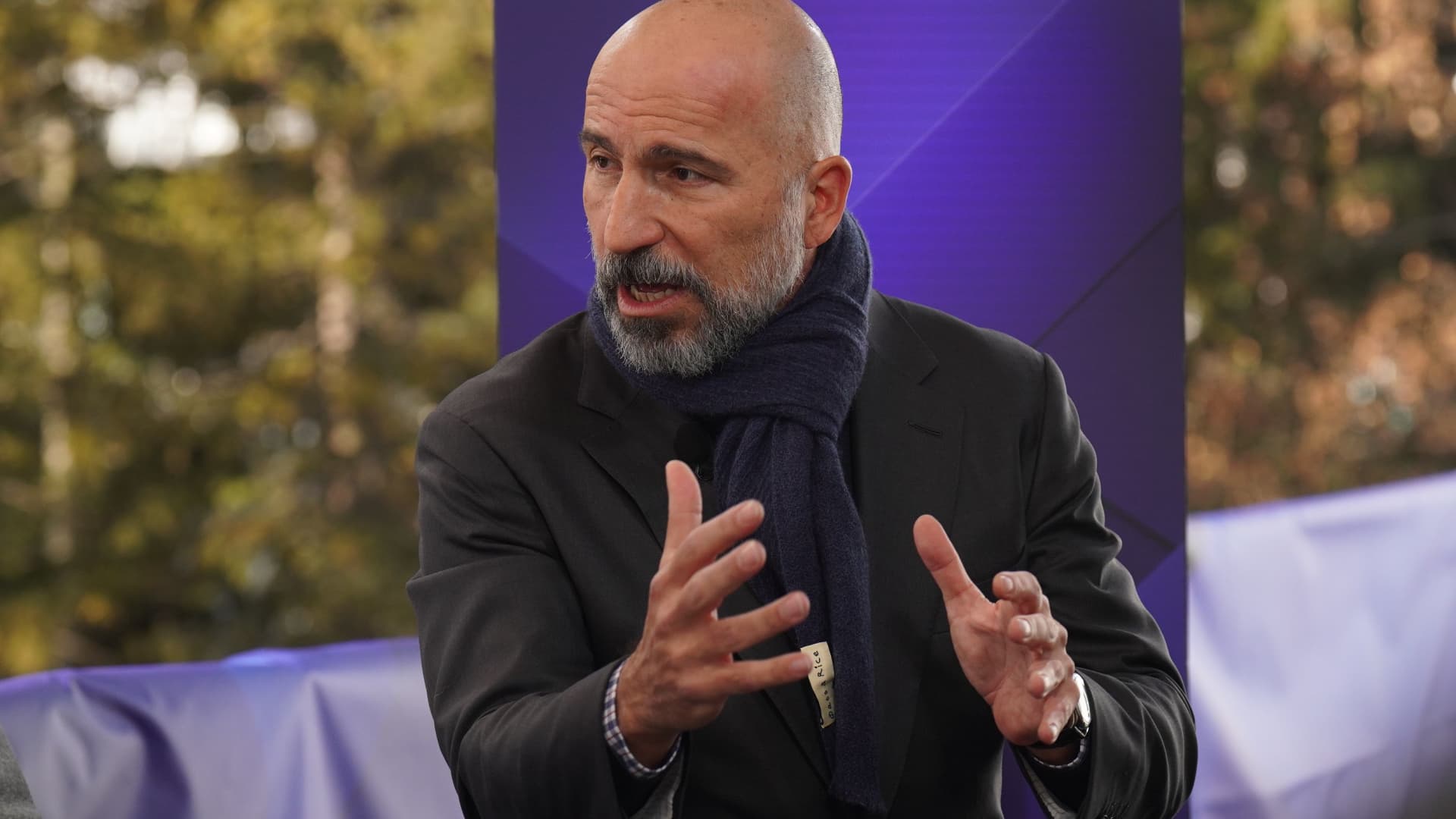
“Consumers are spending, and they’re spending locally. There’s no sign of that slowing down right now,” CEO Dara Khosrowshahi said in an interview on CNBC on Wednesday.
The drop in revenue was due to the performance of Uber’s mobility business, or ride-hailing business. Revenue rose 5% year over year to $6.8 billion, compared to analysts’ expectations of $7.11 billion, according to Street Accounts.
In prepared remarks ahead of the earnings call, Khosrowshahi said Uber faces a “complex macro backdrop characterized by weather disruptions, geopolitical tensions and fluctuations in gas prices.” U.S. gasoline prices have increased by about 50% since the U.S. began combat operations in Iran in February.
Rising prices are especially difficult for Uber drivers, who pay for their own fuel. In late March, Uber announced several fuel discounts and other offers for drivers, which are expected to last until roughly the end of May.
Khosrowshahi told CNBC that Uber has seen little impact on consumers from rising energy prices, although its Middle East operations continue to experience aftershocks.
The company reported 3.6 billion trips in the first quarter. Gross bookings increased 25% to $53.7 billion, beating the average estimate of $52.8 billion. The company expects second-quarter bookings to be between $56.25 billion and $57.75 billion, beating the consensus estimate of $56.17 billion.
Uber is investing in self-driving cars and plans to purchase them from select partners, including Warbi, Wave, Rivian, and Nuro, once they are verified to operate safely without a human supervisor or driver.
The company’s AV partners also include robotaxi service providers such as: of the alphabet China’s Waymo and WeRide want to make their self-driving cars available through the Uber app.
Khosrowshahi told analysts on an earnings call that Uber’s mobility business accelerated faster than its overall business. He expects these tailwinds to continue, as the company aims to roll out Waymo services in 15 cities by the end of 2026.
“We think this is going to be another $1 trillion[total addressable market]and we don’t think this is a winner-take-all market,” he said.
Uber sells services to the AV industry, including custom insurance, operations and maintenance, and training data.
As part of its internal cost-cutting efforts, Uber is deploying artificial intelligence to improve engineering productivity and curb hiring. We’re also building a customer-facing AI agent into our platform.
The company said in prepared comments that 95% of its engineers now use AI coding tools on a monthly basis, and more than 10% of its code is “written autonomously by AI coding agents.”
Khosrowshahi said AI helps Uber personalize its app for customers, and that these algorithms can predict three-quarters of rides on the company’s platform.
See: Inside Uber’s ‘All Apps’ Strategy

