

sydney —
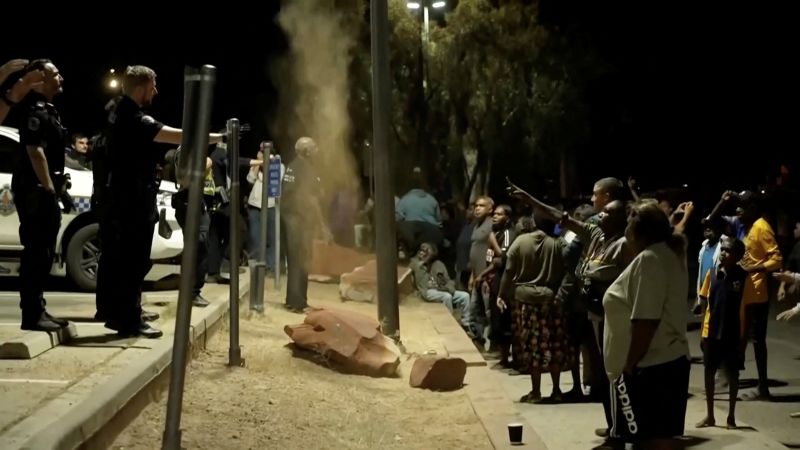
A violent crowd clashed with police outside a hospital in a remote Australian outback town on Thursday night, demanding authorities hand over a suspected child killer.
Dramatic footage showed officers dodging stones and sticks as rioters vandalized and set police cars on fire. Police were seen firing tear gas into the crowd and picking up smoke bombs and throwing them back.
Northern Territory Police Commissioner Martin Dole described the scene in Alice Springs, considered the gateway to Uluru (formerly Ayers Rock) in the country’s desert heart, as “absolute anarchy”.
Jefferson Lewis, 47, was arrested Thursday on suspicion of killing the 5-year-old girl, now known as Kumanjai Little Baby. This pseudonym is a pseudonym given by families among the indigenous Walpiri people as a cultural measure to avoid speaking the deceased’s name during the mourning period.

Ms Lewis had been the subject of an intense search in central Australia since Saturday night after she was seen holding hands with her child hours before she was reported missing.
After a four-day search in which indigenous communities and local police worked closely together, the girl’s body was found at the edge of a river, approximately 5 kilometers from where she was last seen.
It was not the police who pursued Lewis, but an angry mob that officers spotted beating the murder suspect in an act of “vigilante justice.”
“At the time we arrested him, he was unconscious and he was being treated when St. John’s Ambulance arrived, as did police,” Chief Dole said.
Mr Doll said Mr Lewis was “pretty severely beaten” before being taken to Alice Springs Hospital, where a crowd of several hundred people had arrived demanding the murder suspect be handed over.
Warlpiri elders and family spokespeople called for peace following the violence.
“What happened this week is not what we expected,” Yapa (Walpiri) elder Robin Granites said in a statement.
“Thanks to the efforts of the community, this man was arrested. We must take the time to mourn baby Kumanjai and support his family, while allowing justice to take its course.”
Relations between the Northern Territory (NT) Police and Indigenous communities are often strained. In 2025, a coroner’s inquest found “clear evidence of deep-seated systemic and structural racism within the Northern Territory Police Force” after Warlpiri man Kumanjayi Walker was shot dead by police in 2019.
Speaking on Friday, local Indigenous elder Michael Riddle said the recent violence had “eroded” the community’s unity in the face of tragedy.
“I think bringing the word ‘payback’ into this scenario only incites violence,” Riddle told reporters.

“There is a system set up here where there is a person being detained and Western rules deal with that person.”
Police said they intend to prosecute those involved.
“Just as Jefferson Lewis faced the law, you will face the law,” Police Chief Dole said Friday.
Girls and women at risk
Australian Prime Minister Anthony Albanese expressed his condolences to Kumanjai Little Baby’s family in a post on Thursday, saying: “Words cannot express the magnitude of the grief her family is experiencing. All Australians have them in our hearts at this time of their terrible loss.”
Indigenous women and girls are more likely to be murdered, raped and assaulted than non-Indigenous women, according to the findings of the Federal Senate Inquiry into Missing and Murdered Indigenous Women.
In response to the 2024 report, the Albanon government acknowledged that “Indigenous women and children experience disproportionately higher rates of homicide, family and domestic violence, sexual violence, child removal and incarceration, and worse outcomes in health, housing, education and employment,” and pledged to act on a number of recommendations, including tighter monitoring of potential offenders.

Lewis, who police say has a violent criminal history, was previously charged with assault and domestic violence and was released from prison six days before Kumanjai Little Baby disappeared on Saturday.
“This was a known perpetrator. There are questions about why this happened so soon after he was released from custody,” said Indigenous independent senator Lydia Thorpe.
In a statement, Kumanjai Little Baby’s mother thanked those who searched for her child.
“It will be so hard to live the rest of our lives without you,” she wrote.
