

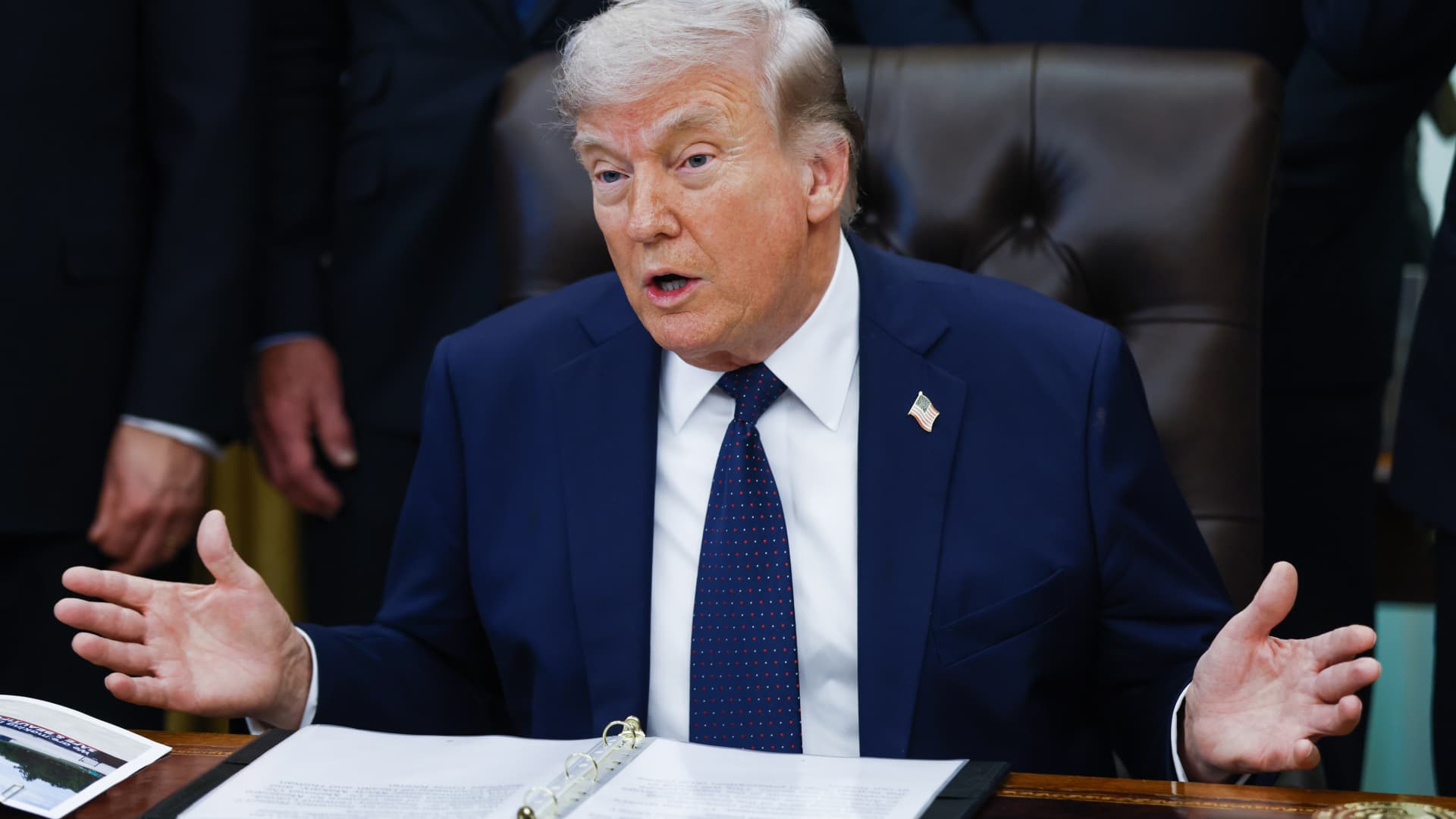

President Donald Trump, locked in a confrontation with Iran that will only end if the economic pain becomes intolerable, may have to maintain a naval blockade against Iran for several weeks, forcing severe economic consequences on the world.
President Trump said Wednesday that the U.S. blockade against Iran will remain in place until Iran agrees to a nuclear deal. Meanwhile, the Iranian government refuses to reopen the Strait of Hormuz until the US withdraws its navy.
It is unclear which side will budge first.
President Trump said Sunday that Iran’s oil infrastructure is days away from exploding as oil is held up due to the blockade.
President Trump told Fox News: “Where things explode, something happens.” “They say there’s only three days left before that happens. If it explodes, you’ll never be able to rebuild it the way it was.”
But experts say Iran has weeks of space left in tanks to store oil that cannot be exported. This should give the Iranian government time to avoid permanent damage and scale back the oil fields in an orderly manner, they said.
Meanwhile, the oil supply shock is worsening by the day, putting pressure on the US as Iran continues to block the strait and the damage to the global economy mounts.
“The question for me is who has the longer runway, Trump or Iran,” said Fernando Ferreira, head of geopolitical risk services at Rapidan Energy.
Iranian tanker blocked
Tehran will feel the heat from the US blockade. According to ship-tracking company Kupler, no Iranian tanker has been confirmed to have passed through the U.S. blockade.
Kupler said Iranian-linked ships crossed the strait but were unable to break through the blockade, which stretches from the Gulf of Oman to the Arabian Sea.
A White House official told CNBC that the Iranian government is losing $500 million a day due to the blockade.
Iranian tankers were chased by the U.S. Navy, and oil and condensate loading at the country’s ports plummeted from 2.1 million barrels a day before the blockade to just 567,000 barrels a day after the blockade, Kupler found.
Since Iran cannot export oil, it will have to fill up its storage tanks. Eventually, the Iranian government will have to cut oil production as storage tanks near capacity.
storage capacity
Rapidan Energy says this is when the Iranian government starts to feel the pressure, but it could take a long time to respond forcefully.
“They were preparing for a lockdown,” Ferreira said. “They thought it through. They saw what happened in Venezuela.”
“They are prepared to hold out for several months,” the analyst said.
Ferreira said Iran has at least 26 days until its storage tanks are full and production cuts are inevitable. He said the estimate assumes 26 million barrels of onshore storage in the region’s 18 empty licensed tankers and 21 million barrels of floating storage.
But Ferreira cautions that this is a conservative estimate. Iran’s maximum storage capacity suggests the country has an additional 39 million barrels of storage space, with 22 more days left than the 26th, analysts said.

Ferreira also said 31 Iranian-linked ships are scheduled to return to the Middle East until late May, which could allow storage of an additional 50 million barrels. That would allow Iran to hold out for up to 76 days, or well over two months, he said.
These estimates assume that Iran consistently keeps its storage facilities full at a rate of 1.8 million barrels per day, Ferreira said. In reality, Iran’s government is likely to start cutting production, which would further expand its stockpiles, he said. They also assume that Iranian oil exports will not be able to avoid the blockade at all, the analysts said.
“Lockdowns can be very effective,” Ferreira said. “It’s about a timeline that will put Iran in excruciating pain.”
He said it would take weeks or months for Iran to come under such pressure. “That runway may be longer than President Trump envisions,” the analyst said.
A White House official said the blockade was “putting incredible economic pressure on Iran” and would remain in place until the United States reached an acceptable deal.
“The straits are international waters and we have no intention of imposing tolls on Iran to the straits,” the official said.
Production stopped
Antoine Halff, an expert at Columbia University’s Center on Global Energy Policy, said oil fields could be permanently damaged if they were shut down suddenly and in a chaotic and uncontrollable manner.
But Mr. Halff, who served as the International Energy Agency’s chief oil analyst, said Iran’s storage capacity would buy it time to shut down the fields in an orderly manner. He said despite President Trump’s comments over the weekend, there is no reason for Iran’s infrastructure to explode.

“If we do everything in an orderly manner, the damage to the site will be minimal. It may not cause any damage to the site,” said Halff, who is also an economist at the U.S. Energy Information Administration.
“It’s certainly a challenge in the short term because of the lack of funding, but it’s not a big challenge in terms of on-the-ground activities,” he said.
Homayun Farakshahi, head of crude oil analysis at Kpler, said Iran might just cut production to the minimum level needed for domestic consumption, but then the whole issue of storage space would become irrelevant.
Farakshahi said the bigger question is when Iran will run out of revenue.
Analysts estimated that Iran was loading 120 million barrels of crude oil on tankers east of the U.S. blockade zone, which could be delivered to customers including China. This is equivalent to about two months’ worth of income for the Iranian government, which could face difficulties selling oil and receiving cash, he said.
“If the blockade continues for two more months, Iran’s oil revenue could drop to zero,” Farakshahi said.
“The administration’s bet is to force Iran to return to the negotiating table with a willingness to make even more concessions,” he said.
