

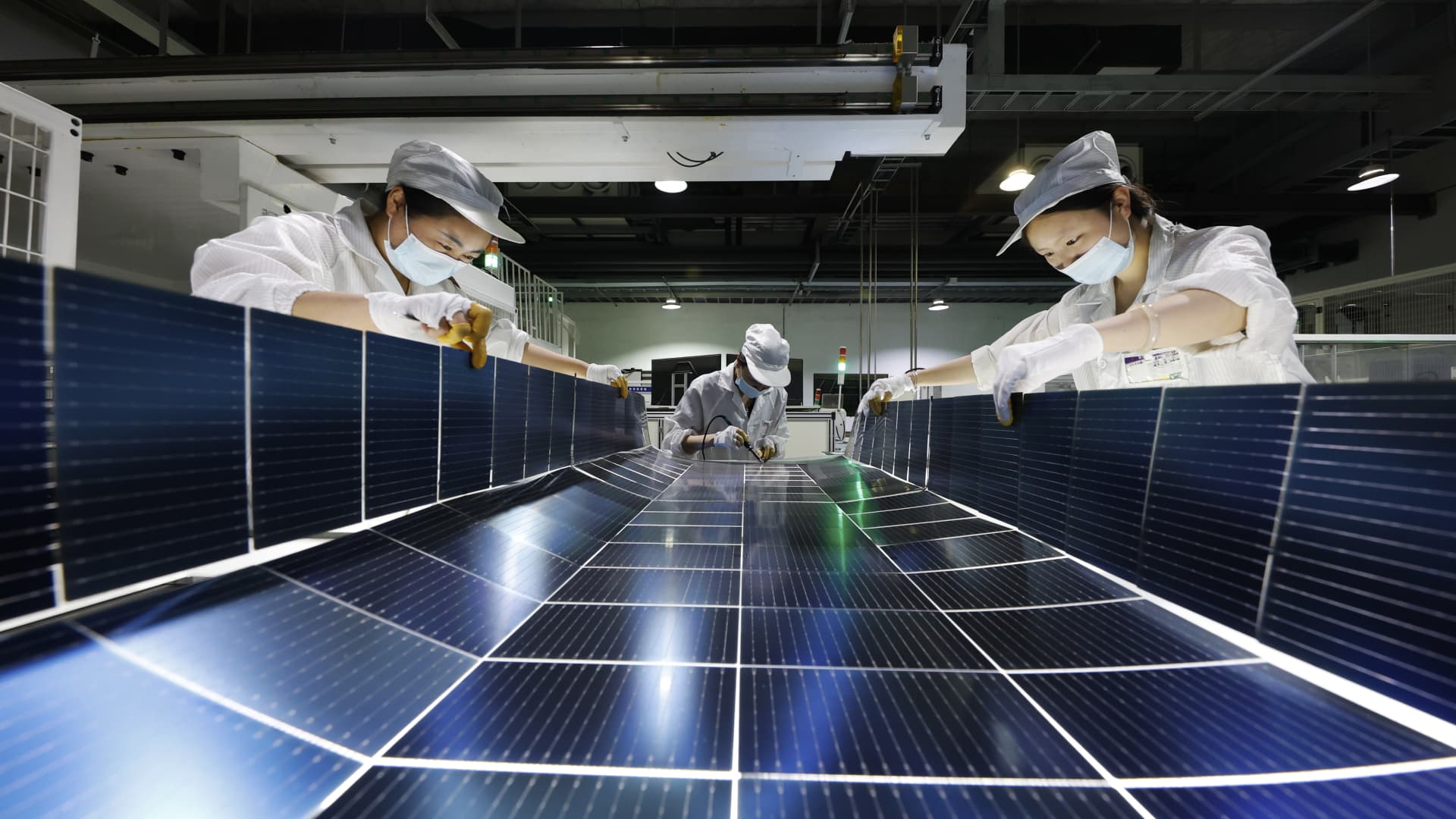
A worker inspects solar panels installed on a lake in Tianchang, eastern China’s Anhui province, on January 12, 2026.
– | AFP | Getty Images
China is calling for “concerted efforts” to ease the solar power industry’s severe overcapacity crisis as part of a campaign to end cut-throat price competition.
The proposed measures include capacity management, standard guidelines, price enforcement, mergers and acquisitions, and intellectual property protection to “promote the quality development of the solar power industry.”
China’s solar power production capacity far exceeds global demand, sparking a price war within the country in recent years.
The country manufactures more than 80% of the world’s solar panel components, according to the International Energy Agency, but the country’s industry faces overcapacity problems due to intense domestic competition, which the Chinese government calls “entrainment.”
The push came on the heels of a meeting on Friday between institutions including China’s Ministry of Industry and Information Technology, the National Development and Reform Commission, the China Photovoltaic Industry Association, and major state-owned power companies that buy solar power, such as China Huanong Group and China Datang Group.
“The meeting called for stronger inter-sectoral cooperation and coordinated efforts to continuously deepen the governance of the solar power industry and fully promote comprehensive governance related to ‘anti-entrainment’,” China’s Ministry of Industry and Information Technology said in a statement on Monday (via Google Translate).
China’s solar oversupply problem has been exacerbated by increased resistance from high-priced markets overseas, as the United States aggressively imposes tariffs on Chinese solar products and the European Union decentralizes solar power supply chains away from Beijing.
In response, the Chinese government has launched an “anti-involution” campaign, cutting production capacity and seeking to end the chaotic pricing system.
Analysts told CNBC that the fallout from the U.S.-Israel-led war on Iran will accelerate the transition away from fossil fuels and change countries’ thinking about the role renewable energy can play in strengthening energy security, potentially boosting demand for solar power.
But Chinese solar power makers told Reuters last week that even though the energy price shock from the Iran war is expected to boost global demand for renewable energy, it is unlikely to ease the industry’s overcapacity challenges.
