

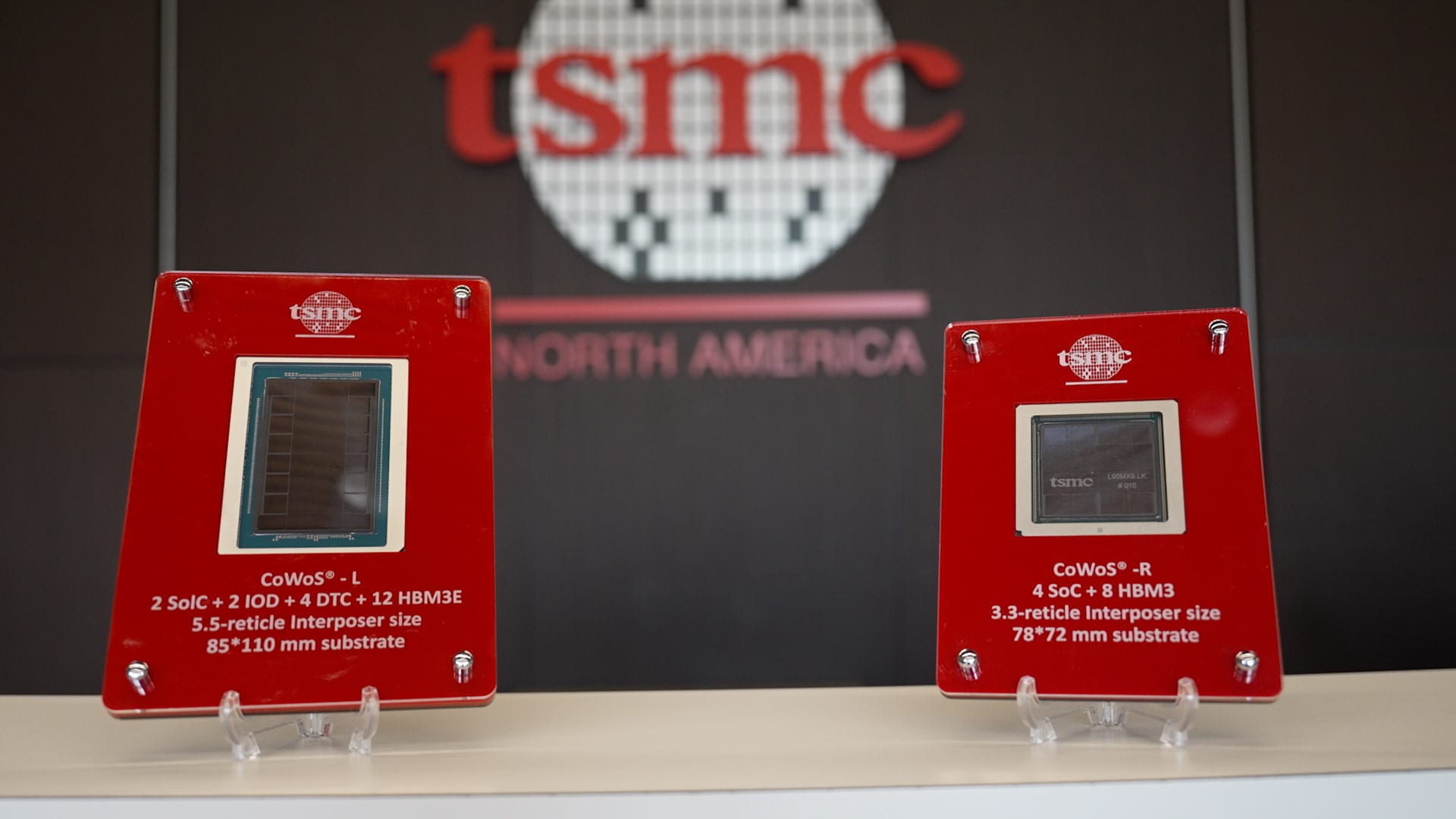
TSMC CoWoS Chip: A sample of a microchip packaged using CoWoS at TSMC’s offices in San Jose, California, published on CNBC on February 20, 2026.
CNBC
As demand for artificial intelligence chips remains very high, Taiwan Semiconductor Manufacturing Co., Ltd. and ASML, two of the largest companies in the chip manufacturing industry, both reported strong financial results this week.
But that didn’t seem to matter to Wall Street.
TSMC on Thursday reported a 58% increase in first-quarter profit, beating expectations and setting a new record. It was the fourth consecutive quarter of record profits for the world’s largest chipmaker.
“AI-related demand continues to be very strong,” CC Wei, president and CEO of TSMC, said at an earnings conference on Thursday.
However, TSMC stock fell about 2% on Thursday.
61% of TSMC’s overall revenue in the first quarter came from its high-performance computing division, which includes AI chips made for its largest customer, Nvidia. This segment increased from 55% in the previous quarter.
Gross margins were also higher at 66% than last quarter, likely because TSMC’s edge in cutting-edge chips allows it to raise prices for large customers like Apple and Nvidia, which rely heavily on chips made below 7nm. These advanced chips accounted for about 74% of revenue.
One weak point was smartphone revenue, which fell 11% compared to the previous quarter as the industry faces continued memory shortages.
Investors were also focused on the impact of the Iran war. TSMC executives said they do not expect any short-term impact from energy or supply chain disruptions due to the conflict, adding that they have safety stocks of specialty gases such as helium and hydrogen.
ASML fell as much as 6.5% on Wednesday, with the stock closing around 2.5% lower on concerns about shrinking sales to China and extremely high expectations from investors. On Thursday, the stock fell another 3%.
The Dutch chip-making equipment maker reported strong first-quarter results and raised its outlook, but it was just in line with what investors had hoped for.
The failure of either stock to take advantage of positive press coverage could be a harbinger of earnings season for the semiconductor industry as a whole.
It’s also the latest example of how astronomical expectations are weighing on chipmaker stocks. Last quarter, Nvidia’s fourth-quarter earnings report was a big hit, but the company suffered a 5% decline.
Chip manufacturing process
ASML’s extreme ultraviolet lithography equipment costs more than $400 million each. These are the only machines in the world capable of etching the minute designs needed to make the cutting-edge chips that TSMC makes for Apple, Nvidia, AMD, and Google. Amazon And so on.
However, the number of EUV machines that ASML reported it was producing for customers such as TSMC failed to impress some analysts.
ASML CEO Christophe Fouquet said on Wednesday that the company could deliver 80 so-called low numerical aperture (NA) EUV machines in 2027 “if customer demand is really supportive.”
“This may be somewhat disappointing given our expectations that 90% could be achieved in 2027,” Barclays said in a note on Wednesday.
TSMC’s CapEx forecast, which includes significant spending on ASML machines, was another area of intense investor scrutiny.
TSMC said Thursday that it expects to spend between $52 billion and $56 billion in 2026. This is up from $40.5 billion in capital spending in 2025.
In today’s environment of extremely high expectations, investors were hoping that TSMC would exceed the 30% annual growth target it set earlier this year. TSMC stuck to its forecast, predicting a 10% increase in second-quarter revenue.
William Li, senior analyst at Counterpoint Research, said TSMC’s biggest challenge will be “scaling capacity fast enough without leaving any revenue behind.”
TSMC is building a new advanced chip manufacturing facility in Arizona, but that may not be enough. Advanced packaging to protect chips and connect them to larger systems is becoming the next bottleneck in chip manufacturing for AI.
Nvidia secured most of the capacity for TSMC’s most advanced type of packaging, called Chip on Wafer on Substrate (CoWoS). TSMC has added two new advanced packaging facilities in Taiwan and is preparing to build two facilities in Arizona later this year to meet demand.
US chipmaker Intel is another leader in advanced packaging. Intel has yet to secure major external customers in the race to catch up with TSMC in chip manufacturing, but advanced packaging could change that. Intel’s packaging customers include Amazon, Cisco, and new initiatives from SpaceX and Tesla.
Counterpoint Research’s Li said, “Over time, this dynamic is likely to evolve as competition increases and companies like Intel strengthen their advanced packaging capabilities to capture a larger share of the opportunity.”
Video: Nvidia expands AI chip packaging capabilities as TSMC expands in the US

CNBC’s Kristina Partinevelos, Arjun Kharpal and Dylan Butts contributed to this report.
