

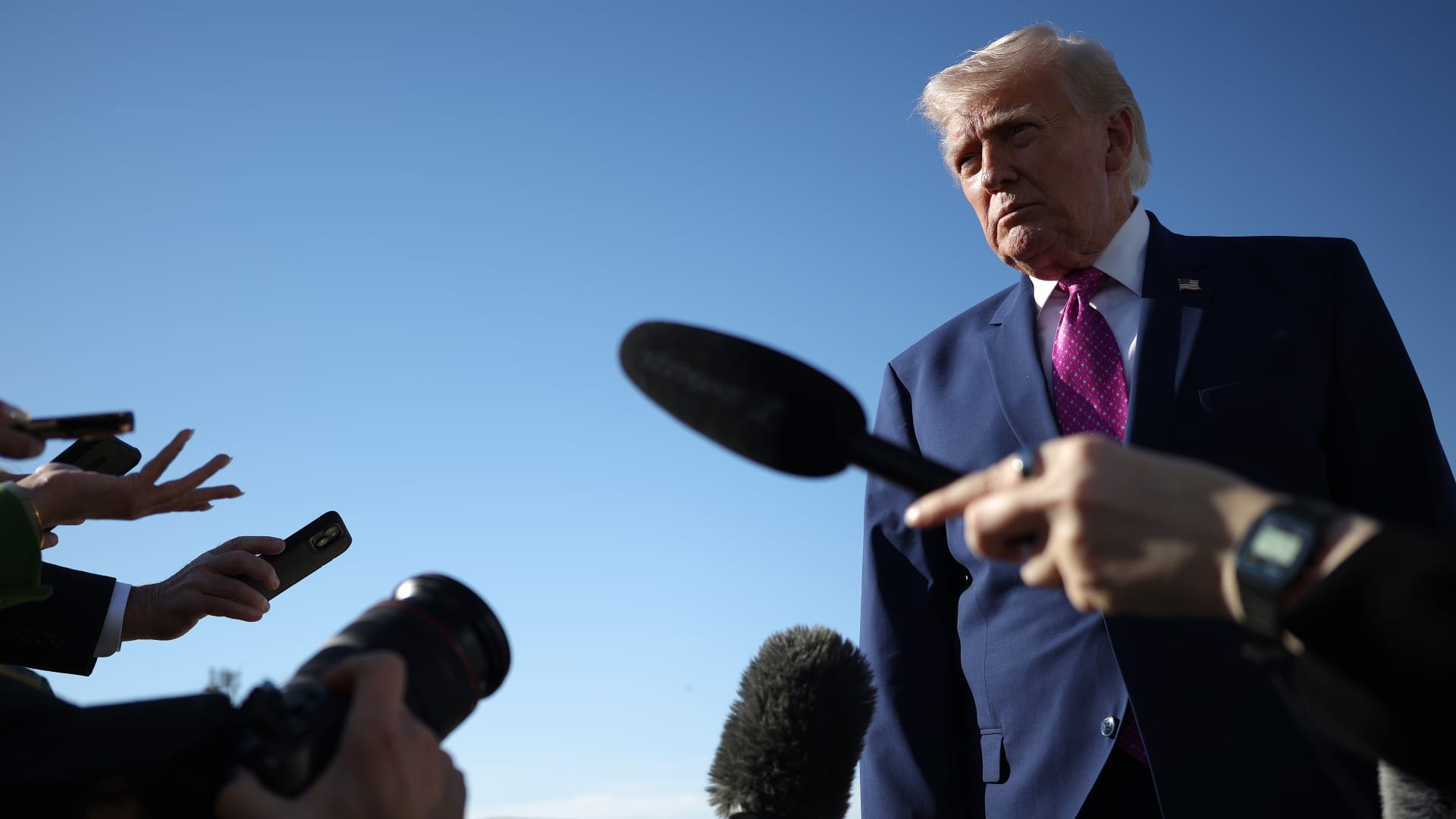
U.S. President Donald Trump speaks to reporters before boarding Air Force One at Joint Base Andrews, Maryland, April 10, 2026.
Win McNamee | Getty Images
President Donald Trump announced on Sunday that the United States would close the Strait of Hormuz after talks in Pakistan to end the war with Iran hit a deadlock.
“Effective immediately, the United States Navy, the world’s greatest navy, will begin the process of blocking any ships attempting to enter or exit the Strait of Hormuz,” Trump said in a post on his social media platform Truth Social. “The blockade will begin soon. Other countries will also be involved in this blockade. Iran cannot be allowed to profit from this illegal act of extortion.”
The US announcement of a strait blockade is likely to dash hopes that the war will end within days after peace talks in Islamabad. Also threatening to worsen the economic crisis that has gripped the global economy since the war broke out, Iran has begun restricting access to the strait, a gateway that carries about a fifth of the world’s population. oil.
President Trump said the U.S. blockade was an effort to prevent Iran from policing the strait and profiting economically from it while the rest of the world suffers from blockades.
“At some point, we will reach a standard where ‘everyone is allowed in, everyone is allowed out.’ But Iran is not allowing that to happen, just saying, ‘There might be a mine somewhere,’ and no one knows but them.” “This is global blackmail, and the leaders of countries, especially the United States, will never be blackmailed.”
President Trump told Fox News’ “Sunday Morning Futures” that the effort was a “total blockade” and “all or nothing,” with no ships allowed to sail until Iran relents.
In his post, President Trump also announced that the U.S. Navy will “search for and interdict any vessel in international waters that causes harm to Iran.”
Iran is preparing to impose fees on ships attempting to pass through the strait, a move that has drawn the ire of President Trump as Tehran seeks to tighten its control over the strait amid a two-week cease-fire in the conflict.
“No one who pays illegal tolls will be able to safely navigate the high seas,” the president said.
Peace talks hosted by Pakistan collapsed over what the United States said was Iran’s unwillingness to abandon its efforts to acquire nuclear weapons. Tehran’s demands include control of the Strait of Hormuz, payment of war reparations and a ceasefire across the region, including Lebanon, Iranian state television and officials said. They are also calling for the release of frozen assets overseas.
The U.S. delegation, led by Vice President J.D. Vance, met with Iranian and Pakistani negotiators for more than 21 hours during an unusual face-to-face summit.
The war and the near-total blockade of the Strait have put enormous pressure on oil prices and the global economy. The market fluctuated wildly during the campaign, with oil prices soaring to more than $100 per barrel at one point.
President Trump said on Fox that the United States needs to weather the storm to prevent Iran from obtaining a nuclear weapon, and argued that energy prices would fall once the war ends.
“It may not happen at first, but it will gradually decrease,” he said.
The president also said that any country that supports Iran, potentially including China, would be subject to a 50% tariff from the United States.
“If they were caught doing that, they would be subject to a 50% tariff, which is an astonishing amount,” Trump said.
President Trump is scheduled to meet with Chinese President Xi Jinping next month.
