

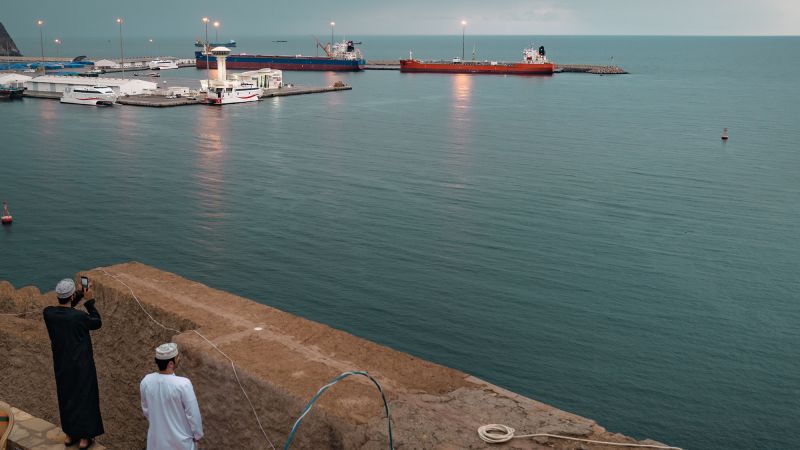
The United States has negotiated a fragile ceasefire that would allow the Strait of Hormuz to reopen, but Asian allies dependent on the waterway are already being forced to rely on other countries for energy security, which is in the interest of America’s greatest adversary.
After the first airstrikes by the US and Israel in February, Iran effectively closed off the Strait of Hormuz, through which a fifth of the world’s oil flows.
Allies in Europe and Asia were not informed of the war in advance and were not asked to participate from the beginning. Nevertheless, as oil prices soar, US President Donald Trump has criticized other countries for not sending military aid, saying countries in need should “take the lead” and try to “get their own oil.”
They appear to be heeding his words now, especially as economies in the Asia-Pacific region suddenly lose their largest source of energy imports and are being hit first in the historic global oil crisis.
U.S. allies Japan, Thailand, South Korea and the Philippines are considering brokering a deal with Iran to ensure safe shipments of oil and gas. Asian countries are also buying more natural resources from America’s rival Russia, and China has shown a willingness to help alleviate fuel shortages and deepen energy cooperation with neighboring countries such as Australia, the Philippines and even Taiwan.
On Tuesday, President Trump announced a two-week ceasefire conditional on the reopening of the Strait of Hormuz, paving the way for oil prices to rise. However, the significant impact of the agreement remained unclear.
While the United States touted its success in reopening the strait, Iran said its military would continue to coordinate shipping movements during the ceasefire and warned that the war was not over. Since the ceasefire was announced, only a few tankers have passed through this narrow passage, which was a free and open international waterway before the war began.
Regardless of the final outcome of the peace negotiations, President Trump’s decision to go to war will reshape regional energy trade and partnerships and have long-term implications for the nature of the United States’ alliances in Asia.

“The crisis has exposed hard truths about America’s power,” said Lock See, a professor at the University of Technology Sydney whose research focuses on energy issues in Asia and Australia. “Despite decades of security guarantees, the United States has failed to prevent the closure of the world’s most important energy chokepoint. Asian allies are now quietly asking whether the U.S. security umbrella extends to energy supply routes.”
Ishi said Asian governments would prioritize diversifying their energy sources, including buying more oil and natural gas from both the United States and its rivals, the world’s biggest producer in both respects.
“This crisis both strengthens and strains the U.S.-Asia alliance,” Shi said. “Allies will now hedge by buying more products from the United States, but they will also build their own resilience.”
The Iran war has had a particularly pronounced impact in Asia, where countries are scrambling to secure more supplies while also trying to conserve energy. But the researchers said the differing responses highlight broader vulnerabilities among Asian countries, prompting those most exposed to the oil crisis to seek their own solutions at the risk of alienating the United States.
The Philippines became the first country to declare a national energy emergency. Despite escalating territorial disputes between the two countries in the South China Sea, China is now purchasing Russian oil for the first time in five years, negotiating with Iran to ensure the safe passage of its ships through the strait, and restarting diplomatic talks with China over energy cooperation.
Japan, which owns the world’s largest strategic oil reserves, released historic amounts of emergency reserves last month to cushion the blow of soaring oil prices. However, Prime Minister Sanae Takaichi said this week that he was working to arrange talks with Iran’s president, and Japanese public broadcaster NHK reported that several ships with ties to Japan had recently passed through the Strait of Hormuz.


South Korea, another U.S. ally, said Friday it would send a special envoy to Iran to discuss safe passage of Iranian ships through the Strait of Hormuz. The country has already sent special envoys to Kazakhstan, Oman and Saudi Arabia to secure supplies of crude oil and naphtha, a petroleum byproduct needed to produce petrochemicals such as plastics and gasoline. The country also took advantage of a temporary exemption from U.S. sanctions to purchase naphtha from Russia for the first time in four years.
“Each country’s approach will represent a combination of influence, capacity and urgency,” said Robert Walker, an economist at the Sydney-based Lowy Institute’s Center for Indo-Pacific Development. China was able to quickly coordinate with Iran and was one of the first countries to ensure its cargo passed safely through the strait. “Diplomatic capacity and access are important in times of crisis,” Walker added.
John Coyne, head of the national security program at the Australian Strategic Policy Institute, said while the energy crisis was likely to encourage greater regional cooperation, it could strain US bilateral relations.
“At stake will be how the United States will react if there is a move to receive more Russian oil, or negotiations over which countries will be allowed to receive oil from the Straits and from Iran,” Coyne said. “There are a lot of unknowns here. Would Iran be happy to see that oil refined and sent to, say, Australia? And how would the Americans react to that?”
US pressure on allies is not limited to Asia. France and Italy are also negotiating directly with Iran to allow shipping through the Strait of Hormuz. Meanwhile, Iran retaliated by launching airstrikes against US Gulf allies, including Saudi Arabia, the UAE, Kuwait, Qatar, and Bahrain, targeting US military bases and energy infrastructure.


For Russia and Iran, the major economies’ desperate search for fuel has resulted in a windfall.
These oil industries were subject to U.S. sanctions aimed at preventing military and nuclear development. But as domestic gasoline prices rose, the Trump administration waived sanctions until mid-April for products already loaded onto ships.
The decision could have netted Russia between $3.3 billion and $5 billion in additional oil revenue in March, according to a post by Roksanna Vigil, a national security and international affairs fellow at the Council on Foreign Relations.
A separate analysis by Luis Vincent Gabe, a founding partner at research firm Gabekal, found that before the war, Iran exported about 1 million barrels a day at $40 to $45 a barrel, but now exports are about 1.7 million barrels at more than $100 a barrel. If Iran is charging ships $2 million to transit the strait, as some reports have suggested, that could bring in an additional $60 million a week in revenue, Gabe noted.
“If the April expiration date arrives without oil prices falling, the White House will be walking into a trap of its own making,” Vigil wrote. “The Trump administration will soon face a difficult choice that will be scrutinized by both sides of the aisle: renew and double down on exemptions favorable to America’s adversaries, or reimpose sanctions on markets that the United States has helped destabilize.”

Another country that could indirectly benefit from an oil supply shock is China.
With the advance of major oil producers, large oil reserves and an extensive renewable energy sector, China is in a better position than its Asian neighbors to weather the energy crisis. This has allowed the country to further increase its geopolitical influence as the United States seeks to aggressively counter its influence in the region.
China has imposed restrictions on fuel exports to protect its domestic industry, but said it would work with Southeast Asian countries to address energy shortages. China also claimed Taiwan as part of its territory and offered energy security if the island’s democracy agreed to peaceful unification. And on Tuesday, Chinese Premier Li Qiang spoke by phone with Australian Prime Minister Anthony Albanese to discuss deepening cooperation on clean energy and electric vehicles.
“China has the reserves and onshore pipelines to become the energy anchor for Asia,” said Shi, of the University of Technology Sydney. “So far, China has not made its plans clear. If the plans are properly implemented, the geopolitical map of the region will change accordingly.”
