

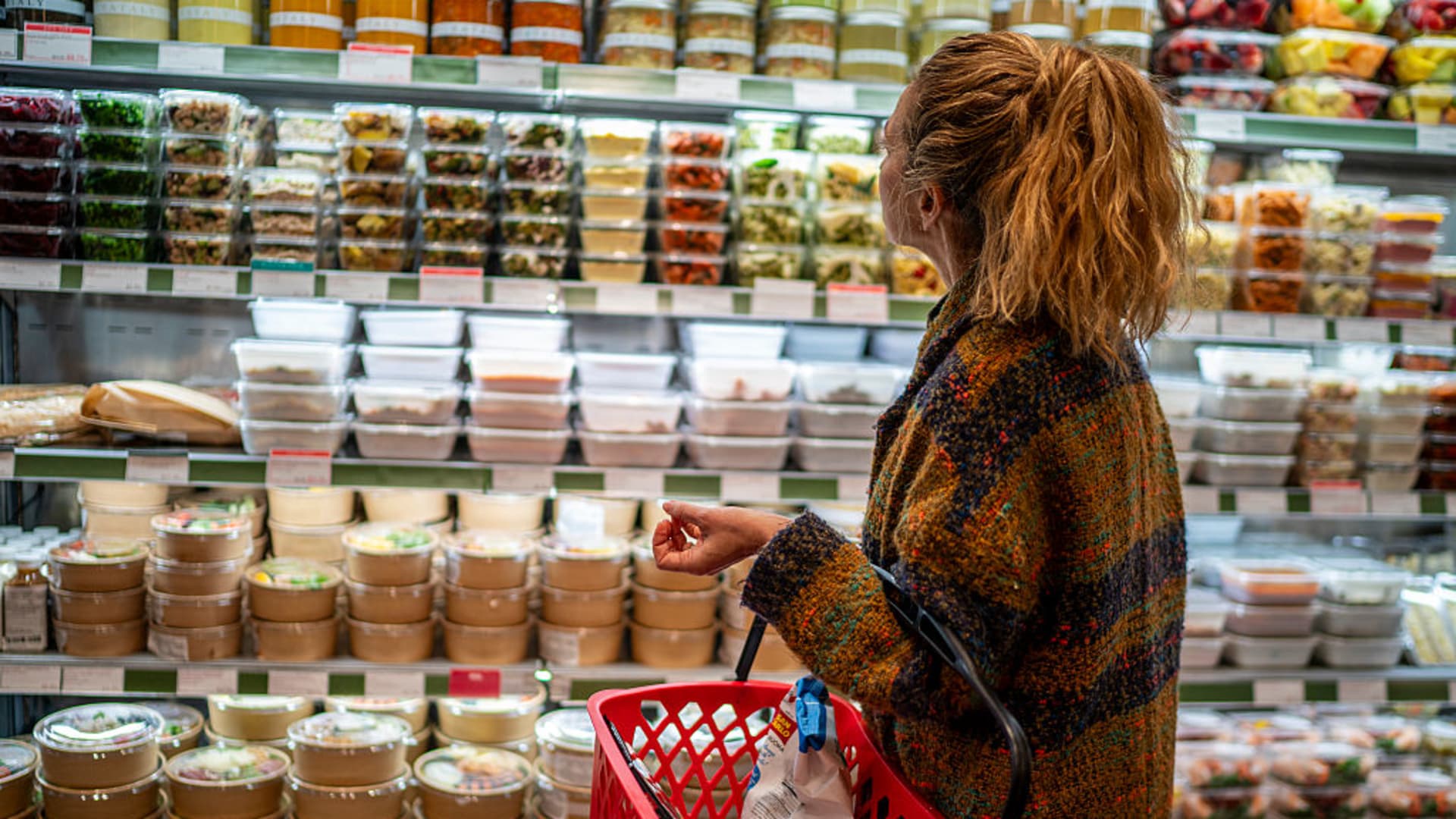
A woman shops for prepared foods at Eataly on March 19, 2026 in Manhattan, New York City.
Robert Nickelsburg Getty Images
Danone’s The CEO told CNBC that inflationary pressures from the Iran war could force the company to consider raising prices, as the outlook for the Middle East conflict remains highly uncertain.
When asked if the company would raise prices, CEO Antoine de Saint-Affric said: “We haven’t raised prices yet.”
“Nobody knows when[the war]will stop,” he told CNBC’s Charlotte Reid. “The outcome from a macroeconomic perspective is going to be very different depending on how the next two to four weeks play out.”
“If it continues for a long time, there will be an impact,” he added.

His comments come as companies increasingly consider how war could affect their operations and cost bases.
The Middle East conflict is entering its sixth week, with US President Donald Trump toughening his stance against Iran over the weekend as he prepares to reopen the Strait of Hormuz.
The president said on Monday that Iran must reopen the strategically important strait, through which a fifth of the world’s oil supplies normally pass, by 8pm ET.
The virtual closure of the narrow corridor has not only led to soaring energy prices, but also fertilizer and transportation costs.
“Higher costs will eventually trickle down as higher prices for commodities, agricultural inputs, energy, packaging and transportation ripple through the supply chain,” ING economist Theis Geijer told CNBC in an email.
He added: “Most economists and businesses were expecting food inflation to slow. It’s clear that won’t happen this year.”
International Monetary Fund President Kristalina Georgieva warned on Monday that even if the conflict were quickly resolved, a war with Iran would inevitably lead to higher inflation and slower economic growth.
Earlier this month, the Food and Drink Federation (FDF) predicted food inflation would be at least 9% by the end of the year, up from its previous forecast of 3.2%. This is the highest annual inflation rate for food and non-alcoholic beverages since 2023.
“Given the rapidly changing situation, the revisions are based on the assumption that the Strait of Hormuz will open to cargo traffic within the next two to three weeks and that most major facilities, such as oil, gas and fertilizer hubs, will return to normal within a year,” FDF said on April 1.
health nutrition shift
While acknowledging the macroeconomic uncertainty and headwinds ahead, de Saint-Afrique remained optimistic about his company’s ability to bounce back amid macroeconomic headwinds.
“This is a time where we need to continue to focus and invest in our brands,” he said.
“People are paying attention, so you’re either relevant or you’re not…Now is the time to continue to focus on what differentiates us, what makes us unique, and what brings value to consumers.”
Danone reported overall prices rose about 2.1% in the fourth quarter, while volume-driven growth was 2.5%. Like many of its peers, the company has been focused on growing volume after years of price hikes as inflation spiked in 2022 as consumers traded in for cheaper brands.
The company is betting it can leverage a healthy brand to maintain its presence, as food brands also face increased competition from cheaper private labels that offer higher margins to grocers. In March, the company announced it would acquire protein shake maker Huel for an undisclosed amount to optimize its position in the fast-growing nutrition space.
Retailers have also warned that they have only a limited time to absorb the increased costs before passing them on to customers.
British retailer Next said late last month that it had booked 15 million pounds ($20 million) for additional costs such as fuel and air transport that could arise from the Middle East conflict, assuming the disruption would last three months.
“If we determine that these costs will continue beyond the next three months, we will begin to pass them on through price increases,” Next said.
