


Pakistani Prime Minister Shehbaz Sharif on Tuesday asked President Donald Trump to extend for two weeks his threat to wipe out “the entire civilization” of Iran unless Iran strikes a deal that includes reopening the Strait of Hormuz.
Latest news: President Trump suspends attacks on Iran for two weeks on condition of opening Strait of Hormuz
In his X post, Sharif also called on Iran’s leadership to agree to open the strait for two weeks “as a gesture of goodwill.”
“We also call on all warring parties to observe a two-week ceasefire everywhere so that diplomacy can achieve a decisive end to the war for the sake of long-term peace and stability in the region,” Sharif wrote.
The plea to the nation from the Pakistani leader, who has acted as a mediator between belligerent powers, came hours before President Trump’s deadline (8 p.m. ET) for the country to strike a deal with Iran or face a major attack on civilian infrastructure — something that could be considered a war crime.
On Tuesday morning, Trump dramatically ramped up his threats, warning on Truth Social that if a deal is not reached, “the entire civilization will perish tonight, never to rise again.”
“But now that there is a complete and total regime change, and a different, wiser, less radicalized way of thinking prevails, maybe something revolutionary and wonderful will happen, who knows?” he wrote.
“Tonight we will learn one of the most important moments in the long and complex history of the world.”
Asked for comment on Sharif’s request, White House press secretary Caroline Levitt told CNBC: “The president is aware of this proposal and will respond.”
President Trump’s threat came after U.S. forces attacked military targets on Iran’s main island, Kharg, the night before. oil export A White House official confirmed this to CNBC.
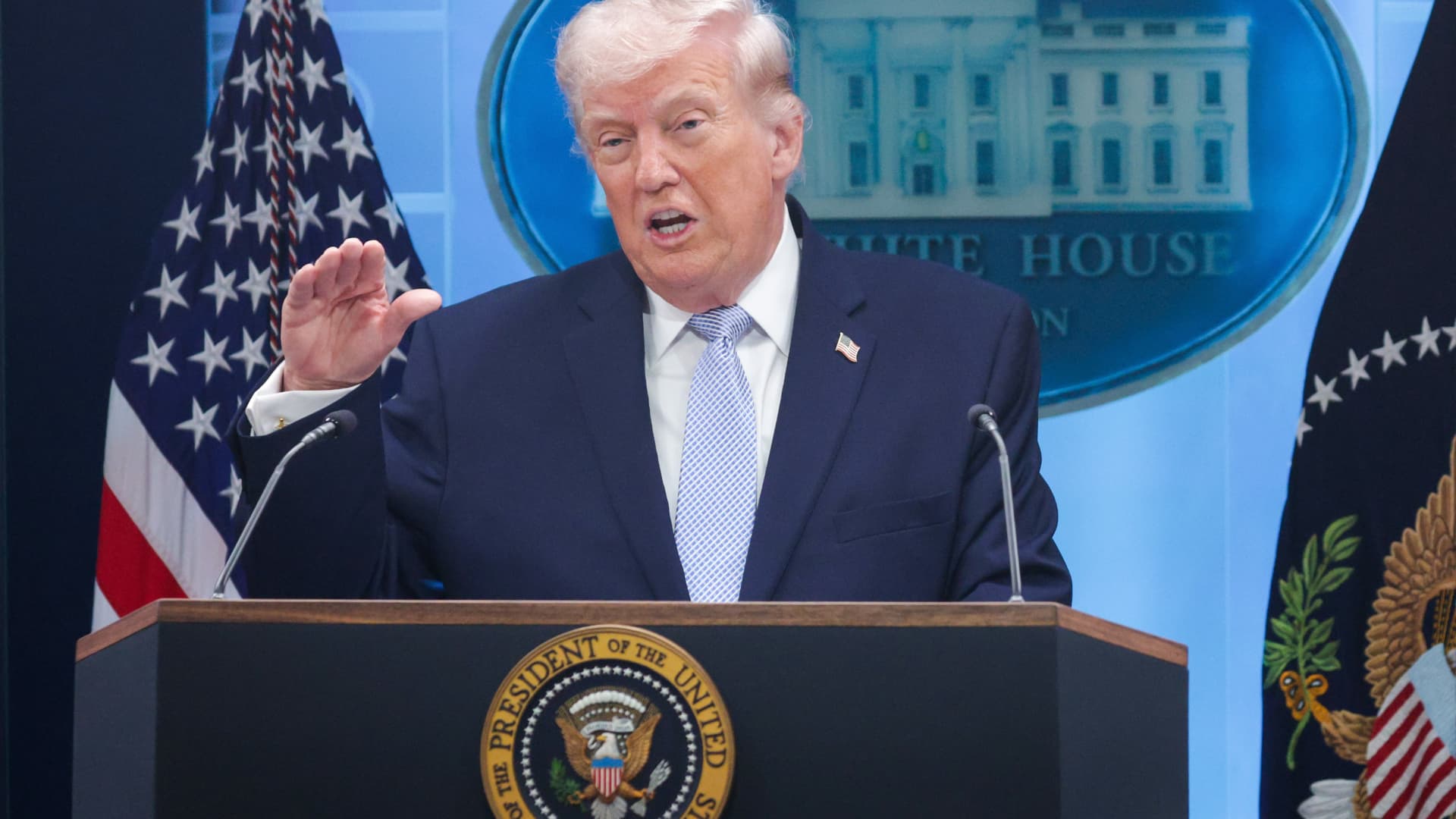
U.S. President Donald Trump speaks during a press conference in the James S. Brady Press Briefing Room at the White House on April 6, 2026 in Washington, DC.
Alex Wong | Getty Images
Since the United States and Israel began war in late February, Iran has blocked most oil shipments through the Strait of Hormuz. The shutdown caused a historic oil supply shock, rapidly increasing global energy prices.
President Trump boasted that Iran’s military had been “destroyed,” but acknowledged that it still controls shipping traffic through the strait and wields significant influence.
In a bellicose social media post on Easter Sunday, he threatened to destroy Iranian bridges and power plants by Tuesday night and called on Iran to “open the strait, you crazy bastard, or you’ll live in hell.”
Negotiation status between the US and Iran
Tuesday’s posts and reports of new U.S. and Israeli attacks on Iranian infrastructure were replaced by contradictory reports about the status of diplomatic efforts between the belligerent powers.
But Sharif wrote in a post on X that “diplomatic efforts towards a peaceful resolution to the ongoing wars in the Middle East are progressing steadily, vigorously and forcefully and could lead to substantial results in the near future.”
The prime minister’s post tagged the official social media profiles of Trump, Vice President J.D. Vance, Secretary of State Marco Rubio, U.S. Special Envoy Steve Witkoff, and senior government officials, including Iran’s president, foreign minister, and speaker of parliament.
Trump’s latest threat immediately prompted a fierce reaction from his political opponents as well as some longtime sympathizers of his MAGA political movement.
“Congress must immediately end this reckless war in Iran before President Donald Trump plunges us into World War III,” House Minority Leader Hakeem Jeffries, a New York Democrat, said on TV. “It’s time for all Republicans to put patriotic duty above party and stop the madness.”
Former Republican congresswoman Marjorie Taylor Greene, a former Trump supporter who left Congress in January after falling out with the president publicly, called for his removal from office under the 25th Amendment.
Since then, many Democratic politicians have joined the call.
Pope Leo XIV also spoke out in front of the papal residence in Castel Gandolfo on Tuesday, appealing to people of good will to “continue to escalate wars, especially those that many say are unjust wars, and are not resolving anything.”
Meanwhile, Britain does not allow the use of American bases as part of operations targeting civilian infrastructure, British news agency I-Paper reported.
A Ministry of Defense spokesperson told CNBC that Britain had given permission to the United States to use British bases for “specific defense operations to deter missile launches into the region by Iran, which are putting British lives at risk.”
“We do not intend to provide detailed commentary on operations involving the use of allied bases,” the spokesperson added.
President Trump has frequently railed about the reluctance of Britain and other North Atlantic Treaty Organization allies to get involved in the Iran war, even as he insists the United States doesn’t need any aid.
Relations between the United States and the alliance came under severe strain earlier this year when President Trump demanded that the United States take control of Greenland, an autonomous region ruled by Denmark, a member of North Atlantic Treaty Organization (NATO).
President Trump’s aggressive stance toward Greenland has subsided, but he suggested on Monday that he remains angry at NATO over Europe’s opposition to seizing the land.
“Greenland, it all started with us wanting to know the truth,” President Trump said Monday at the end of a White House press conference. “We want Greenland. They don’t want to give it to us. And I said, ‘Goodbye, goodbye.'”
President Trump’s terms of Tuesday’s agreement
Trump said at the news conference that for Iran to meet Tuesday’s deadline, it would have to agree to “a deal that I would accept,” and that part of that deal would include a requirement for free flow of oil and everything else.
President Trump has criticized talk of Iran imposing tolls on the strait and has expressed interest in the United States imposing its own tolls instead.
The United States, Iran and regional mediators are reportedly discussing a 45-day cease-fire as a last resort to avoid triggering President Trump’s impending deadline.
However, a White House official told CNBC on Monday morning that President Trump does not support that idea and that Iran explicitly rejects a temporary ceasefire and instead seeks a deal to permanently end the war.
Asked about the proposal, President Trump told reporters at the White House Easter Egg Roll on Monday: “I’m the only one setting up a ceasefire.”
President Trump claimed that he wanted the United States to continue military operations even if it put the Iranian people at risk because they had lived in a “violent and frightening world” under a repressive regime.
“They are willing to suffer to gain freedom,” he said at a press conference on Monday. “There were a lot of interceptions saying, ‘Keep bombing.’ Bombs being dropped near their homes. ‘Keep bombing. Do it.’
But Trump has also argued that Iran’s new regime, which will replace many of the top officials killed by the United States and Israel during the war, will be more rational and less extreme.
Not everyone agrees. JPMorgan research analysts said in a note to clients on Monday that the conflict has empowered the Revolutionary Guards and that Iran’s strategy is based on its ability to outwit rather than overwhelm its opponents.
“Iran may have lost its supreme leader and commander and suffered severe damage to its nuclear facilities and military assets, but there are no signs of surrender,” they wrote.
—CNBC’s Jackson Peck contributed to this report.
