

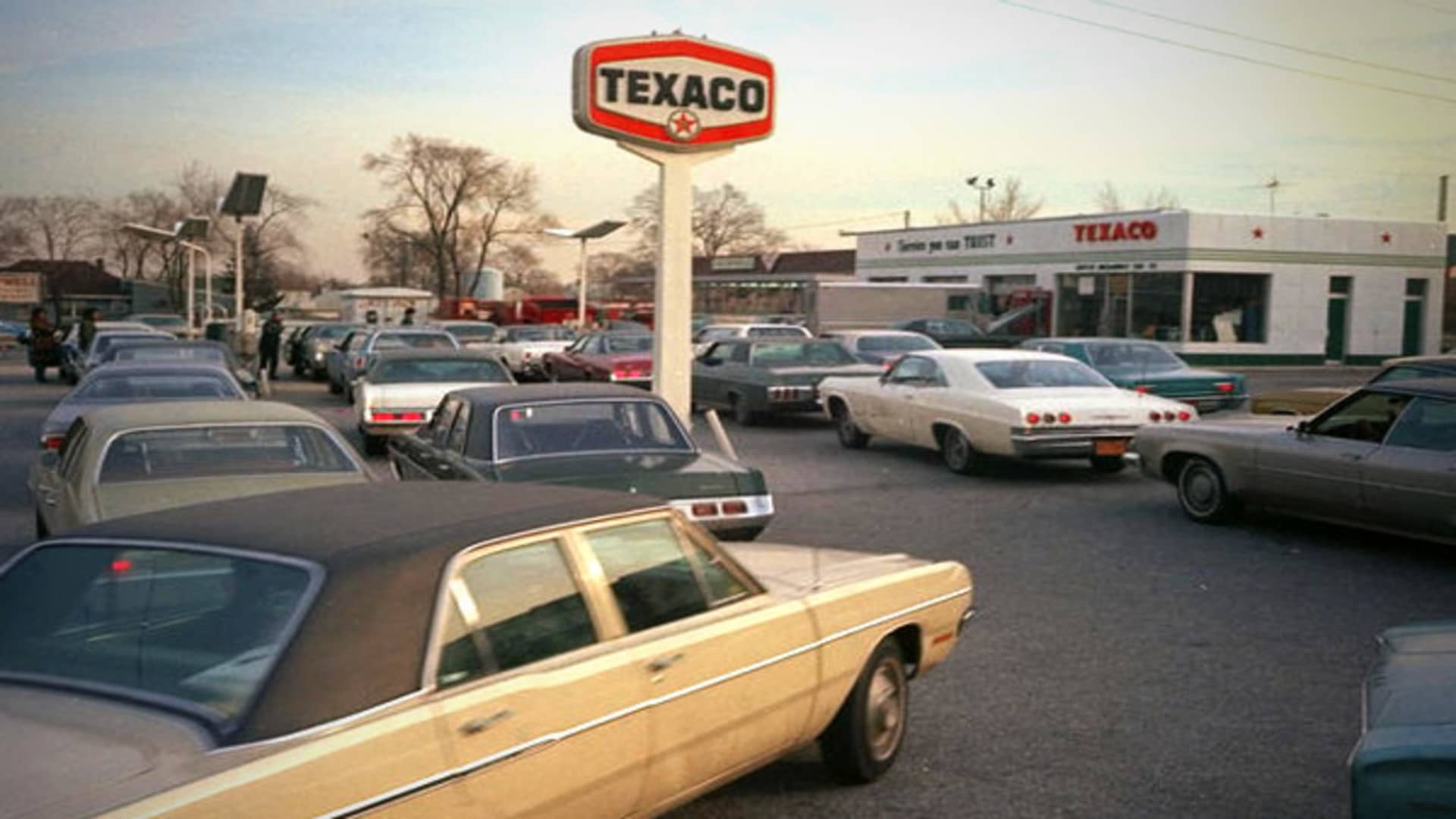
In 1973, OPEC declared an oil embargo on the United States, which decided to supply the Israeli military during the Yom Kippur War. The embargo lasted until March 1974, during which time oil prices quadrupled. To control supply, the federal government under Nixon rationed oil to states up to 1972 levels. By February 1974, the American Automobile Association estimated that 20 percent of gas stations were out of fuel to sell. The second energy crisis in the past decade was in 1979, after the Iranian revolution.
Photo: Associated Press
The U.S. economy has made a surprising recovery recently, confounding forecasters who have been saying the economy would collapse after nearly six years of expansion since the coronavirus hit. So when will the wheels finally come off?
There’s no way to know, says former top White House economist Tyler Goodspeed in a new book that will confound the legion of professional forecasters who regularly predict impending doom.
“Recessions are fundamentally unpredictable,” Goodspeed said in an interview about his book, “Recessions: The Real Reasons Economies Shrink and What to Do About It,” which will be published Tuesday. He served as acting chairman of the White House Council of Economic Advisers during the first Trump administration.
Goodspeed’s thoughts are very relevant to the Iran war, but for now he asks readers to draw their own conclusions about it. Since leaving government, he has worked as ExxonMobil’s chief economist. Given the sensitive nature of the conflict, CNBC agreed not to ask Goodspeed directly about the war.
Nevertheless, energy features prominently in Goodspeed’s analysis of when and why the United States hit an economic wall over the decades. His conversation transcript has been edited for length and clarity.
Q: You say that recessions are unpredictable. What does that mean? There are many people who try to predict.
Tyler Goodspeed: In short, a recession is a shock, a shock that we can neither fully predict nor effectively avoid.
We have tools to predict recessions, like the yield curve. However, when these tools are actually tested on historical records, they produce many false positives and false negatives.
To be honest, I’m still looking at the yield curve to see what’s going on. I don’t believe in astrology, but I still check my horoscope from time to time.
tyler goodspeed
Provided by: Tyler Goodspeed
Q: You are only human. In other words, a recession is a shock. What types of shocks cause recessions?
Goodspeed: There are many types. One is a kind of large aggregate, macroshock, like a pandemic that affects all sectors of the economy more or less equally and simultaneously. There is another category of shocks that directly affect perhaps only one or two sectors, but those sectors are highly correlated with the rest of the economy.
If you look back not just over the last 80 years, but actually over the past three and a half centuries, energy is one of the sectors that has caused or been affected by many shocks that have then permeated throughout the economy. It’s not difficult to understand why. Because energy is put into many other areas, and it is very difficult to find alternatives for fuel, heating, and materials that use petroleum products over a period of 12 or even 24 months.
But it’s more than just energy. The relatively mild recession of 1960 was also the result of a major steel strike at the end of 1959, which led to many inventory shortages in 1960. Consider all the downstream effects of a steel shortage. The US depression of 1927. The main reason for this was that Ford Motor Company halted all production for several months in order to remodel its factories to produce Model A cars instead of Model T cars. Again, given all the connections upstream and downstream of auto production, we shouldn’t be surprised if that, combined with the coal strike in the Carolinas and the boll weevil infestation, led to a recession.
Importantly, energy is not the only cause of shock, but is involved in many of them in interesting ways.
Q: In your book, you write that high energy prices contributed significantly to the deepening of the recession before and after the 2008 financial crisis, even though there were no wars, embargoes, or other major obvious impacts hitting the energy market. what happened?
Goodspeed: To be honest, that was one of the biggest surprises for me. We are all familiar with the standard narrative of the 2008-2009 recession. We forget that the highest price for energy in general, and oil and gasoline in particular, since 1945 was not in 1973 during the Arab oil embargo. This was not 1979, right after the Iranian revolution. It wasn’t 1990, during the first Gulf War. That was in June 2008 (when prices went up) brent crude oil (approximately $150 per barrel).
By the summer of 2008, the average American household was having to spend about $2,000 more annually on energy, goods, and services than just a few years earlier. Now, at the same time, my mortgage payments were increasing, and my mortgage interest payments were increasing by about $800 a year.
Is it an energy price shock or a mortgage shock?
Q: It seems like both. But can we stop the recession? Should we do something like spend on stimulus?
Goodspeed: Despite the rise of stronger and more complex states, the duration and depth of depressions have remained surprisingly constant over time, and statistically no different after 1945 than before. So it doesn’t seem like the state will be able to end the recession.
But there is a wealth of historical evidence that fiscal and monetary policy cuts during recessions can make matters worse. The most obvious example of this would be the Great Depression in the United States and the British Depression in the 1840s, which actually coincided with the Great Irish Famine. The lesson there is to first do no harm.
I feel that the economy as a whole is recovering from the recession, but that doesn’t mean every individual or every household is. There is at least a normative case for providing relief in cases where relief is needed during a recession, and perhaps even enhanced relief relative to regular unemployment insurance.
During periods of economic expansion, there is a tendency to believe that treatments or other methods can calm down the economy to avoid a recession. But the reality is that history keeps happening, and recessions will continue to happen. There has never been an undying economic expansion.
Q: What else do you want people to know about the recession?
Goodspeed: Regardless of what happens over the next year or two, the long-term structural trend is toward long-term expansion. We are getting better at absorbing the kinds of shocks that historically would have caused recessions.
