

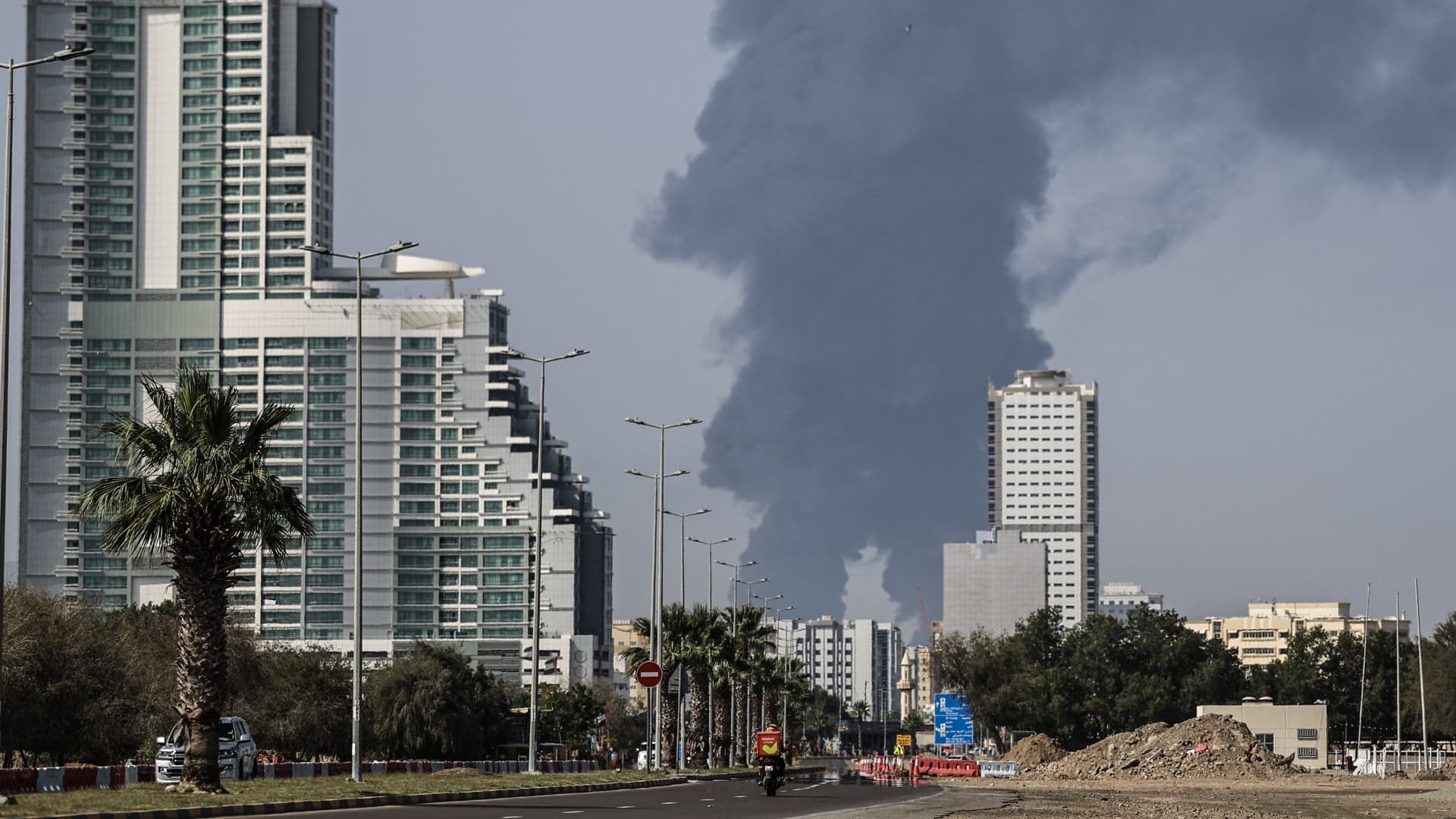
On March 14, 2026, smoke rises from the direction of an energy facility in Fujairah, a Gulf emirate. Smoke was seen rising from the direction of a major energy facility in the UAE on March 14, in what appears to be the latest attack to target oil facilities in the Gulf, hours after the US attacked Iran’s Kharg Island.
– | AFP | Getty Images
As fighting in the Middle East continues for a fifth week, US President Donald Trump said the United States could “take Iran’s oil” and seize Iran’s export hub Kharg Island.
“It’s better to take the oil,” President Trump told the Financial Times on Sunday, comparing it to the U.S. military operation in Venezuela earlier this year, when the United States effectively took control of the Latin American country’s oil industry following the detention of that country’s leader, Nicolas Maduro.
According to Reuters, the Trump administration is considering sending ground troops to Kharg Island, with one administration official warning that such an operation would be “very dangerous.” Tehran has the ability to reach the island with missiles and drones.
In an interview with the FT, President Trump said, “My favorite thing to do is get oil from Iran, but some stupid people back in the United States say, ‘Why would you do that?'” But they are stupid people. ”
“We may or may not take Kharg Island. We have many options,” Trump said. “It would also mean we would have to be there (Kharg Island) for a while.”
The White House and the U.S. State Department did not immediately respond to CNBC’s requests for comment.
President Trump’s comments come as the conflict between the United States, Israel, and Iran expands across the region, increasing risks to energy and infrastructure. crude oil Prices are rising.
May futures prices for Brent crude rose more than 3.2% to $116.12 per barrel in early Asian time, with the international index heading for a record monthly gain. US West Texas Intermediate futures rose 3.4% to $102.96 per barrel.
The Washington Post reported Saturday night that the Pentagon is preparing for a possible weeks-long ground war in Iran, with about 3,500 troops arriving in the region on Friday. Thousands of soldiers from the 82nd Airborne Division have also been ordered to support the war effort.
President Trump said last week that Iranian negotiators were “begging” the U.S. to strike a deal to end the war, but while Iran denies any direct interaction with the U.S., Trump said in an interview with the FT that indirect negotiations between the U.S. and Iran through a “special envoy” in Pakistan were progressing well.
mixed messaging
President Trump told reporters on Air Force One on Sunday night on his way to Joint Base Andrews that the two countries had had “very good talks, both directly and indirectly.”
The United States has sent a 15-point peace plan to Iran, including a complete halt to Iran’s nuclear program and significant limits on the range and size of its missile forces. The Iranian government publicly rejected the offer and offered its own terms.
But President Trump insisted that Iran had agreed to most of the 15 points proposed by the United States for a peace agreement. “They gave us most of the points… They agree with us on the plan,” he said, adding that Iran had allowed up to 20 ships laden with oil to pass through the Strait of Hormuz “as a sign of respect.”
“All I can say is that we’re doing very well in those negotiations. But I don’t know about Iran, because we negotiate with them and then we always have to blow them up,” Trump said.
Asked about the possibility of sending ground troops, Trump said, “There are a lot of alternatives,” adding that the U.S. military’s accomplishments against Iran so far resembled “regime change.”

Seth Krumrich, vice president of Global Guardian and former chief of staff for special operations at Centcom, said the possibility of a U.S. ground operation would likely prompt Iranian forces to escalate attacks on power infrastructure and desalination plants across the Gulf region.
“We’re probably closer to the beginning or middle of this story than the end,” Krumlich told CNBC’s “Squawk Box Asia” on Monday.
Critical infrastructure in the region is already under fire. Kuwait announced in a social media post on Monday morning that Sunday night’s attack damaged a service building at a power generation and desalination plant and killed one worker.
The country said the facility was targeted as part of Iran’s invasion of Kuwait. According to the Ministry of Power, the deceased worker was an Indian national.
Emergency teams were immediately dispatched to limit damage and maintain operations, and authorities worked with security agencies to ensure the safety of the scene. In a statement, officials said Kuwait’s electricity and water systems remain stable and contingency plans have been activated to ensure continued supply.
The Gulf Coast Desalination Plant supplies most of the region’s drinking water, making it critical infrastructure and a sensitive target if things go wrong.
The Houthis, allied with Iran, have also joined the conflict and fired missiles at Israel. “Yemeni forces have carried out their first military operation using a barrage of ballistic missiles targeting important Israeli military installations,” Houthi spokesman Yahya Salih said in a post on X.
—CNBC’s Lee Ying Shan and Azhar Sukri contributed to this report.
