

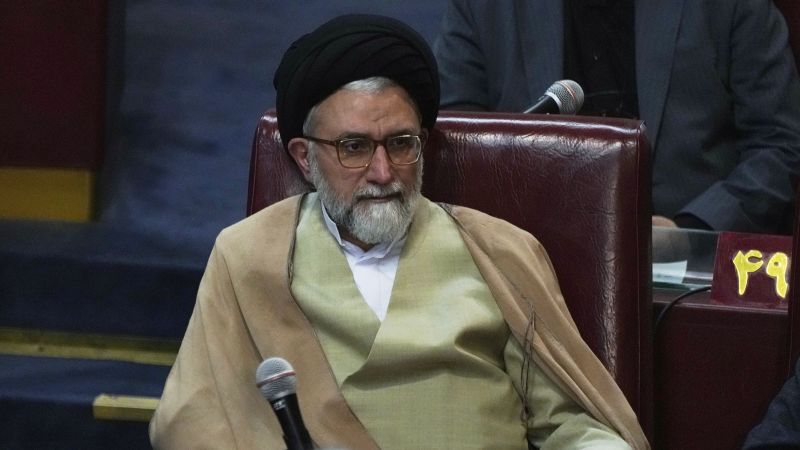
Israel said it killed Iran’s intelligence minister in an attack on Tehran on Tuesday night, a day after killing two other senior Iranian officials in an attack on the capital. The attack demonstrates Israel’s relentless efforts to target power brokers within the regime.
Meanwhile, Iran accused the United States and Israel of attacking some of its oil and gas production facilities, including South Pars, the world’s largest natural gas field. Iran has vowed to retaliate against the attack, which marks a significant escalation of the war.
Here’s what you need to know on day 19.
What are the main headings?

Information Minister Killed: Israel announced on Wednesday that it had killed Iranian Information Minister Esmail Khatib in an attack the night before. Announcing Khatib’s killing (later acknowledged by Iran), Israeli Defense Minister Yisrael Katz said he had authorized the military to kill “any senior Iranian official” if given the opportunity “without further approval.”
Government official killed: Khatib’s killing came after Iran on Tuesday confirmed the death of Ali Larijani, its powerful security chief and Iran’s highest-ranking official killed since the death of Supreme Leader Ali Khamenei on the first day of the war. Israel also killed the head of the Basij militia group feared by Iran. In response, Iran announced “rapid attacks” and “violent” attacks against Israel.
Oil prices soar: Global oil prices soared to $110 per barrel on Wednesday as energy infrastructure strikes across the Middle East rocked markets. Brent crude, the world oil benchmark, rose to $110.90 per barrel, while U.S. crude hit $99.78 per barrel, following reports that Iran had attacked energy infrastructure in Gulf states.
Bombing of gas facilities: U.S. officials deny that U.S. forces attacked Iranian gas fields and say the attacks were carried out by Israel. The denial came after Iranian state media on Wednesday accused the United States and Israel of attacking the world’s largest South Pars natural gas field and other energy facilities, marking a serious escalation.
US attack on Iran: Meanwhile, the US military announced it had dropped a 5,000-pound guided bomb designed to penetrate targets deep underground in Iranian missile bases along the Strait of Hormuz. Analysts said the bombing could be the opening salvo in a three-week campaign to make the waterway, through which a fifth of the world’s oil normally flows, safe again for oil tanker navigation.
U.S. official resigns: Joe Kent, the top U.S. intelligence official appointed by President Trump, announced on Tuesday that he would abruptly resign from his position, citing concerns about the administration’s war with Iran. President Trump said Kent’s resignation was a “good thing” because he was “very weak on national security.” In an interview with Tucker Carlson on Wednesday, he said he feels Israel is drawing the United States into the conflict and broadly influencing U.S. policy in the Middle East. He also said there was “no intelligence” that Iran was ready to launch a “massive surprise attack.”
President Trump dismisses allies: President Trump criticized allies for not cooperating with the war and securing the Strait of Hormuz, and said the United States should reconsider joining NATO. Several U.S. partners have balked at President Trump’s request to send warships to help transport oil through the strait, but a senior United Arab Emirates official said Tuesday they were willing to help.

Gulf states: Energy infrastructure in Persian Gulf states came under attack on Wednesday, with a fire reported at a major facility in Qatar and an air threat intercepted in Saudi Arabia, following a warning from the Iranian Islamic Revolutionary Guards Corps (IRGC). The incident marks a significant escalation in tensions in the region, as critical energy infrastructure becomes increasingly embroiled in conflict.
Baghdad targeted: Early Wednesday morning local time, drone and rocket attacks resumed around the US embassy in Baghdad. Targets on Tuesday included a hotel in Baghdad, a U.S. diplomatic compound near Baghdad International Airport, and an oil field in southern Iraq. Iranian-backed militias have claimed responsibility for some of the attacks, saying they were acting in support of Tehran.
Iran attacks Israel: Israel announced early Wednesday morning that it was intercepting a new missile salvo from Iran. CNN spotted what appeared to be a cluster bomb over central Israel, with impact locations reported in various cities, including Tel Aviv. Two people were killed in central Israel, Israeli emergency officials said.
Nuclear power plant hit: Iran’s Atomic Energy Organization said a “hostile projectile” hit the site of the Bushehr nuclear power plant in southern Iran on Tuesday, but no casualties or damage to facilities along the Persian Gulf were reported. It did not say which country was behind the attack.
Diplomatic tensions: Qatar expelled Iran’s military and security attaché following the attack on the Ras Laffan natural gas processing facility, the backbone of Qatar’s economy.
Sophie Tanno contributed to this report.
