

Havana
—
US President Donald Trump mused on Monday whether he would have the “honor of occupying Cuba” on the same day the island’s communist-run power grid suffered its first nationwide collapse since the US effectively cut off the flow of oil to the country.
“You know, I’ve been hearing about the United States and Cuba all my life, but when will the United States have the honor of occupying Cuba? That would be a great honor,” President Trump said from the Oval Office. “I think we can somehow take hold of Cuba, yes, take hold of Cuba – whether we liberate it or take it away, we can do whatever we want with it.”
Asked whether the U.S. military operation in Cuba would mirror the capture of Nicolas Maduro in Venezuela in January or resemble the U.S.’s ongoing military conflict with Iran, Trump told reporters: “I can’t say that.”
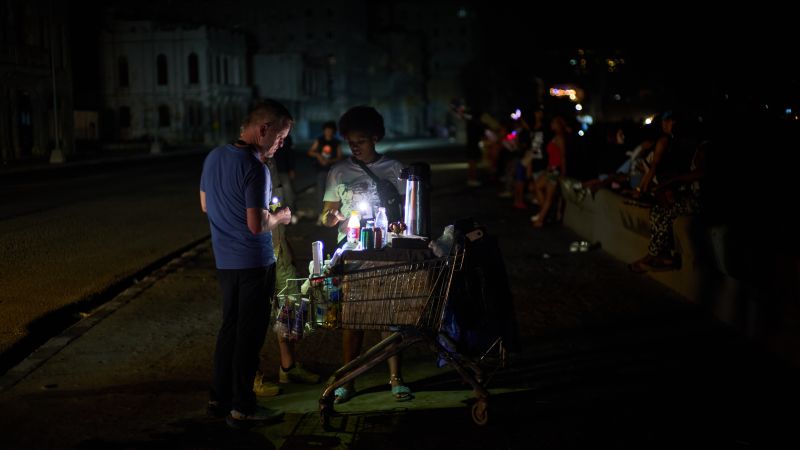
President Trump’s comments came as Cuba is once again plunged into darkness due to a power outage. No faults were detected in the power equipment that was operating when Cuba’s power grid collapsed, the state-run power grid operator announced on Monday, adding that it was working to restore power across the country.

By Tuesday afternoon, power had been restored to about 55% of Havana’s customers and all health centers across the capital. Service was also restored in the western and central-eastern regions of the island after several power plants were reconnected. Still, as is often the case with power outages of this magnitude, recovery has been slow.
In recent years, nationwide power outages have been frequently reported. Cuban officials have previously blamed U.S. economic sanctions, but critics have also blamed a lack of investment in the island’s deteriorating power generation system.
Cuba is a country of approximately 10 million people that relies heavily on oil for power generation. The government’s de facto fuel blockade has worsened the country’s energy crisis, causing more intermittent power outages, rationing of medical supplies and fewer tourists, officials said. Fuel prices are so high that gas can cost as much as $9 a liter on the informal market, meaning it costs more than $300 to fill up a car’s gas tank, more than most Cubans’ annual income.
CNN has reached out to the White House for comment.
“U.S. (government) officials must be very happy that Cuban families have been affected,” Carlos Fernández de Cossio, Cuba’s undersecretary of foreign affairs, said in response to Monday’s power outage.
Miguel, an Airbnb host at a beach resort in Varadero, told CNN that the city is often spared from power outages, but the scale of this outage has affected him.


Dayana Masin, a resident of Havana, told Reuters she was not surprised by the power outages and said civilians should stock up on “wood stoves, solar panels for those who can afford them, water for those who don’t have access to water, and gas for those who have it.”
Musician Lazaro Caron said the power outage would affect his work, but acknowledged: “There’s nothing you can do but face it and keep moving forward. We’ll see what happens.”
On Saturday, residents of the central Cuban city of Moron took to the streets to protest over problems with electricity supply and access to food.
Cuban President Miguel Díaz Canel said on Friday that no oil had been supplied to the island for the past three months. He also said Friday that Cuban officials held talks with the United States to “identify bilateral issues that need to be resolved.”
“The impact[of the lockdown]has been profound, and the cruelest manifestation of that is in these energy issues,” the president said. “This causes suffering to the population.”

Unusual protests triggered by power outage in Cuba
According to a report in a state-run newspaper, anti-government demonstrators attacked a Communist Party office in central Cuba, sparking an unprecedented eruption of public dissent in the wake of power outages exacerbated by the U.S. oil blockade.

In response to the energy crisis, the government announced emergency measures, including shortening school hours, postponing major sporting and cultural events, and reducing transport services.
Many government-run hospitals have cut back on services, and fuel shortages and a lack of operational dump trucks are causing garbage to pile up across neighborhoods.
On nearly every street corner, conversations center around when power outages will occur and for how long. At night in Havana, most of the city is shrouded in near-total darkness, so the stars are often clearly visible.
Fuel sales at government-run gas stations are currently severely restricted. Only tourists, diplomats and Cubans who are given slots using the online system can fill them, usually after waiting for hours.
Doug Madley, director of internet analysis at network monitoring firm Kentic, said recent data shows that internet traffic in Cuba has fallen sharply amid the energy crisis. “According to the latest measurements, traffic in Cuba at this time of day is only one-third of normal,” he told CNN.
Airlines from many countries have canceled flights to Cuba, citing aviation fuel shortages and other security concerns. American Airlines, Delta Air Lines, and JetBlue Airways suspended service to the Caribbean island.
Air Canada, Canada’s largest airline, announced last month that it would suspend flights to Cuba due to a shortage of aviation fuel on the island. The suspension of service is expected to continue until November 1st.
US President Donald Trump said last week that Cuba was in “deep crisis” and that the US may or may not participate in a “friendly takeover” of the island. “The culprit, as they say, is the smoke,” he said.
U.S. Secretary of State Marco Rubio echoed those comments Tuesday, saying Cuba needs new leadership. “They’re in a lot of trouble, but the people in charge don’t know how to fix it, and new people need to be appointed,” he said from the Oval Office.
Asked whether he supported easing the trade embargo against Cuba, Rubio declined to be specific. “Suffice it to say that the embargo is tied to political changes on the island. The law, the embargo, is codified, but the bottom line is that the economy is not working.”

Following a bold American military operation to oust Venezuelan President Nicolás Maduro from power in early January, the United States blocked oil supplies from Venezuela to Cuba.
He then threatened to impose tariffs on other countries exporting oil to Cuba, claiming that Havana posed an “extraordinary threat” by “cooperating with adversarial states and malign actors (and) accepting their military and intelligence capabilities.”
Cuba rejects the claims and called on the United States to ease its pressure campaign.
This story has been updated with additional information.
