

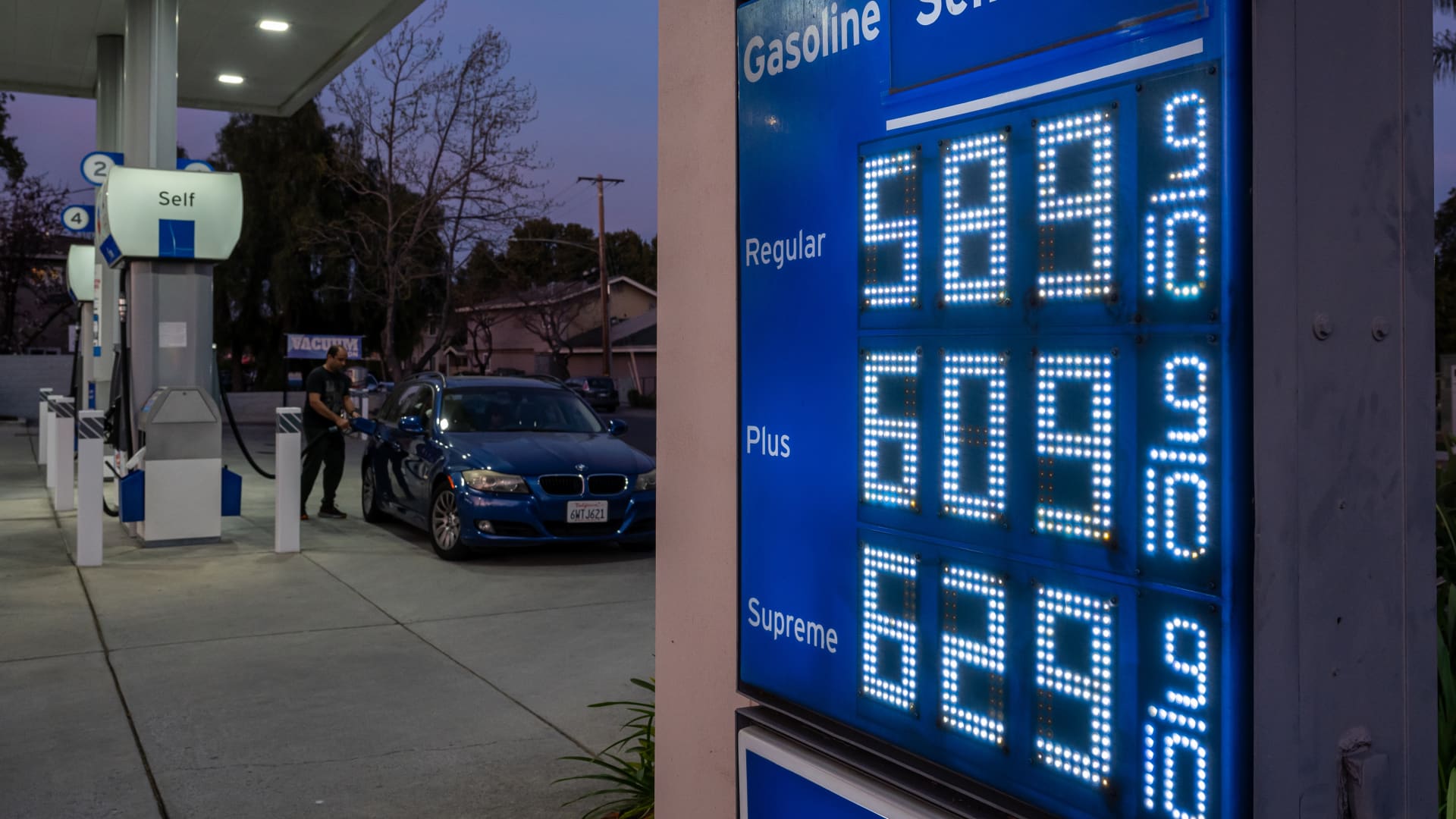
A sign displaying the price of unleaded gasoline at a Chevron gas station in Palo Alto, California, USA, on Tuesday, March 10, 2026.
David Paul Morris | Bloomberg | Getty Images
Economists said the Iran war and the resulting rise in oil and gasoline prices risked worsening the so-called K-shaped economy.
The term, which emerged during the coronavirus pandemic, uses the letter “K” to describe differences in economic experience. In other words, high-income households are doing better and better, forming an upward arm, while low-income households are falling further behind, forming a downward arm.

Economists said oil and gasoline price increases are a tax on household purchasing power and tend to hit low-income earners harder than the wealthy.
Nicholas Bloom, an economics professor at Stanford University, said he worries the momentum is accelerating the K-shape of the economy.
“As an economist, I think inequality is a big concern,” Bloom said Monday during a Harvard Kennedy School webinar on the economic impact of the Iran war.
Oil and gasoline prices soar due to Iran war
A driver refuels a vehicle at a Chevron gas station on Monday, March 2, 2026 in Rodeo, California, USA.
David Paul Morris | Bloomberg | Getty Images
The war effectively halted traffic in the Strait of Hormuz, a critical shipping route for global oil supplies, resulting in the largest oil supply disruption in history.
As a result, the price of crude oil and the price of gasoline refined from crude oil have soared.
Brent crude, the global benchmark for oil, has risen more than 40% since the conflict began on February 28, to around $102 per barrel as of 2pm ET on Tuesday.
The national average gasoline price reached $3.79 per gallon as of Tuesday, up about 87 cents per gallon, or 30%, from a month ago, according to AAA.
The average price of gasoline is higher than at any point since October 2023, according to the U.S. Energy Information Administration.
“This is especially tough for low- and moderate-income households with little or no financial cushion, so if they need to put more of their income into the gas tank, they may have to cut other expenses or pay down credit cards and other debt more slowly,” said Mark Zandi, chief economist at Moody’s.
“Low-income households allocate a higher percentage of their budgets to energy, so higher gas prices act like a regressive tax,” he said.
What is a K-shaped economy?
The concept of wealth and income inequality is not new.
Rising stock markets and rising home values tend to energize the upper classes, who disproportionately own such assets, leaving lower-income households behind.
But the coronavirus pandemic has accelerated these dynamics, giving rise to the concept of a K-shaped economy, as stocks and housing wealth soar and low-income people struggle to recover from high unemployment and rising prices.
Before the United States and Israel attacked Iran, the high cost of living led to widespread poverty, which helped further polarize the nation.
Currently, gasoline prices are also pushing down the lower bound of K.
Michael Klein, an economics professor at Tufts University, said higher oil prices act like a tariff: “a tax on people’s ability to spend.”
In this case, households would pay taxes to oil companies rather than the federal government, he said during a webinar on the economic impact of the Iran war.
Klein said when households spend more of their income on gasoline, they have less income to buy other goods and services. He said such changes in consumption could have a negative impact on the U.S. economy, since consumer spending makes up a large portion of gross domestic product (GDP).
Oil prices affect food, travel and other sectors
Travelers arrive at William P. Hobby Airport on Monday, March 9, 2026 in Houston, Texas, USA.
Mark Felix | Bloomberg | Getty Images
Experts say changes in oil prices will have a ripple effect, pushing up prices in other areas of the economy.
For example, U.S. diesel prices on Tuesday rose above $5 a gallon for the first time since 2022, when Russia’s invasion of Ukraine disrupted global energy markets. Economists say this could lead to higher trucking costs, for example, and higher prices for food and other goods and services.
As of March 13, global prices for jet fuel, a key cost component for airlines, had risen about 83% in the past month, according to data from the International Air Transport Association.
“Higher fuel costs and downstream effects on shipping, travel and trade are likely to put further pressure on consumer prices,” said Stephen Cates, a certified financial planner and financial analyst at Bankrate.
Companies often pass on at least some of their costs to consumers.
