

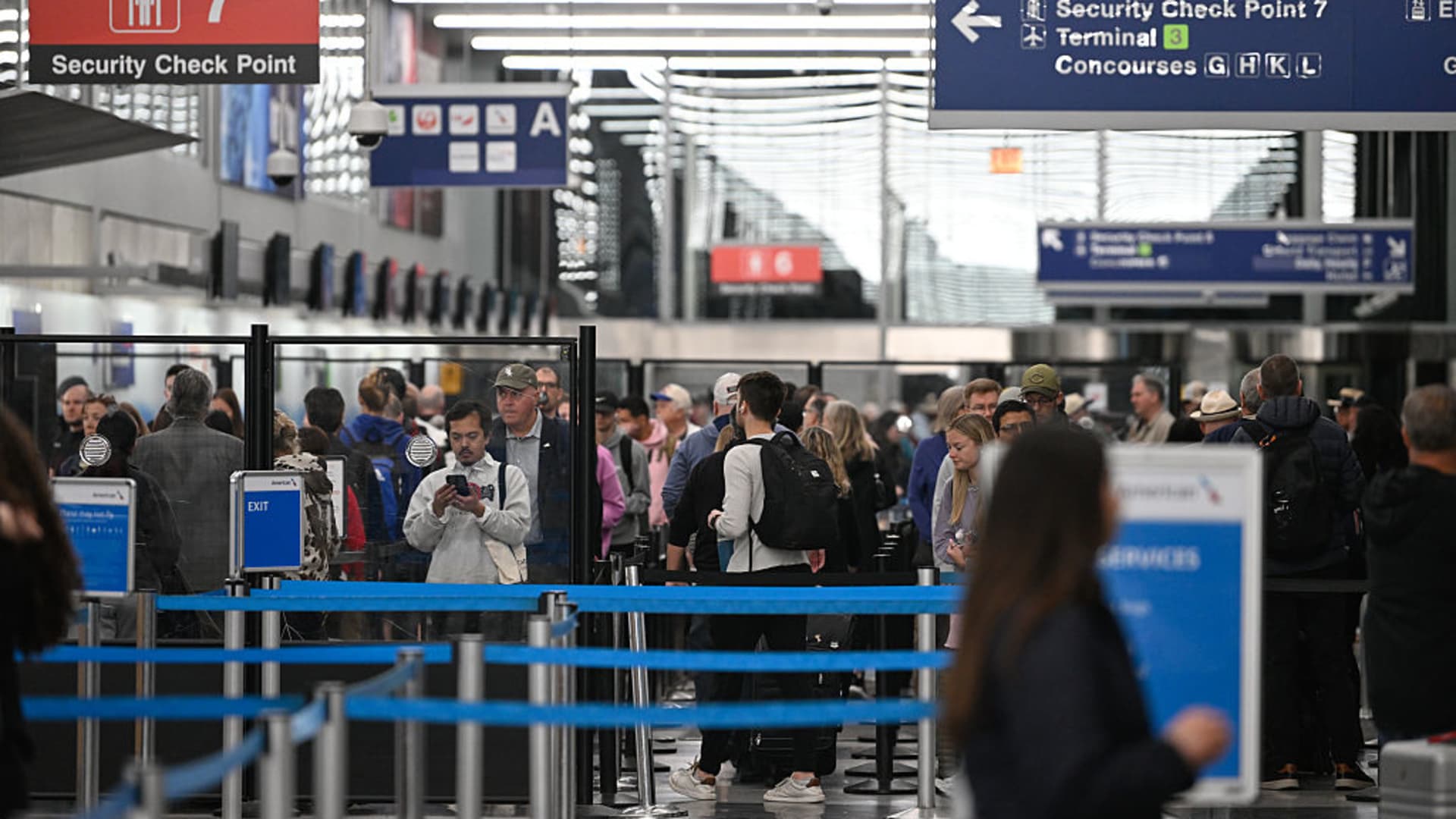
People wait in long TSA lines at O’Hare and other airports in Chicago, Illinois, on March 9, 2026, as the partial government shutdown continues for weeks.
Peter Zai/ | Anadolu | Getty Images
The first three months of this year have brought significant disruption to travellers.
Since early 2026, the Iran war, cartel violence in Mexico, U.S. military operations in Venezuela, and severe snowstorms on the East Coast have totaled tens of thousands of flights and disrupted many Americans’ travel plans.
There’s always a certain amount of unpredictability when it comes to travel. But travel advisors and other experts say recent events highlight precautions Americans can take to make travel less painful or avoid it, and the financial pain that comes with it.
“When you think about worst-case scenarios, this is the worst-case scenario,” Sofia Markovich, travel advisor and founder of Sofia’s Travel, said of the chaos surrounding the U.S. and Israeli attack on Iran.
But travelers can learn something from this situation, she and other travel advisors said.
A traveler checks flight status on an arrival and departure board at the airport in Krakow, Poland, March 5, 2026.
Marcin Golba | Null Photo | Getty Images
Increased travel volatility appears likely to continue in the near to medium term, advisers said.
For example, it is unclear how long the war in Iran will last and how intense the operations will be. President Donald Trump has also threatened military action in Cuba and earlier this year expressed interest in taking control of Greenland. The continued closure of the Department of Homeland Security may result in additional delays and bottlenecks at airport security checkpoints.
“We need to be prepared because we don’t know where (disruption) is going to come from,” said Amalia Lazarov, a travel advisor at Travelious, which specializes in Middle East travel.
“Probably more will happen,” Lazarov said. “But we are ready to deal with any situation.”

Here are some ways travelers can most effectively protect themselves, according to travel experts.
Many of their tips add cost to your travel itinerary. But for those who can afford it, they say the act is often worth the higher price tag for the peace of mind it brings.
Direct flight instead of connecting flight
An Emirates airliner lands at Frankfurt Airport, Germany, on March 3, 2026.
Andreas Lenz | Getty Images
A Google Flights analysis released in September found that travelers can save an average of about 22% on their ticket price by booking a flight with a connecting flight instead of a direct flight to their destination.
However, most travel experts recommend flying direct if possible.
Because if a traveler’s first flight is delayed, they may miss their second flight. And if something goes wrong with your second flight, you could be temporarily stranded in a random city.
“My motto has always been direct flights,” Markovic said. “Avoid connections like the plague.
“If you can avoid being connected, it’s worth paying extra over connecting,” she says.
For example, Markovich often takes a 2.5-hour drive from Birmingham, Alabama, and flies direct from Atlanta (a major transportation hub with relatively many nonstop flights), rather than making a multi-leg journey by plane from a local airport.
This is not to say that direct flights are without problems. Markovic said airlines could also cancel these if there were significant disruptions. But they reduce the overall risk of delays, she said.
Experts say some people may not have a choice, depending on their departure airport and destination.

Markovic said if you need to make a connection, make sure you allow enough time for your connection. For example, for international flights, she recommends a layover of at least 3 to 4 hours so you have plenty of time in case something goes wrong.
Additionally, make sure there are multiple flights operating from your connecting airport to your final destination, Markovic said. This could allow travelers to find a new flight to their destination the same day if something goes wrong with their itinerary, she said.
refundable tickets
Travelers wait in line at a Transportation Security Administration checkpoint at William P. Hobby Airport in Houston, Texas, on March 9, 2026.
Mark Felix | Bloomberg | Getty Images
Travel advisors recommend considering refundable tickets instead of non-refundable fares amid heightened uncertainty.
“It’s best not to book basic economy flights or non-changeable tickets,” Margie Hand, a travel advisor at Andabo Travel, wrote in an email.
Refundable tickets generally cost much more, but offer more flexibility than non-refundable tickets, experts say.
For example, if a traveler who purchased a basic economy fare wants to cancel a flight, they typically only get a partial credit for future travel on that airline, according to The Points Guy. Travelers who purchased a refundable fare typically have the option to cancel and receive a full refund back to their original method of payment.
However, even if the fare is refundable, there may be some caveats. For example, according to Kayak, some airlines may charge a fee for refunds, while others may give travelers a short period of time to request a refund.
TSA officers work at the security checkpoint at Ronald Reagan International Airport in Arlington, Virginia, on March 15, 2026.
Aaron Schwartz | Reuters
One possible workaround: Passengers who use points to buy tickets often don’t need to book a more expensive fare class to get a refund, said NerdWallet travel expert Sally French. In such cases, it may be easier to have points re-deposited into the traveler’s account rather than getting a cash refund, but such policies vary by airline, French said.
According to federal law, regardless of fare type, travelers are entitled to cancel their flight within 24 hours of purchase and receive a full refund if the ticket was purchased at least one week before departure. This is the case, for example, if the airline cancels the flight and the passenger chooses not to accept an alternative flight or other compensation from the airline.
Experts say hotels and properties available on sites like AirBnb typically have different refund policies that travelers should evaluate.
“Refundable (air) tickets always help,” Lazarov said. “I recommend it in difficult times.”
In some cases, purchasing a refundable ticket can be cheaper than purchasing travel insurance and may be worth it if the majority of a traveler’s costs come from airfare, she said.
travel insurance
A mobile phone screen displays the status of a canceled Emirates flight and a computer screen displays the website for the canceled flight in Krakow, Poland, March 3, 2026. Global air travel is facing disruption following military attacks on Iran by the United States and Israel. Emirates, like other airlines, has suspended thousands of flights due to the total closure of airspace over Iran, Iraq and Jordan, as well as restricted areas across the UAE.
Marcin Golba | Null Photo | Getty Images
Hand said the “easiest and most obvious” way for travelers to protect themselves financially is to buy travel insurance. Travel insurance can reimburse policyholders for non-refundable travel expenses other than airline tickets, such as hotels and tours.
However, most travel insurance policies do not cover acts of war for policyholders, Hand said.

Hand and other travel experts recommend considering insurance that allows you to cancel for any reason. These policies are often much more expensive, but give travelers more flexibility to cancel their trip and get their money back from their insurance company, they said.
However, these policies also have some limitations.
For example, policyholders must purchase insurance immediately after making a deposit and cancel at least 1-2 days before the trip begins to receive coverage.
Rebooking and buffer days
A pilot walks past a Delta Air Lines plane as flights are delayed and canceled due to a severe winter storm at Ronald Reagan Washington National Airport in Arlington, Virginia, on January 26, 2026.
Saul Loeb | AFP | Getty Images
Airlines often automatically rebook passengers on another flight if they cancel a passenger’s original fare.
But the option airlines choose for passengers may not be the earliest departure option, Markovic said. She recommends checking your airline’s app or calling your airline as soon as possible to find a more optimal flight.
“They might put you on a flight two days later, but there might be seats available earlier,” she said.
Passengers who absolutely can’t make it on time for their trip, such as a cruise, group tour or wedding, should also consider building a buffer day into their itinerary so they can arrive well in advance of an important event despite delays or disruptions, Hand said.
