

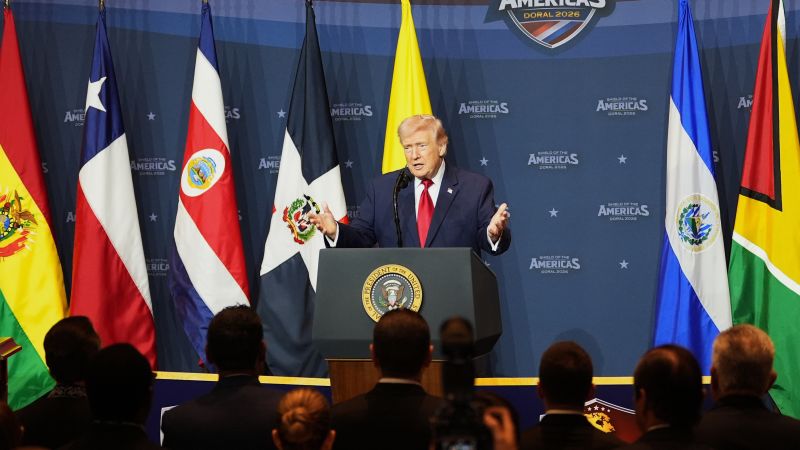
On Wednesday, days after President Trump took to the stage at an event in Florida to warn about “hostile foreign influence” in Latin America, the Chinese embassy in the United States briefly shared an AI-generated video that poked fun at President Donald Trump’s Shield of the Americas summit.
The video was released by the Chinese embassy on the
The 18-second animation depicts a bald eagle in a suit presiding over a gathering of white pigeons, believed to represent Latin American countries.
When the eagle presses a red button, he first detonates an atomic bomb, then promises to “keep everyone safe” with a large red, white, and blue shield. However, the shield soon turns into a cage to trap the frightened pigeons. On the other hand, the eagle said, “Relax. Sometimes safety requires a little control.”
By early Friday morning, the video had disappeared from the embassy’s X account.
CNN has reached out to the U.S. State Department for comment on the video and is awaiting a response.
The video, released days after a meeting that brought together right-wing and center-right leaders from 12 Latin American countries, appears to cast doubt on a proposal put forward by President Trump during the summit to create a “regional military coalition.”
Although the summit was presented primarily as a security initiative, President Trump also used the opportunity to warn about China’s growing presence in the region, as part of his administration’s broader plan to reaffirm America’s “superiority” over the Western Hemisphere.
“We deny our non-hemispheric competitors the ability to station military forces or other threatening capabilities in our hemisphere, or to possess or control assets of strategic importance,” the administration declared in November 2025, unraveling the “Trump corollary” of the centuries-old Monroe Doctrine.
But while James Monroe ordered Europe to stay away from the Americas, Trump is intent on getting rid of China. President Trump falsely claimed in his 2025 inaugural address that China “operates” the Panama Canal.
In fact, the Hong Kong-based company owned two major terminals at each end of the canal at the time. Last month, Panama’s High Court ruled the deal illegal, and the Chinese government called the decision “truly shameful and pathetic.”
Despite the ruling, President Trump continues to raise the issue in public. At the summit, the president said the United States “will not allow hostile foreign influences to gain a foothold in this hemisphere, including the Panama Canal.”
For decades, Beijing has expanded its commercial, financial and infrastructure ties in the region.
In recent years, China has become one of Latin American countries’ major trading partners, financing large-scale strategic projects.
One of the latest examples is Peru’s Chancay Port, which opened in 2024 with the support of Chinese shipping giant COSCO Shipping, which will significantly reduce maritime transport times between South America and Asia.
Trade growth also reflects this close relationship. According to the General Administration of Customs, China’s exports to Latin America increased by 9.3% from January to November 2025 compared to the same period in 2024.
Countries politically close to Washington also maintain strong economic ties with China. In Argentina, for example, imports from China rose 57.1% year-on-year to more than US$16 billion in 2025, even though President Javier Millay is considered one of Trump’s staunchest allies in the region.
