

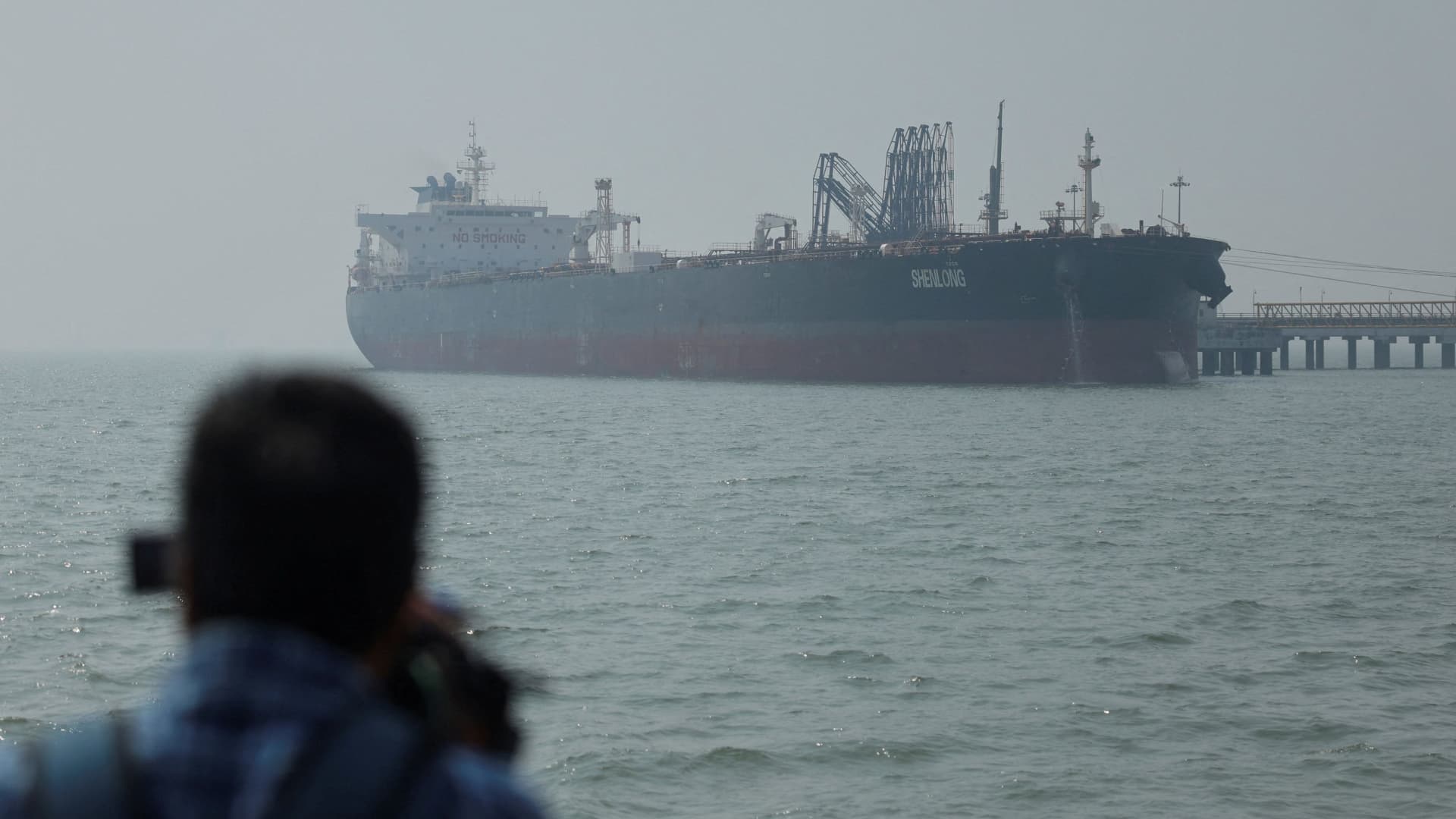
On March 12, 2026 in Muscat, Oman, the tanker Kalisto is anchored in Port Sultan Qaboos as traffic is backed up in the Strait of Hormuz amid the conflict between the US, Israel and Iran.
Benoît Tessier | Reuters
Brent crude oil, the world benchmark, hovered near $100 on Friday morning as the war between the United States and Iran heads into its third week.
brent futures As of 7:49 a.m. ET, the price was down 1.13% at $99.32 a barrel. The U.S. closed above $100 on Thursday. West Texas Intermediate Crude Oil Futures It fell 2.07% to $93.75 per barrel.

crude oil price
Oil prices rose for another week, with Brent futures up more than 9%. This follows last week’s 27.9% rise and was the biggest weekly increase in oil prices since the 2020 coronavirus pandemic. WTI futures, which had their best week since 1983 last week, are expected to end the week 5.8% higher.
Traders continue to monitor developments in the Middle East, with the war between the United States and Israel with Iran soon to extend into three weeks. President Donald Trump signaled overnight that an end to the conflict was not imminent.
“We have unparalleled firepower, unlimited ammunition and plenty of time,” he said, calling on supporters on Friday to “wait and see what happens” with the Iranian regime.
On Friday morning, Axios reported that President Trump claimed in a phone call with G7 leaders earlier this week that Iran was “on the verge of surrender.” The next day, Iran’s new supreme leader Mojtaba Khamenei vowed to continue fighting in a message broadcast on state television.
This week, a number of foreign ships have been hit with munitions in or near the Strait of Hormuz, a key oil shipping route that has been blocked amid the escalating conflict. The attack raised concerns that a prolonged war could lead to a global economic shock.
“Be prepared for oil prices to reach $200 per barrel, because oil prices depend on regional security and destabilize regional security,” Ebrahim Zolfakari, spokesman for Iran’s military command, said on Wednesday, according to Reuters.
Oil prices are still rising even after the International Energy Agency agreed to release a record 400 million barrels of oil from emergency stockpiles and the White House moved to temporarily lift certain sanctions on Russian exports.
Barclays’ Emmanuel Cau said in a note Friday morning that investors who had initially priced in a short-term conflict were becoming increasingly nervous.
“Global stock prices have not fallen as much as in past oil shocks because investors still believe in President Trump’s put,” they said. “However, tensions are rising by the day, and the longer the Strait of Hormuz remains closed, the more stagflationary the market will become. Keep an eye on central banks as they prepare for a hawkish rate reset next week.”
Amjad Buseis, CEO of British oil producer Enquest, appeared on CNBC’s “Squawk Box Europe” on Friday and said the oil market “has never seen anything of this scale before.”
“Every day we’re seeing delays and another 20 million barrels[off the market]that’s going to have an impact and it’s going to continue to have an impact,” he said.
“I think this is probably going to be a longer and more difficult crisis than before. We’ll probably have to look out for the bad more than the good.”
Buseis pointed out that the last time global oil supplies were similarly reduced was the Arab embargo in the 1970s.
“Prices have since quadrupled, I think prices here have gone up 50%, and I think this is going to be for quite a long time,” he told CNBC.
