

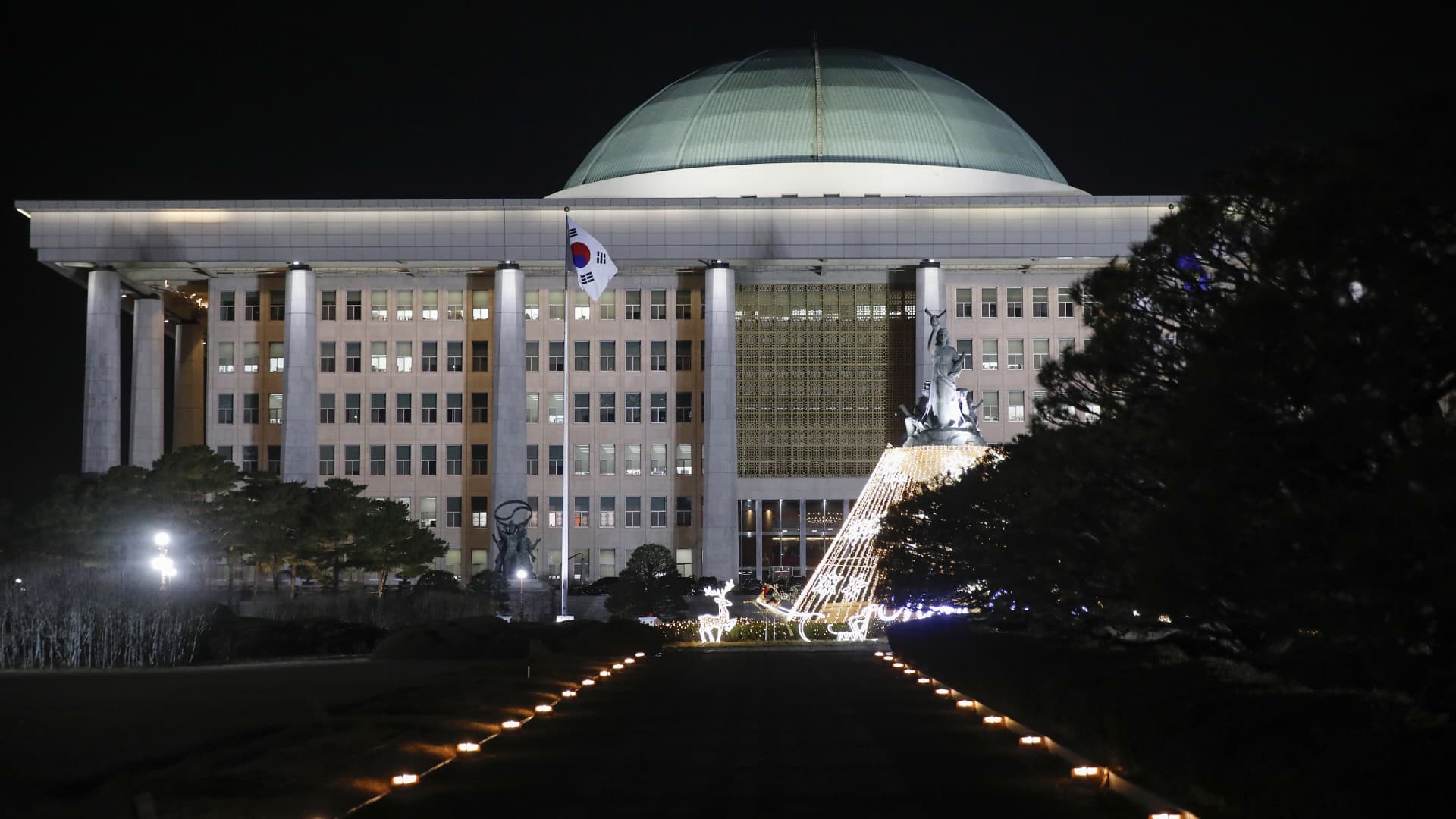
SEOUL, SOUTH KOREA – DECEMBER 14: The National Assembly building is seen on the night after the impeachment of South Korean President Yoon Seok-yeol on December 14, 2024 in Seoul, South Korea. (Photo provided by Woohae Cho/Getty Images)
Cho Woo Hye | Getty Images News | Getty Images
South Korea’s parliament on Thursday passed a special bill to establish a state-run investment corporation to manage the South Korean government’s planned $350 billion investment in the United States.
According to South Korean media outlet Yonhap News, the new corporation will specialize in implementing investment packages and will be fully funded by the government.
Passage of the bill means that in exchange for more favorable “reciprocal” tariff rates, South Korea will have the legal framework it needs to fulfill its investment commitments with the US government.
The investment will consist of $150 billion for shipbuilding and $200 billion for projects in strategic areas, with an annual cap of $20 billion.
The move comes after US President Donald Trump threatened in January to raise tariffs on Asia’s fourth-largest economy to 25% from the 15% agreed to under the Korea-US trade deal in July 2025.
In a post on Truth Social, President Trump said, “The South Korean Congress is not implementing its agreement with the United States.”
Last month, the U.S. Supreme Court struck down most of Trump’s tariffs and urged him to impose new 10% tariffs under Section 122.
Industry Minister Kim Jung-hwan was reported to have said in February, “Although the ruling has increased uncertainty regarding exports to the United States, the overall export conditions secured through the Korea-US Customs Agreement will remain largely unchanged.”
South Korea’s parliament passed a special bill following Washington’s recent trade sweep in the form of Section 301 investigations into 16 trading partners, including South Korea, potentially paving the way for President Trump to replace the rescinded tariffs.
Section 301 allows the United States to impose tariffs on imports from economies found to have unfair trade practices.
