

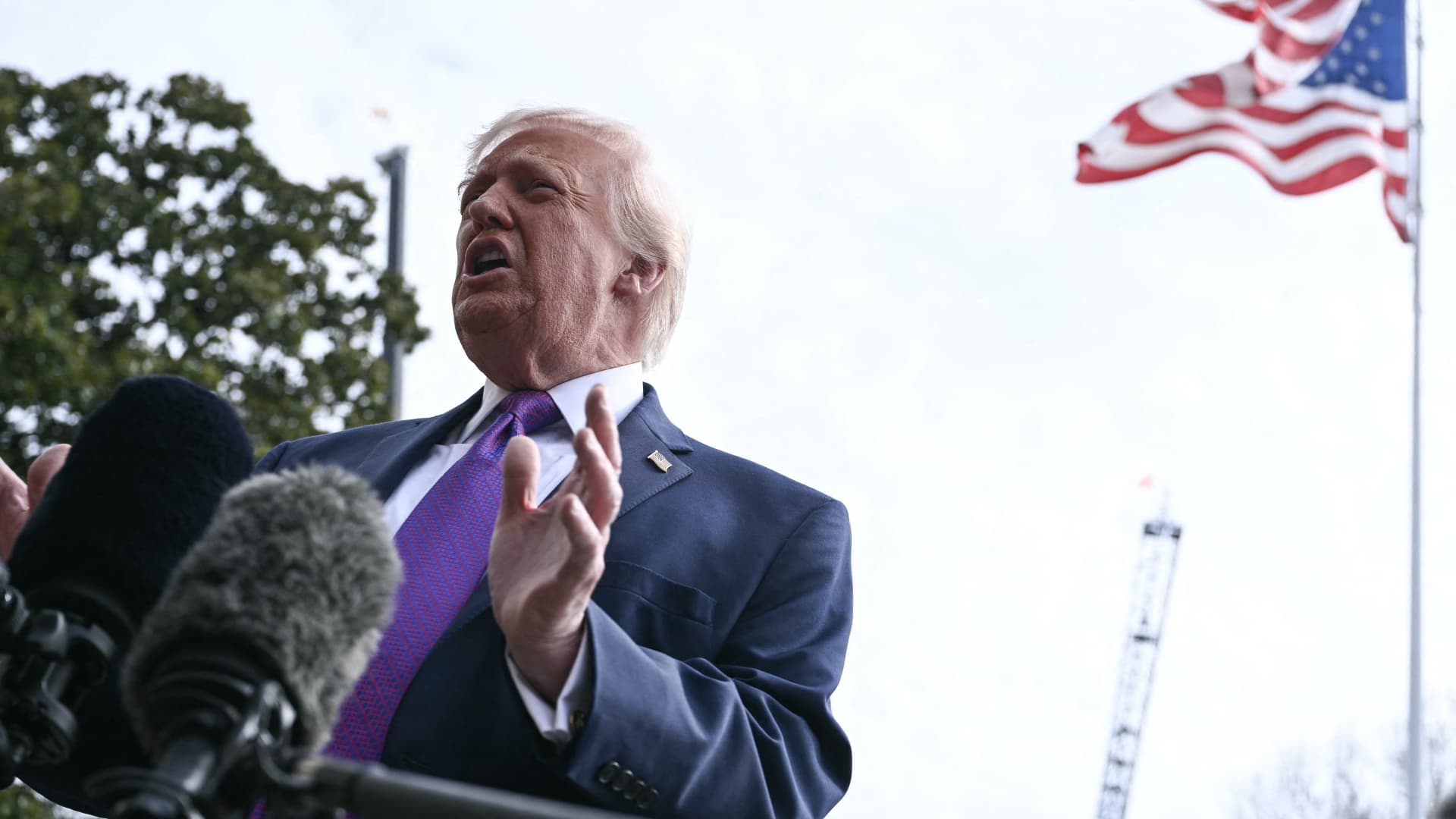
U.S. President Donald Trump speaks to reporters before boarding Marine One as it departs from the South Lawn of the White House on March 11, 2026 in Washington, DC.
Brendan Smialowski AFP | Getty Images
The Trump administration on Wednesday announced new trade investigations into China, Mexico, the European Union and more than a dozen other countries, aimed at replacing President Donald Trump’s reciprocal tariffs that were recently ruled illegal by the Supreme Court.
U.S. Trade Representative Jamison Greer told reporters in a phone call that the investigation will likely expand to more countries and will be conducted under Section 301 of the Trade Act of 1974.
The law allows the United States to impose tariffs on imports from other countries found to be involved in unfair trade practices.
Section 301 tariffs could replace at least some of the reciprocal tariffs President Trump imposed on most countries around the world last year without Congressional approval.
“The president’s trade policy remains unchanged,” Greer said.
“We will protect American jobs and ensure fair trade with our trading partners,” he said.
Greer said the Section 301 investigation “will target specific economic laws, policies, and practices related to structural overcapacity and production in the manufacturing sector.”
“We hope this investigation will uncover a variety of unfair trade practices related to overcapacity and overcapacity in the manufacturing industry,” he said. “In our view, major trading partners still have production capacity that is not tied to market incentives from domestic and global demand.”
That led to a large and persistent trade surplus, he said.
In addition to Mexico, China, and the EU, the countries surveyed include Japan, India, Taiwan, Vietnam, South Korea, Singapore, Switzerland, Norway, Indonesia, Malaysia, Cambodia, Bangladesh, and Thailand.
“We expect that other Section 301 investigations will be conducted on a country-specific basis, or perhaps other tools and investigations may emerge,” Greer said. “I won’t go into too much detail.”
Under Section 301, the Office of the Trade Representative would receive written comments on the investigation and hold a public hearing. “We will also consult with the trading partners that are the subject of this investigation,” Greer said.
“After all of this is done, the USTR will obtain the findings and analysis and recommend actions as appropriate,” he said. “Responsive measures can take many forms. It could be tariffs, it could be service charges, it could be other things.”
In a 6-3 decision on February 20, the Supreme Court said it did not have the authority to impose such a duty under the International Emergency Economic Powers Act (IEEPA), which Trump had argued.
Within hours of that decision, President Trump signed an executive order imposing a new 10% “universal tariff” under Section 122 of the Trade Act. Section 122 tariffs expire within 150 days.
Treasury Secretary Scott Bessent predicted in an interview with CNBC last week that U.S. tariffs would return to pre-Supreme Court ruling levels by August.
Bessent said the Office of the U.S. Trade Representative and the Department of Commerce will complete trade-related investigations that could lead to additional tariffs in the coming months.
“I strongly believe that tariff rates will return to their original rates within five months. The response from the authorities has been very thorough,” Bessent said.
“They have survived over 4,000 legal challenges. They are moving slower, but they are stronger,” he said.
