

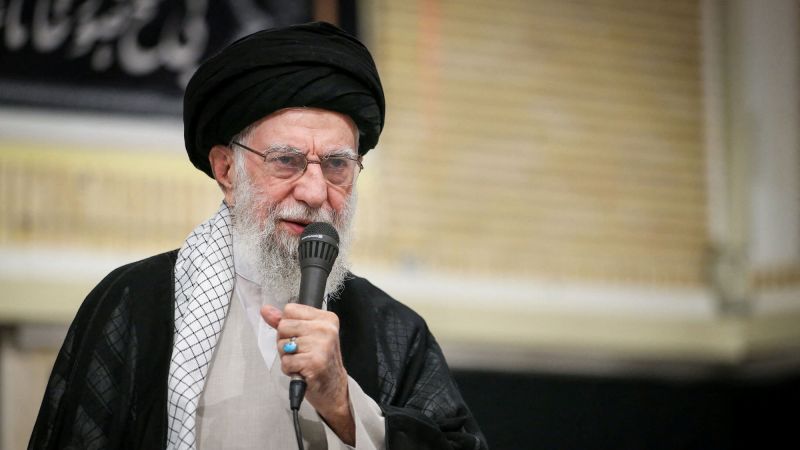
According to US President Donald Trump and two Israeli officials, Supreme Leader Ayatollah Khamenei, who ruled Iran for about 40 years, has been killed.
Israel has not shared evidence about Khamenei’s death, and Iran’s Foreign Ministry spokesperson earlier insisted that both Khamenei, 86, and the Iranian president were “safe.”
However, Khamenei has not been seen in public or on video since Israel and the US attacked Iran with a barrage of airstrikes on Saturday morning.
President Trump announced the death on his platform Truth Social, calling Khamenei “one of the most evil figures in history.” Israeli intelligence sources concluded early Saturday that Khamenei and other senior Iranian officials were killed.
The news appeared to have the potential to plunge the Islamic Republic into its most serious crisis since its founding.
Cheers and celebrations erupted in parts of Tehran on Saturday night following news of Khamenei’s death.
Here’s what we know:
Shortly after the US and Israel launched a joint attack on Iran on Saturday, Israeli sources told CNN that the airstrikes targeted Iran’s top leadership, including Ayatollah Khamenei.
Airbus satellite images showed black smoke billowing from the supreme leader’s residence in the capital Tehran. Images appear to show that several buildings on the site were severely damaged by the strike.

President Trump called the news of Khamenei’s death “the Iranian people’s greatest chance to reclaim their homeland.”
When President Trump announced the joint U.S.-Israeli attack, he said one of its goals was regime change and called on Iranians to rise up against the government once the operation was over. But it is unclear whether such a change will be brought about by Khamenei’s death, which experts say is likely to usher in hardline rule by the Islamic Revolutionary Guard Corps.
Reports of Khamenei’s death come at a time when Iran is perhaps at its weakest since taking power in 1989. The country was already isolated and economically battered by decades of Western sanctions, but U.S. and Israeli airstrikes in June 2025 dealt a severe blow to his rule.
Just six months later, protests that began over economic grievances quickly turned political, spreading to all 31 states within weeks. The regime responded with a brutal crackdown that killed thousands of demonstrators and sparked a global outcry that included threats of intervention by the Trump administration.
The intervention took place on Saturday, with President Trump saying the U.S. military was conducting “a large-scale, ongoing operation to prevent this very evil, extremist dictatorship from threatening the core national security interests of the United States and our country.”

He also called on Iranians to “take over your government,” adding: “We have a president who will give you what you want, so let’s see how you react.”
According to Iran’s constitution, the Assembly of Experts is tasked with appointing a new supreme leader. Pending his appointment, an interim three-member council consisting of the president, the attorney general and a jurist from the country’s Guardian Council is tasked with carrying out the leadership’s duties, according to the Middle East Institute.
Who could lead Iran next remains a mystery, even to those who removed him. US Secretary of State Marco Rubio said in January that “no one knows” who would succeed Khamenei if he is removed from office.
“I don’t think anyone has an easy answer to what happens next in Iran if the Supreme Leader and the regime collapse,” he said.
Khamenei became the focus of many demonstrators’ anger during large-scale protests in January. Videos from some protests showed crowds chanting “Death to Khamenei” in direct defiance of his authority, while others called for his resignation. The regime used unprecedented levels of violence, and authorities branded the demonstrations a continuation of an Israeli-American conspiracy against the Islamic Republic.
The protests were the largest since 2022, when 22-year-old Mahsa Amini died in religious police custody. These protests were also suppressed with lethal force.
In footage obtained by CNN from a witness in Tehran on Saturday, when news of Khamenei’s death broke, two women’s voices can be heard chanting “Death to the Islamic Republic” and “Long live the Shah” in Farsi, before cheers and whistles rang out.
In a similar video, cheers can be heard echoing through the city’s residential areas.
Khamenei’s death could trigger the biggest change in regional dynamics since the Hamas-led attack on Israel on October 7, 2023. Israeli Prime Minister Benjamin Netanyahu then launched a sweeping campaign to eliminate opponents of his country across the Middle East, including Iran and its regional proxies.
This is the second time in less than a century that the United States has acted to remove an Iranian leader from power. In 1953, Mohammad Mosaddegh, a secular, democratically elected prime minister, was overthrown in an Iranian military coup supported by the CIA and British intelligence after nationalizing the country’s oil industry. The event restored Shah Mohammad Reza Pahlavi to the throne and played a central role in the Islamic Republic’s anti-American narrative after the monarch’s abdication in the 1979 Islamic Revolution. Khamenei regularly cites it as a symbol of US imperialism and a reason for his distrust of the West.
Iran is home to a diverse population of over 90 million people, including Persians, Azerbaijanis, Arabs, Balochs, and Kurds. Under Khamenei’s decades-long rule, the Islamic Republic has largely succeeded in containing civil unrest and ethnic unrest.

But with no clear successor, his death would raise serious concerns about the stability of not just Iran but the wider region, with potential implications for the global economy.

