

islamabad
—
Afghanistan and Pakistan are at war again, exchanging deadly artillery and mortar fire across their rugged border, with Islamabad’s defense minister saying the country’s patience has “reached its limits” and declaring “war” against its Taliban-controlled neighbor.
It is the latest flare-up in a sporadic conflict that pits Pakistan’s well-funded and powerful nuclear-armed military against tough Afghan Taliban fighters with decades of combat experience, including victories over American and NATO forces in 2021 after years of insurgency.
Here’s what we know about recent violence that threatens to exacerbate instability in the region.
Late Thursday night, Taliban forces launched attacks on Pakistani positions along part of the porous and disputed border, which stretches 2,600 miles through rugged mountains and desert.
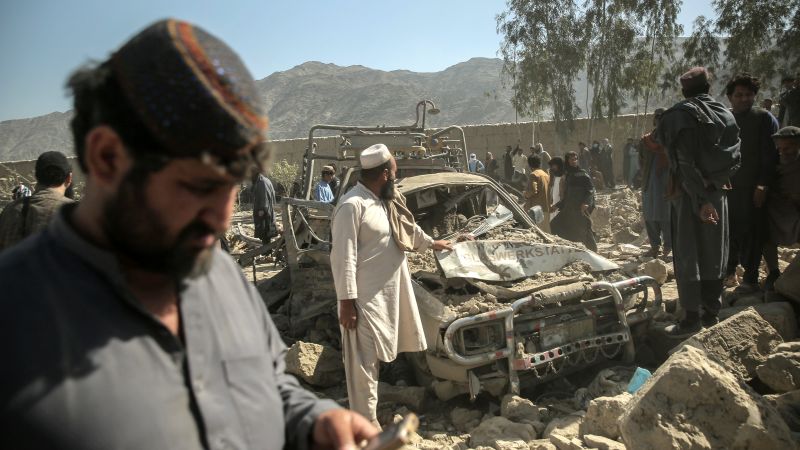
The Kabul government said the attacks were in retaliation for Pakistan’s bombing of an alleged militant camp in Afghanistan over the weekend, killing at least 18 people.
In response, Pakistan launched Ghazab Lil Haq, or “Operation Righteous Fury,” early Friday morning.

Pakistani airstrikes hit Kabul in southeastern Paktia and Kandahar, the Taliban’s spiritual birthplace. Kandahar is believed to be the base of Taliban secret leader Hibatullah Akhundzada.
Pakistan said the airstrikes early Friday targeted Taliban defenses in Afghanistan, marking a significant escalation in its retaliatory strategy.
A Kabul resident described the moment her family woke up Friday to the sound of a loud explosion.
“It was scary,” said the woman, who CNN is not naming for safety reasons.
“Then I heard gunshots. I looked out my apartment window and saw flames like bullets rising into the sky,” she said, adding that she was still awake at 5 a.m. because she couldn’t sleep because she was worried about what would happen next.
“Since the first explosion, most of the lights in surrounding houses and apartments have remained on,” the woman said. “I think everyone in Kabul is sitting in fear that a bomb will hit them.”
Muhammad Ullah, a resident of Pakistan’s northwestern Baizai district, said he heard “a series of explosions” on Thursday night, which continued into the morning.

Both countries have reported different casualty numbers for Friday’s attack. Pakistan claimed its forces had killed 133 Afghan Taliban fighters, but Afghanistan said eight soldiers were killed. CNN has been unable to verify reports from remote areas where fighting is taking place.
Mortar shells fired by the Afghan Taliban hit a house in northwestern Pakistan’s Bajar district, injuring five people, including two children and a woman, police officer Fazal Akbar announced.
yes. Although the two countries share close economic and cultural ties, they have a complicated history.
Last October, the two countries fought their bloodiest conflict in years, but a fragile ceasefire has been in place ever since.
After the Afghan Taliban were ousted from power by NATO forces in 2001 for harboring the perpetrators of the September 11 attacks, Pakistan became one of their major backers.
The fighters fled across the border into Pakistan and supported the subsequent U.S.-backed insurgency against the Afghan government. This war was the longest in U.S. history.
But since the Taliban ultimately won the war following a chaotic US withdrawal and return to power in Kabul, Pakistan has faced a surge in Islamist violence.
Islamabad blames Pakistani Taliban militants for much of the violence and accuses Kabul of giving them refuge within its territory.

Many of these attacks were carried out using US weapons left behind during the chaotic withdrawal, CNN reported. The Afghan Taliban denies accepting a Pakistani with the same name.
More than 1,200 people, including military and civilians, were killed in militant attacks across the country in 2025, according to data shared with CNN by Pakistan’s military. This is double the number recorded in 2021, when the US withdrew from Kabul and the Afghan Taliban returned to power.
Many Afghan Taliban figures still have property and family members in Pakistan, the country’s Defense Minister Khawaja Asif told CNN in November. Asked by CNN if the current surge in violence defines a counterattack, he said: “Yes, I think so.”
Asif took to social media early Friday to accuse Afghanistan of “exporting terror” by recruiting “all terrorists from around the world” while depriving its own people of human rights.
“Our patience has run out,” Asif wrote to X. “Now, an all-out war has begun between us and you.”
According to the International Institute for Strategic Studies’ (IISS) Military Balance 2025, the disparity between the Pakistani and Afghan forces is stark in terms of numbers.
The military remains Pakistan’s most powerful institution and has consolidated its control throughout the country’s history through coups and constitutional reforms.
As a nuclear-armed state, Pakistan commands a sophisticated defense apparatus consisting of an army, navy, air force, and marines. These branches have a total of about 660,000 active-duty soldiers, reinforced by nearly 300,000 militia and gendarmerie troops, according to the IISS.

Their traditional forces have been augmented by a modern arsenal that includes U.S.-made F-16 fighters, French Mirage jets, and JF-17s co-produced with China, Islamabad’s main defense partner.
In contrast, Afghanistan has a unique unified force in the form of the Taliban.
The Taliban’s military, estimated at less than 200,000 personnel, lacks a functional air force and relies instead on a handful of aging Soviet-era attack helicopters, transport planes abandoned during the U.S. withdrawal, and even quadcopter drones.
Although they do not have the heavy weapons of their neighbors, their guerrilla tactics are a defining feature of their military identity, reinforced by their ideological rigidity, religious zeal, and decades of asymmetric warfare.
Previous flare-ups have subsided after days of fighting and mediation by foreign governments including Saudi Arabia and Türkiye.
Analysts fear further escalation could further exacerbate instability.
Abdul Basit, a senior associate fellow at the S. Rajaratnam School of International Relations, said “dangerous times lie ahead.”
“Any retaliation by the Afghans will reach into Pakistan’s urban centers…This is a recipe for chaos, and it is chaos that terrorist networks seek to thrive on.”
“Drones are a poor man’s air force. The Taliban in Afghanistan have drones, we have suicide bombers. They are innovative,” he said.

“Pakistan has made clear that it will act again if the Afghan Taliban do not take action against TTP leaders and fighters in Afghan territory,” said Samina Ahmed, Crisis Group’s senior project director for South Asia and senior advisor for Asia.
“Islamabad and Kabul should resume negotiations as soon as possible with the mediation of trusted partners such as Turkiye, Qatar and Saudi Arabia.”
