

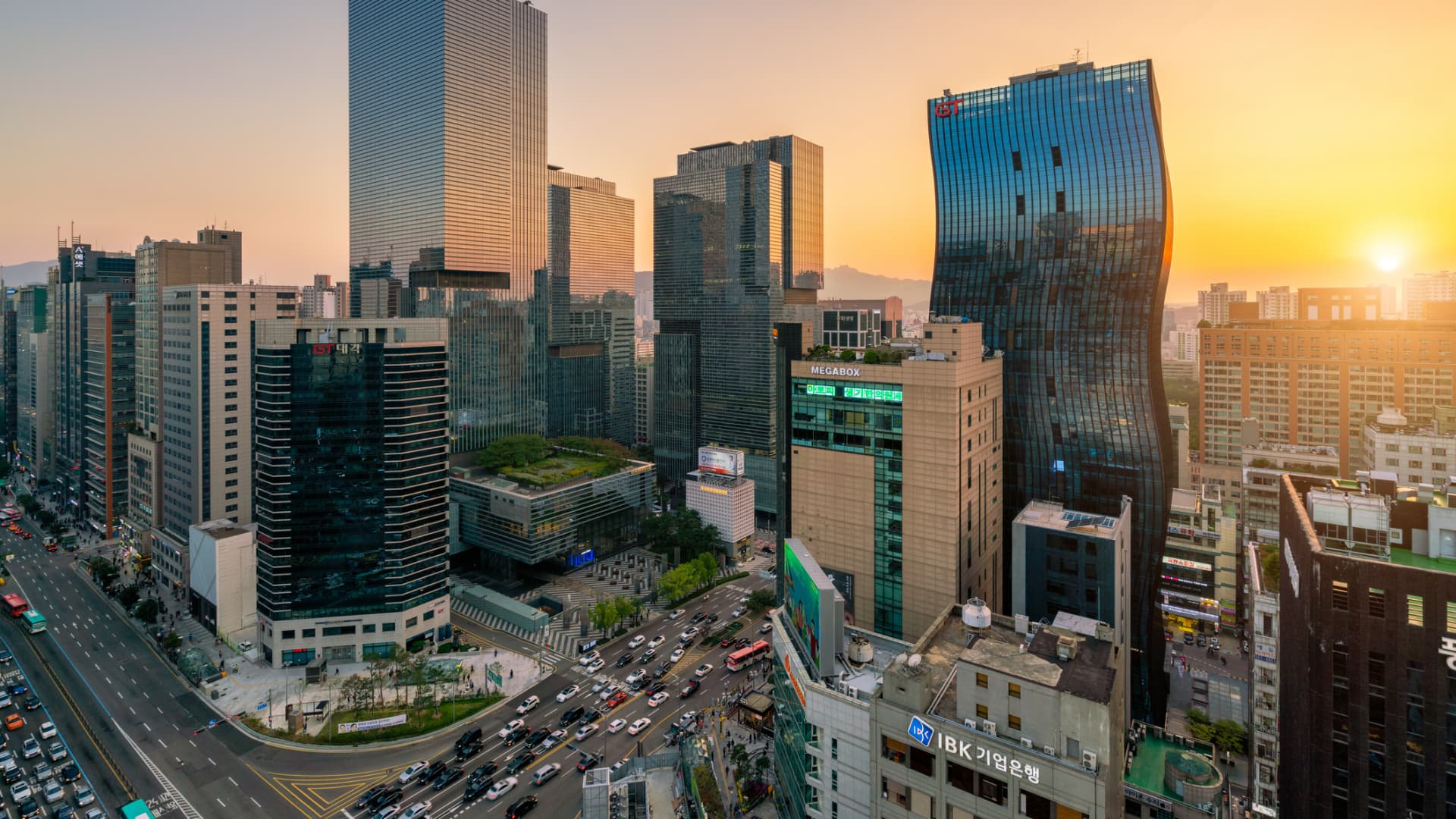
Sunset landscape of light trails passing through an intersection in Seoul Gangnam central business district in Seoul city, South Korea
Mongkol Joo Won | Moment | Getty Images
Asia-Pacific markets traded mixed on Monday amid tariff uncertainty after US President Donald Trump announced over the weekend that he would raise global tariffs from 10% to 15%.
The move comes in the wake of a U.S. Supreme Court ruling invalidating a wide range of presidential trade policies established under the International Emergency Economic Powers Act of 1977 (IEEPA).
However, U.S. trading partners are not immune, said Claudio Galimberti, chief economist at Rystad Energy.
“While the Supreme Court’s decision invalidates most existing tariffs and weakens our ability to target individual countries, it does not dismantle the broader tariff framework,” he said in a note after the announcement.
Galimberti added that if the tariff cap is reached without prior exemption from IEEPA, average tax rates could rise even more than under the system just struck down by the Supreme Court.
Korean Kospi rallied for three consecutive sessions to a new all-time high, then pared its gains to close at 5,846.
The small-cap Kosdaq fell 0.17% to close at 1,151.99.
australian S&P/ASX 200 It decreased by 0.61% to 9,026.
hong kong Hang Seng Index It jumped over 2%.
Markets in China and Japan were closed for public holidays.
Bitcoin fell more than 3% to below $65,000 after US President Donald Trump announced plans to raise global tariffs to 15%.
“The Bitcoin decline appears to be more of a classic risk sentiment reset than a crypto-specific shock,” said Christopher Hamilton, head of client investment solutions for Asia Pacific ex-Japan.
“Bitcoin is becoming increasingly sensitive to global liquidity conditions. When markets reprice growth, inflation, or policy risk, as we are currently seeing with tariffs, Bitcoin often acts as a high-beta expression of risk rather than a defensive asset.”
Oil prices finally fell, erasing earlier gains. international benchmark brent Crude oil futures fell 0.6% to $71.33 per barrel. west texas intermediate Futures fell 0.78% to $65.96.
“The Supreme Court’s decision is a setback…but it’s not the end of his policy agenda,” said Arthur Laffer Jr., president of Laffer Tengler Investments.
Laffer said countries like Vietnam and India that have trade deals with the United States should think twice before withdrawing from them, arguing that trade remains a central pillar of President Trump’s political and economic strategy and that the president is likely to continue pursuing the issue.
U.S. stocks rose on Friday after a Supreme Court ruling that could provide relief to companies burdened by higher costs from tariffs and ease fears of persistent inflation still plaguing the U.S. economy.
of S&P500 It rose 0.69% to close at 6,909.51. Nasdaq Composite It rose 0.9% to settle at 22,886.07. of Dow Jones Industrial Average It added 230.81 points (0.47%) and finished at 49,625.97. The 30-stock index recovered from an early drop of 200 points due to disappointing economic data.
—CNBC’s Sean Conlon and Pia Singh contributed to this report.
