

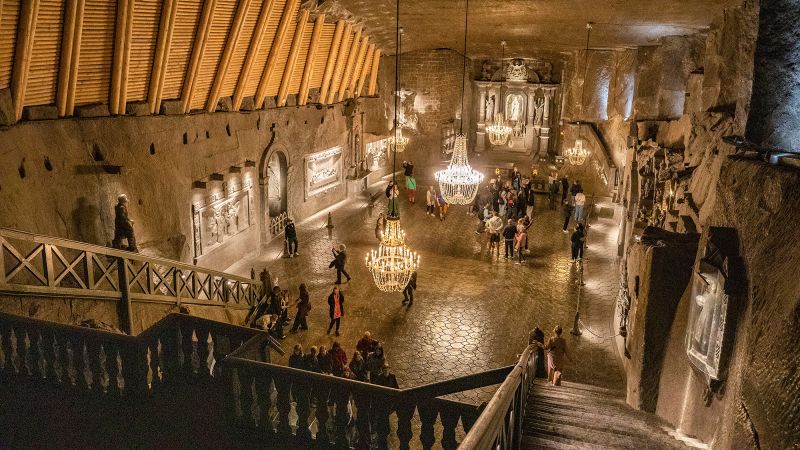
Wieliczka, Poland
—
As you descend the dizzying 380 steps, the walls are an imperfect gray. It looks like a rock, but tastes salty. How will visitors know? You are encouraged to lick it.
Just southeast of Krakow, Poland’s second-largest city, lies the underground world of the Wieliczka Salt Mine, part cathedral, part industrial ruin, and part theme park.
Listed as a UNESCO World Heritage Site in 1978, the mine welcomes up to 9,000 tourists every day. Salt production in Wieliczka ended in 1996. But after 700 years of operation and more than 250 miles of underground tunnels, the mine remains a tourist attraction.
Over the centuries, miners in Wieliczka created nine levels of tunnels and chambers that reach 1,073 feet (approximately 330 meters) below the surface. Currently, about 2% of what they create is available to the public. Even some of them are impressive.
Visitors can walk the classic tourist route (just over 3 miles in about 2 hours) with a guide, or choose the “Miner’s Route.” You’ll be provided with a headlamp, helmet, and emergency carbon monoxide absorbent for the 3-hour adventure.
The tourist route begins by descending the 380 steps or taking the elevator. A maze of passageways leads to preserved chambers carved by hand from the rock. It is now full of statues, sculptures and magnificent chandeliers that allow you to trace the history of the mine and learn about the lives of the people who worked there. The tourist route ends on the third floor underground, 450 feet below ground. The miner’s route passes between depths of 187 feet and 330 feet.
Tour guide Patricia Antoniak explains that the salt wall is not white because the sodium chloride is not pure, and encourages visitors to lick the surface. “That’s not true,” she warned, before letting out a loud “Wow!” for a moment. “A lot of people lick that part.”
“Rocks are 90 to 95 percent salt, or sodium chloride, and impurities give the salt its gray color,” she says. Wieliczka has a mixture of sand, silt and claystone, as well as other minerals. Antoniak added that even though the color is different, it’s still edible. “It was used to preserve food without refining it.”
Halite, the formal name for rock salt, is formed when ancient bodies of water evaporate. Some deposits are hundreds of millions of years old. Wieliczka’s is relatively young, about 13.5 million years old.
Later, tectonic movements in the Carpathian Mountains brought the salt layer closer to the surface, making it easier to find. Wieliczka contains both “stratified” or layered deposits and “massive” deposits, where the most decorative rooms are located. Miners carved them out inch by inch until 1743, when gunpowder was introduced. Mechanical drills followed about 150 years later.
To prevent collapse, miners left a layer of salt in each chamber. Today, the structure has been strengthened with modern engineering techniques, including the insertion of fiberglass rods into the walls.
salt mines and gold mines

Salt has long been an essential part of life here, but excavations began in the late 13th century. Prehistoric communities boiled water from saltwater springs and evaporated it to collect salt, which was traded as currency.
As demand increased, wells were dug, followed by shafts, to access the salt water. It was in one of these shafts that the first rock salt blocks were discovered in the late 1200s.
In the 14th century, the mine became a royal property under the reign of King Casimir III of Poland. Known as the Great King of Kashmir, he recognized the economic power of salt. Revenue from mining accounted for one-third of the state’s revenue during his reign, and the wealth helped finance Poland’s first university. By the end of the 15th century, Wieliczka was producing between 7,000 and 8,000 tons of salt per year.
Although not as dangerous as other forms of mining, life in the mines was harsh. “It wasn’t a bad job, with good air, soft rock, and short working days,” says Antoniak. “Working here was not easy, but it was easier than in other mines.”
Still, the work was difficult. Excavating a single room can take decades, often spanning generations of the same family. Among the most dangerous jobs belonged to the so-called “punishers”, who burned excess methane in the room to prevent explosions.
The environment was even harsher for horses, which were introduced in the 1500s to use powered pulleys to lift salt to the surface. Once underground, the animals never saw daylight again. A horse-drawn carriage still stands in one of the rooms.
During World War II, mines played a darker role. During the Nazi occupation, it was converted into an underground factory producing aircraft parts. Forced laborers, prisoners of the nearby Płaszów concentration camp, including many Hungarian Jews, worked there while forbidden to speak to ordinary miners. The surgery lasted only a few months. It turns out that moisture and salt are not suitable for metalworking.
Although mining has ceased, salt production continues. Water infiltration is dangerous because it dissolves salts and weakens the walls, which are then pumped to the surface. The brine evaporates, leaving behind crystals in a process similar to the production of sea salt. More than 10,000 tons are produced annually.

Wieliczka’s tourism history dates back to the early 18th century. Visitors once attended a fireworks display in the chamber or took a boat ride across the underground saltwater lake. Famous guests came even earlier, including the Polish astronomer Nicolaus Copernicus, who is thought to have inspected the mines in 1493.
“He was the first ‘tourist’ to the mines, not to work, but to see the miners cutting and transporting the salt,” says Antoniak. A salt sculpture of Copernicus was installed in the room in 1973.
A highlight for many visitors is St. Kinga’s Chapel, a vast underground church carved out of a former mining chamber. It is dedicated to Kinga, a 13th century Hungarian princess and patron saint of salt miners.
Legend has it that Kinga asked her father for a dowry of rock salt when she married a Polish duke. After he offered her access to Hungary’s largest salt mine, she threw her engagement ring down the shaft. The ring was later discovered in Poland, said to have been embedded in a block of salt found near Krakow, possibly Wieliczka.
The chapel was completed in 1964 and took 67 years to carve by three miners: József Markovski, Tomasz Markovski and Antoni Virodek. Masses are still held on Sundays and on special occasions such as weddings. A sweeping staircase leads to the room, where scenes from the Bible are carved into the walls, along with a salt rock altar and a chandelier made of salt crystals.

Nowadays, Wieliczka is not only a museum, but also an event venue. Two rooms have wooden floors for galas and private functions. One of them was about 120 feet tall and even hosted bungee jumping and tethered hot air balloon rides.
There is also a spa specialized in respiratory treatments located 450 feet underground. This is an underground version of the modern wellness “salt cave”.
“It’s healthy here. It’s not dusty and hard to breathe like in a coal mine,” says Antoniak. “Salt miners don’t suffer from black lung and live longer than other miners. There are very few bacteria in the air.” Salt’s antiseptic properties and ability to absorb moisture help limit harmful microorganisms.
“The air is saturated with minerals. It is not contaminated with dust or pollen. For example, for people with allergies, it is good to breathe here underground,” she says.
Although it is no longer an active mine, several hundred miners still work in Wieliczka. Maintaining a site takes a lot of effort, Antoniak explains. The biggest threat is water, which can weaken the structure of the cave.
“The job of many miners is to collect water and pump it to the surface.
We need to make sure they are safe so we can let visitors in. So they make sure that the wooden structure still supports the ceiling. ”
More than 380 miners are currently working to protect underground facilities from water damage and preserve the excavation site. He is the administrator of a kingdom carved from salt.
