

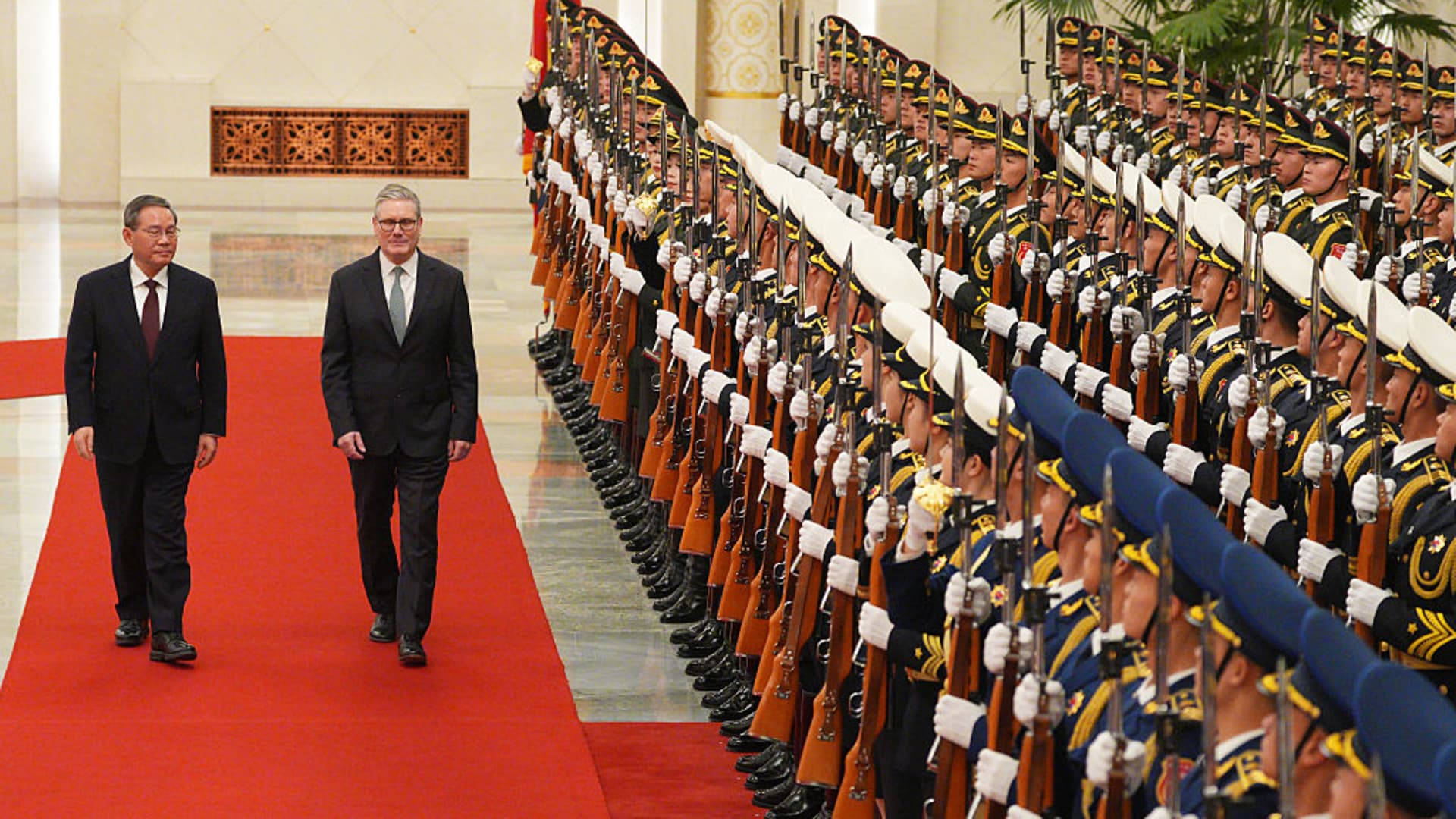
British Prime Minister Keir Starmer attends a welcoming ceremony with Prime Minister of the People’s Republic of China Li Qiang prior to a meeting at the Great Hall of the People during his visit to China, January 29, 2026, in Beijing, China.
Karl Cote | Getty Images News | Getty Images
Geopolitical plates are shifting again, and early tremors are already being seen in many parts of the world, with profound implications for the realignment of traditional alliances, global markets, and state power.
What we are witnessing in the first quarter of 2026 feels increasingly like one of historic seismic moments, rather than a single headline related to President Donald Trump, or a single moment like Canadian Prime Minister Mark Carney’s “breakdown” in his World Order speech at Davos, or a single moment like a bilateral meeting or state visit. But given the cumulative weight of ongoing high-level diplomatic maneuvers against Beijing, and the prospect of more to come, there is something structural going on that demands attention.
For both markets and policymakers, the diplomatic traffic tells a shocking story: the world is turning back to China.
This is not without precedent. In the years after China joined the World Trade Organization in 2001, world leaders and business executives made annual pilgrimages to Beijing, much like those made by zealous politicians and merchants during the Qing Dynasty, drawn by the promise of market access, manufacturing technology, scale and scope of production, and the astonishing rate of China’s GDP growth at the time. That gravitational pull continued through most of Xi Jinping’s first five-year term, when China still counted on the promise of profits and opportunities rather than political constraints and economic retrenchment.
This momentum has changed dramatically in the years leading up to, and especially since, the pandemic. Supply chain shocks, coercive trade practices, intellectual property theft, data restrictions, a focus on human rights, and escalating geopolitical rivalries have hardened Western attitudes toward Beijing. The words “risk aversion” and “decoupling” have migrated from Washington policy circles to boardrooms in the United States and Europe. Diplomatic back and forth didn’t stop, but it slowed significantly as governments and businesses readjusted their exposure to what were increasingly seen as both geopolitical rivals and economic competitors.
What is so striking about the current moment is that the trend now appears to be reversing, cautiously and without the over-enthusiasm that characterized the post-WTO era. The catalyst for this change is not a change in China’s governance or economic structure, a change in its political system, or a change in the Chinese government’s own view of the West. As difficult as it is for many in Washington to admit, there is a growing awareness of instability emanating from Washington itself, a perception that is uncomfortable for the U.S. national security establishment and even more difficult for allies to process.

This realignment was particularly evident at Davos, where President Trump publicly mocked French President Emmanuel Macron, criticized him for not being grateful enough to Canada, and viewed NATO as a money pit. His false claims that NATO allies were not up to the task on the front lines in Afghanistan and later withdrew reinforced the broader perception that times and realities have changed. But the disdain for Europe did not begin there. This trend has intensified since Vice President J.D. Vance’s fiery speech at last year’s Munich Security Conference in which he publicly criticized European partners. Since then, that change in tone has rippled across European capitals.
Public opinion data suggests that this paradigm shift is not being taken lightly. In Germany, a recent poll found that 71% of respondents now view the United States as an enemy, while a continent-wide survey shows that only 16% still view the United States as an ally. These numbers indicate more than frustration. They represent a recalibration of allies’ risk perceptions. Risk is one of the most important currencies in geopolitics, and the U.S. government has spent years building an elaborate risk structure around China. Now, it seems that architecture is being turned upside down.
European leaders and the responsibilities of “middle powers”
The Chinese government did not engineer this paradigm shift, but if it plays its cards right, it stands to benefit from it. Over the past year, a steady procession of allied leaders has headed to China. Each visit is based on national economic self-interest, and while trust in China may be limited, dependence on Washington now feels less certain, or more precisely, more risky.
French President Emmanuel Macron’s courtship of Beijing reflects his call for European “strategic autonomy”. Spain’s King Felipe VI set the tone for his China-Europe visit with an emphasis on the symbol of “partnership.” British Prime Minister Keir Starmer visited Beijing to resume strategic-level dialogue and deepen financial cooperation, including expanding London’s renminbi payments infrastructure, pledging to facilitate cross-listings through mechanisms such as the China-UK Stock Connect scheme, and institutional conduits that shape global capital flows while strengthening China’s global financial influence.
Ireland’s leadership also visited, but Australia sought stability after years of bitter trade tensions, recriminations and retaliation. India and China engaged at the summit level even as they endured border tensions along their Himalayan border. Next up is German Chancellor Friedrich Merz, whose visit is particularly significant given Germany’s central role in Europe’s industrial supply chain as the auto industry lags and loses global market share to Chinese rivals.
Taken individually, these visits are practical exercises in economic policy. Taken together, they reflect the necessary increased agency of what Carney calls the “middle power” rebalancing by countries large enough to shape global outcomes and unwilling to be trapped in the vicissitudes of the great powers. The promise of this hedging strategy lies in diversification, diplomatic selectivity, and isolation from tariff shocks. The danger lies in global divisions, weakened alliances, and a China harboring its newly acquired influence without offering openness or tolerance in return.
Distrust towards China and the pivotal Munich meeting
As the Munich Security Conference begins, there are signs of tension in both the United States and China. “The international order based on rights and rules is currently being destroyed,” German Chancellor Merz said in his opening remarks on the first day of the conference, but also said in English that the United States could not “fade alone” and described Americans as “friends.”
History warns of international realignment against China. In 2017, Xi Jinping visited Davos and gave a lauded and admired speech, similar to Mark Carney’s staunch defense of free trade and globalization in the face of the protectionist Trump 1.0 agenda. China was briefly chosen as an alternative country and safe haven, but the Chinese government has failed to fulfill that promise. Instead, the era of wolf-warrior diplomacy has arrived. There is also a good chance that China will waste this moment.
Signs of friction with China are already visible. A report ahead of this year’s Munich Security Conference highlighted strained institutional relations between Brussels and China, including restrictions on diplomatic access, unresolved disputes over industrial overcapacity, and criticism of the Sino-Russian alliance. While engagement at the bilateral level is expanding in 2026, the EU’s institutional mistrust of China remains.
Therefore, Munich has great importance. The US and China will need to reassure hurt Europeans. Secretary of State Marco Rubio will lead the official US delegation and will be under intense scrutiny following Vance’s performance last year, but China will have to do more than express warmth from the podium if it wants to maintain its momentum in 2026.
Hovering over all this is President Trump’s scheduled visit to Beijing in early April, the crown jewel of diplomatic visits for China. Xi Jinping will host the US president after welcoming US allies, reinforcing China’s insistence that global diplomacy remains centered on Beijing. According to the Chinese government, the Middle Kingdom has returned.
But substance will be more important than symbolism. Chinese authorities have already signaled pressure to sell arms to Taiwan. Under previous administrations, including my Obama administration, this influence has run up against statutory guardrails under the Taiwan Relations Act, which obligates the United States to provide defense capabilities for Taiwan. President Trump’s more discretionary approach complicates that dynamic.
If Beijing has made its demands clear, Washington should also make its demands clear, from tolerance for Jimmy Lai to substantive and measurable cooperation on Ukraine. Engagement without reciprocity risks showing that pressure can be used to gain access at minimal cost.
All of this highlights why the ongoing geopolitical rebalancing extends far beyond diplomacy. The world system is not completely recalibrating toward China, but it is being recalibrated with allies hedging, middle powers asserting their proxies, and the United States putting more pressure on its allies than on its adversaries. History shows that in the past the world has moved into China, drawn by a belief in growth and limitless opportunity, only to quickly retreat amidst geopolitical tensions and shocks. Now, companies appear to be cautiously pragmatically retreating again, driven by limited options and strategic necessity rather than trust in China’s goodwill.
As this trend gains momentum, it is reshaping the terrain in which global companies must operate, impacting how they re-enter China while avoiding undue exposure, how they engage with intermediary powers seeking strategic optionality, and how they compete in third markets with Chinese companies that are now globally active at scale. It is changing capital allocation across the geopolitical spectrum, forcing a recalibration of compliance, prompting further redesign of supply chain architectures, and introducing more complex forms of dual-state risk exposure that span both the United States and China. Companies cannot afford to misread, misinterpret, or dismiss this inflection point as a temporary Trump phenomenon. While he certainly started this course, geopolitical fault lines are likely to continue to shift, and this will be a big one if it fully materializes.
—Dewardrick McNeil, Managing Director and Senior Policy Analyst, Longview Global, CNBC Contributor

