

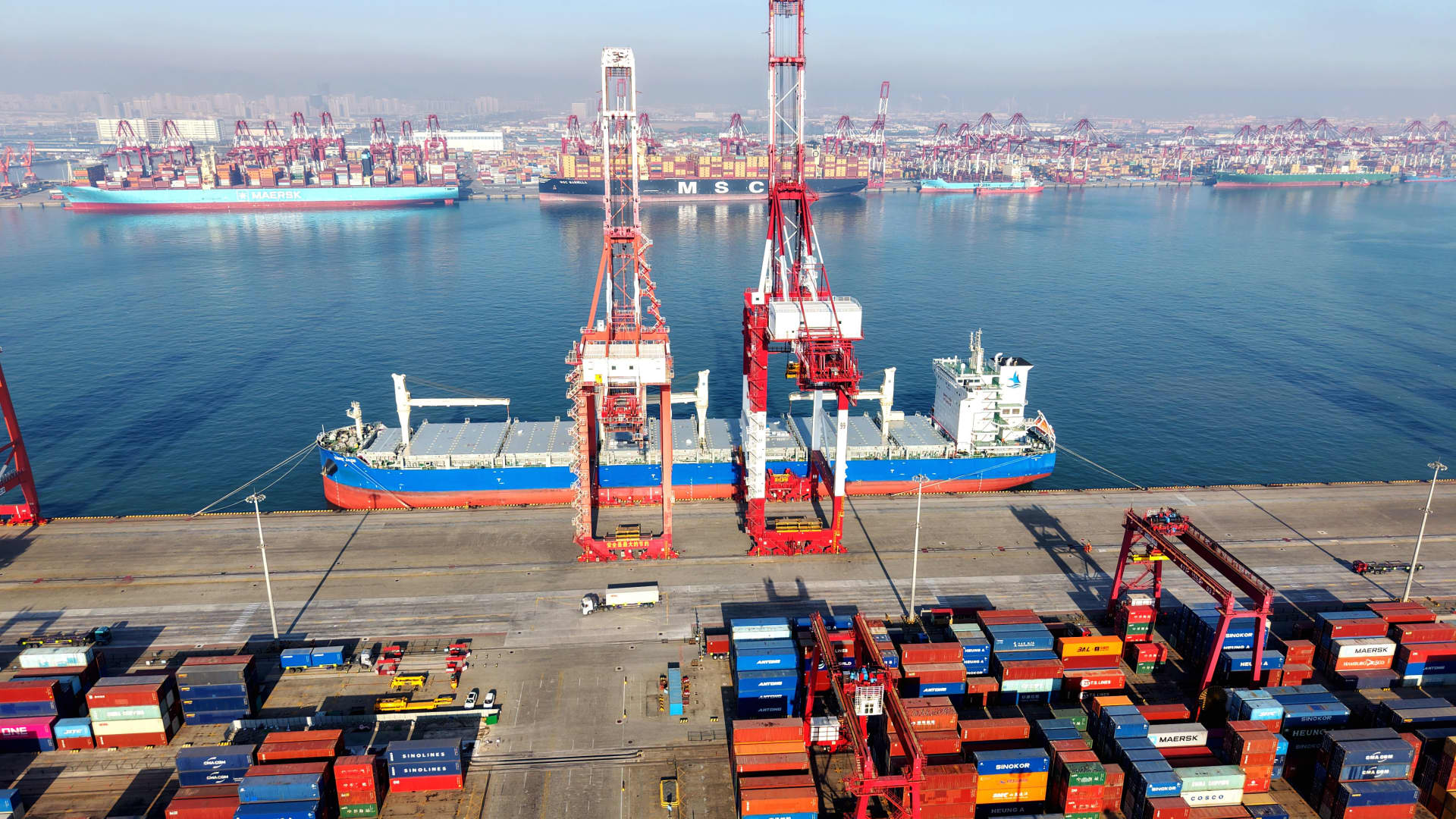
Qingdao, China – January 13, 2026 – A cargo ship is loading and unloading foreign trade containers at Qingdao Port in Qingdao City, Shandong Province, China on January 13, 2026.
Photo | Future Publishing | Getty Images
China’s export growth in December was much stronger than expected, with the annual trade surplus at a record high, while imports rose at the fastest pace in three months.
Exports rose 6.6% in U.S. dollar terms from a year earlier, according to Chinese customs statistics on Wednesday, beating the median analyst estimate of a 3% increase and accelerating from a 5.9% increase in November.
Imports rose 5.7% year-on-year in December, beating expectations for a 0.9% increase and the highest level since September last year, when imports rose 7.4%, according to LSEG data.
China’s full-year exports rose 5.5%, but imports were flat, leaving China with a trade surplus of $1.19 trillion, up 20% from 2024.
Shipments to the United States fell 30% in December from a year earlier, marking the ninth straight month of decline, while imports from the country fell 29%, according to customs data.
Amid tariff tensions, China’s exports to the US fell by 20% and imports by 14.6%, suggesting a sharp decline in trade with the US in 2025.
Chinese customs official spokesperson Lu Daliang told reporters on Wednesday that trade relations with the United States must be “mutually beneficial” and called for “dialogue and negotiations” to resolve issues and expand cooperation.
As China’s exporters expand shipments to markets outside the United States, the growing trade imbalance has raised concerns from major trading partners, including the European Union.
At a press conference in December, International Monetary Fund Managing Director Kristalina Georgieva urged the Chinese government to move away from dependence on exports for growth and accelerate domestic consumption expansion.
unnecessary worry
Eswar Prasad, a senior fellow at the Brookings Institution, said China’s trade surplus would be “as disruptive to the global trading system as President Trump’s tariffs” as weak domestic demand drags on global growth.
Prasad warned that countries around the world are likely to seek to protect their economies by erecting trade barriers.
Chinese officials pledged in December to increase imports and work to balance trade.
In December, China’s exports to the European Union and the Association of Southeast Asian Nations increased by 12% and 11%, respectively, while imports from European countries increased by 18%, while imports from Southeast Asian countries decreased by 5%.
The nearly $19 trillion economy is struggling to shake off deflationary pressures as the deepening real estate collapse weighs on household demand and a weak job market clouds consumer confidence. The country’s consumer prices will remain flat in 2025, falling short of the official target of about 2% growth.
The World Bank raised its 2026 growth forecast for China to 4.4%, 0.4 percentage points higher than its June forecast, in a report released on Tuesday, expecting further fiscal stimulus, continued export resilience and improving investment sentiment.
Zhiwei Zhang, president and chief economist at Pinpoint Asset Management, said the Chinese government is likely to keep its macro policy stance unchanged for at least the first quarter as strong export growth eases weak domestic demand and trade tensions with the United States ease.

Subscribe now
In October, China and the United States agreed to a one-year trade cease-fire, reversing a series of export controls and tariff hikes, following a meeting between Chinese President Xi Jinping and U.S. President Donald Trump. The Chinese government has also pledged to buy at least 12 million tons of U.S. soybeans over the next two months.
The country bought 111.8 million tonnes of soybeans last year, up 6.5% from 2024 levels, according to official data. Imports in December increased by 1.3% to 8 million tons.
China’s rare earth exports rose 32% to 4,392 tonnes in December, with shipments of this important mineral up 12.9% year-on-year over the year.
China is scheduled to release annual and fourth-quarter gross domestic product data next Monday. Economists polled by Reuters had expected the world’s second-largest economy to grow 4.5% in the fourth quarter. The Chinese government had set a growth target of around 5% for 2025.

