

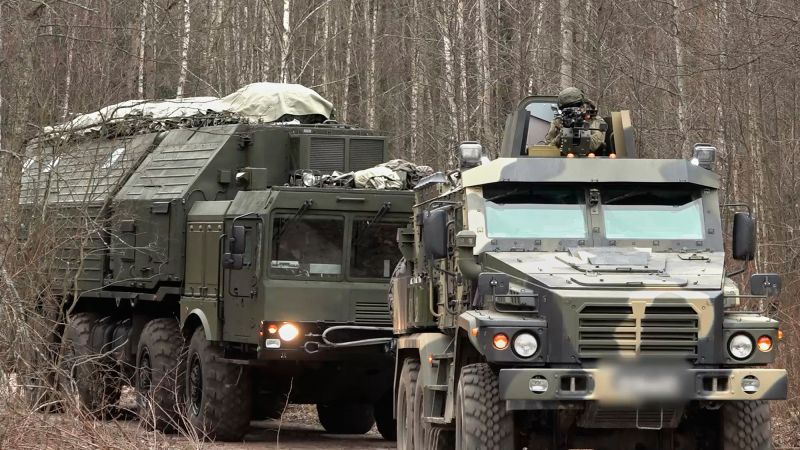
Russia fired Oleshnik missiles into Ukraine overnight on Friday, its second attack since the start of the all-out war in 2022. Kiev and its allies say the attack was intended as a warning to the West.
Russian defense officials have not said where Oreshnik landed, but Ukrainian authorities reported on Friday that there were several explosions and a ballistic missile attack in the western city of Lviv.
The first use of this new weapon, which can carry nuclear or conventional payloads, was to target an apparently vacant factory in Dnipropetrovsk in late November 2024.
Here’s what we know about the missile.
This is likely an intermediate-range ballistic missile, with past experience indicating a range of 600 to 1,000 miles. U.S. defense officials have indicated that they consider the Oreshnik launched in November 2024 to be an “intermediate-range ballistic missile,” or IRBM, with an actual range that could exceed 3,000 miles.
The distance from Kapustin Yar, the Russian base where it is believed to have been fired, to this week’s target, Lviv, is about 900 miles.
A distinctive feature of the Oreshnik is its ability to rain multiple separate warheads from the main missile. Up to six independently targeted reentry vehicles (MIRVs), each carrying four to six weapons, will be separated from the hypersonic-moving missile. Each can be aimed at a specific object, allowing a single ballistic missile to launch a larger attack.
Oleshnik means “hazel tree” and is based on the appearance of its warheads as they fall to Earth in fiery streaks of light. Ukrainians called the first person to fire “Kedr” (seeder).
U.S. officials have suggested it could be an evolution or basic copy of the RS-26 Lebezi missile, first developed in 2008.
Russia and the United States are in a dispute over the renewal of the Intermediate-Range Nuclear Forces Treaty, which aims to completely ban IRBMs and reduce the threat of nuclear-capable missiles in continental Europe. The United States formally withdrew from the treaty in 2019.
Russia’s first Oreshnik test launch in 2024 came days after the Biden administration gave Kiev permission to fire a U.S.-supplied ATACMS missile at Russia.

Oreshnik is faster than most modern missiles, traveling at an estimated speed of 8,000 miles per hour (13,000 kilometers per hour). Its trajectory would sharply rise out of the atmosphere and then plummet back down again, directing the warheads to separate targets. This makes it almost impossible for Ukraine to stop it with its available air defense systems.
This type of missile was designed to carry a nuclear payload. Rare, expensive, and reminiscent of the Cold War era.
Although Oleshnik has so far carried only conventional explosives, its speed and capabilities are of missile-class proportions, reflecting a nuclear threat. It appears that the United States was notified before the first use at the end of 2024 to prevent it from being mistakenly interpreted as a nuclear launch.
Ukrainian experts from the Military Research Institute of the Kyiv Institute of Scientific and Forensic Specialists who examined what is said to be the remains of the first Oleshnik missile launched in Dnipropetrovsk in November 2024 told CNN early last year that the missile did not use many modern circuits and did not show any major technological advances, relying on known designs and elements.
Why is it a big deal that Russia fired now?
This is a big deal since Russia launched a nuclear-capable missile at Lviv, an hour’s drive from the border with NATO member Poland. This marks Russia’s bold stance toward the largest military alliance in history, at a time when the United States’ role in the alliance has been called into question.
“Such attacks near the borders of the EU and NATO are a serious threat to the security of the European continent and a test for the transatlantic community,” Ukrainian Foreign Minister Andriy Sibikha said on Friday on broadcast X.
EU foreign policy chief Kaja Karas echoed this sentiment, saying on Friday that “reports of Russia’s use of the Oleshnik missile are a clear escalation against Ukraine and a warning to Europe and the United States.”
The Russian government claims the attack was in response to the targeting of Russian President Vladimir Putin’s official residence late last year. (The CIA assesses that Ukraine did not target the residence.) This is likely another example of Russia wielding its saber, at a time when Russia’s ally Venezuela is under US attack and a sanctioned oil tanker flying its flag was seized by US forces near Iceland, reminding adversaries of its extensive and destructive arsenal.
The Kremlin has claimed that many Oleshniks are in production and that some may be stationed in Belarus, in an apparent bid to heighten concerns that the missiles could leave European cities vulnerable to attack.
