

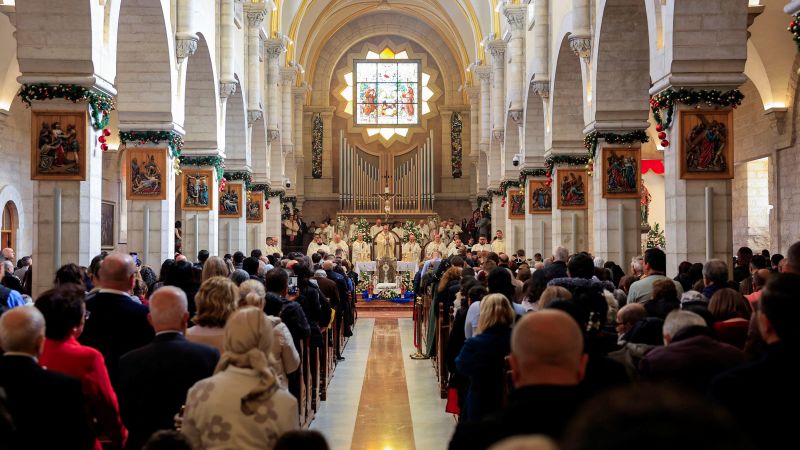
Christmas celebrations have returned to the birthplace of Jesus for the first time in two years, but the joy remains overshadowed by another tumultuous year for Palestinians living under Israeli occupation in the West Bank.
A morning mass was held at Bethlehem’s Church of the Nativity on Thursday, a day after Palestinians and foreign tourists flocked to Manger Square to attend the first celebration since the suspension of activities in solidarity with Palestinians suffering two years of deadly war in Gaza.
Palestinian politician Mustafa Barghouti said that despite the celebrations, the number of participants remained limited because of Israeli military checkpoints blocking roads in the West Bank.


“The West Bank is completely surrounded,” Barghouti told CNN’s Matthew Chance in Bethlehem on Wednesday. “Israel has closed the roads. Of course, many people have not been able to come. … Many cannot afford to come, and many are having great difficulty getting from one place to another.”
As the war in Gaza escalates, the occupied West Bank has seen a sharp escalation in Israeli military operations, the destruction of a record number of Palestinian homes, and an unprecedented expansion of Jewish settlements, as corruption allegations and stagnant decision-making plague the Palestinian leadership.
The United Nations Office for the Coordination of Humanitarian Affairs (UN OCHA) said in a report released in November that more than 30,000 Palestinians will be forcibly expelled from their homes in West Bank cities in 2025 in what has become “the longest and largest displacement crisis in the West Bank since 1967.”

The West Bank lies between Israel and Jordan, has been occupied by Israeli forces since 1967, and is home to more than 3.3 million Palestinians.
A record number of Palestinian homes and structures have been demolished in the West Bank this year over building permits, which human rights groups such as the Norwegian Refugee Council (NRC) said in October were a “deliberate policy of deprivation.”
“Families are being stripped of their homes, water and livelihoods in a calculated effort to force them off their land and secure permanent settlements,” said Angelita Caleda, NRC’s Regional Director for the Middle East and North Africa. “This is not an accidental destruction. This is a deliberate policy of dispossession.”


Killings continue in the West Bank as well, with at least 233 Palestinians, including 52 children, killed this year alone, mostly by Israeli forces using live ammunition, according to OCHA data. The Israeli military has launched several large-scale military operations against Palestinian militants in West Bank cities.
The violence coincided with record-breaking illegal settlement construction across the Palestinian territories.
This month, the Israeli cabinet approved the legalization and establishment of 19 settler outposts, and in May Israel announced the establishment of 22 new settlements, the largest settlement expansion in more than 30 years, according to Israeli settlement watchdog Peace Now.
The entire Israeli settlement is considered illegal under international law. The outposts are not only illegal under international law, but also prohibited under Israeli law.
In a joint statement, the 14 countries criticized the 19 new settlements, saying, “Such unilateral actions as part of a broader consolidation of settlement policy in the West Bank not only violate international law but also risk fostering instability.”

Despite international calls for a negotiated solution to the decades-long occupation, Israeli leaders have made their rejection of a future Palestinian state clearer than ever before and since Hamas’ attack on southern Israel on October 7, 2023.
Far-right Finance Minister Bezalel Smotrich, himself a settler, announced the settlement expansion in a statement earlier this month.
“We are preventing the establishment of a Palestinian terrorist state on the ground,” he said. “We will continue to develop, build and settle the land inherited from our ancestors, believing in the justice of our path.”
