

Vilnius, Lithuania
AP
—
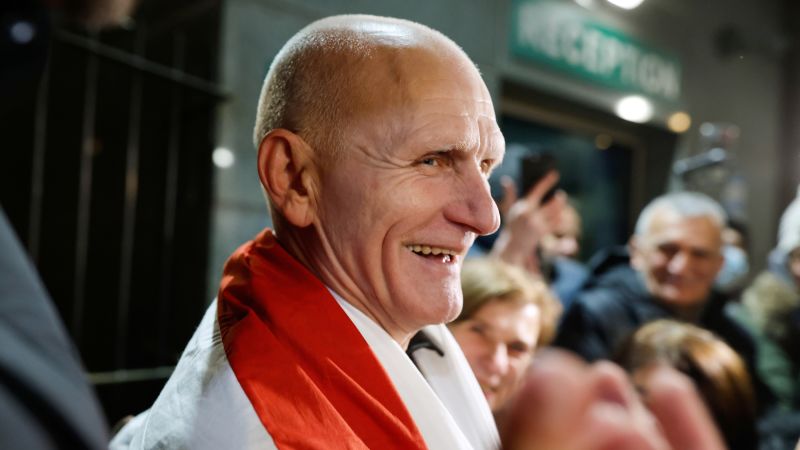
Belarusian authorities released Nobel Peace Prize laureate Ales Bialiatsky and leading opposition figure Maria Kolesnikova from prison on Saturday, human rights activists confirmed to The Associated Press.
Their release comes as authoritarian President Alexander Lukashenko seeks to improve relations with the United States. President Lukashenko pardoned 123 prisoners in exchange for sanctions relief, state news agency Belta reported. The United States announced early Saturday that it would lift sanctions on the country’s potash sector.
Minsk, a close ally of Russia, has faced Western isolation and sanctions for years. Mr. Lukashenko has ruled the country of 9.5 million people with an iron fist for more than three decades, but Belarus has been repeatedly sanctioned by Western powers both for its crackdown on human rights and for allowing Moscow to use territory in its 2022 invasion of Ukraine. Belarus has released hundreds of prisoners since July 2024.
John Cole, the US special envoy to Belarus, announced the lifting of sanctions on Cali after meeting with President Lukashenko in Minsk on Friday and Saturday.
Belarus’ state news agency Belta reported on Saturday that Kohl told journalists that the two days of talks had been “very productive.” He said “our goal” is to normalize relations between Washington and Minsk.
“We are lifting sanctions and releasing prisoners. We are always talking to each other,” he said, according to Belta newspaper. He also said that relations between the two countries are moving from “baby steps to more confident steps” as dialogue expands.
Bialiatsky and Kolesnikova are among those released.
Pavel Sapelka, a human rights activist with the Viasna Human Rights Group, said Bialiatsky and Kolesnikova were released from prison late Saturday.
Human rights defender Biaryatsky was awarded the 2022 Nobel Peace Prize, along with prominent Russian human rights organization Memorial and the Ukrainian Civil Liberties Center.

Mr Bialiatsky received the award while in prison awaiting trial, but was later convicted of smuggling and financing public order offenses, charges widely condemned as politically motivated, and was sentenced to 10 years in prison in 2023.
Authorities said Mr. Bialiatsky, who founded Belarus’ oldest and most prominent human rights organization Viasna, was considered particularly dangerous because of what authorities said were his “extremist tendencies.” The 63-year-old is imprisoned in the Gorki penal colony, which is notorious for assaults and hard labor. Bialiatsky’s wife said his health was deteriorating and he had multiple chronic illnesses.
The United Nations Committee of Human Rights Experts called on Belarus to release him.
Kolesnikova was a central figure in the massive protests that rocked Belarus in 2020 and is a close ally of exiled opposition leader Sviatlana Tsikhanouskaya.

Kolesnikova, known for her close-cropped hair and trademark heart-shape gesture, became an even bigger symbol of resistance when Belarusian authorities tried to deport her in September 2020. Driven to the border with Ukraine, she briefly broke away from security forces in a remote area, tore up her passport and walked back to Belarus.
The 43-year-old professional flutist was convicted in 2021 of charges including conspiracy to seize power and sentenced to 11 years in prison.
Vyasna said others released include Viktar Babaryka, an opposition figure who sought to challenge Lukashenko in the 2020 presidential election, which was widely seen as rigged, but was found guilty and sentenced to 14 years in prison on charges he rejected as political.
Viasna said the group’s imprisoned defenders Valiantsin Stefanovic and Vladimir Lapković, as well as prominent opposition figure Maxim Zunak, had also been released.
Most of them were brought to Ukraine, Tsikhanouskaya’s senior adviser Franak Vyachorka told The Associated Press.
“I think Mr. Lukashenko decided to expel people to Ukraine to show that he was in control of the situation,” Mr. Biachorka said.
Biacharka said eight or nine other prisoners, including Bialyatsky, were taken to Lithuania on Saturday, and more prisoners were expected to be taken to Lithuania in the coming days.
Ukrainian authorities confirmed that Belarus had handed over 114 civilians. Ukrainian President Volodymyr Zelenskiy said five of them were Ukrainian nationals.
The last time U.S. officials met with Lukashenko in September 2025, Washington announced it would ease some sanctions on Belarus, and Minsk released more than 50 political prisoners to Lithuania. Overall, Belarus has released more than 430 political prisoners since July 2024, in what was widely seen as an effort to move closer to the West.
“The release of political prisoners means that Mr. Lukashenko understands the pain of Western sanctions and is trying to ease them,” Tikhanovskaya told The Associated Press on Saturday.
“But don’t be naive. Mr. Lukashenko has not changed his policy, the repression continues, and he continues to support Russia’s war against Ukraine. That is why we need to be extremely cautious about any talk of sanctions relief, lest we strengthen Russia’s war machine and encourage continued repression,” he added.
Tikhnuskaya also said that European Union sanctions on Belarus’ potash fertilizer are much more painful for Minsk than those imposed by the United States, and that while easing American sanctions could lead to the release of political prisoners, European sanctions should encourage long-term, systemic change in Belarus and an end to Russia’s war in Ukraine.
Belarus, which previously accounted for about 20% of global potash fertilizer exports, has faced a significant drop in shipments since Western sanctions targeted state-run producer Belarus potash and cut off shipments through Lithuania’s Klaipėda port, the country’s main export route.

“Sanctions by the US, EU and their allies have significantly weakened Belarus’ potash industry, depriving the country of a major source of foreign exchange earnings and access to key markets,” Anastasiya Luzgina of the Belarusian Economic Research Center BEROC told The Associated Press.
“The Minsk government hopes that the lifting of U.S. sanctions on Cali will pave the way for the easing of more painful European sanctions. At least the U.S. action will allow us to start discussions.”
According to Belta newspaper, the latest US-Belarus talks also touched on Venezuela and Russia’s ongoing invasion of Ukraine.
Mr. Kohl told reporters that Mr. Lukashenko had given him “good advice” on how to deal with the war in Ukraine, adding that Mr. Lukashenko and Russian President Vladimir Putin were “long-time friends” and had “the level of relationship necessary to discuss these issues.”
“Of course, President Putin may accept some advice and not others,” Kohl said.
