

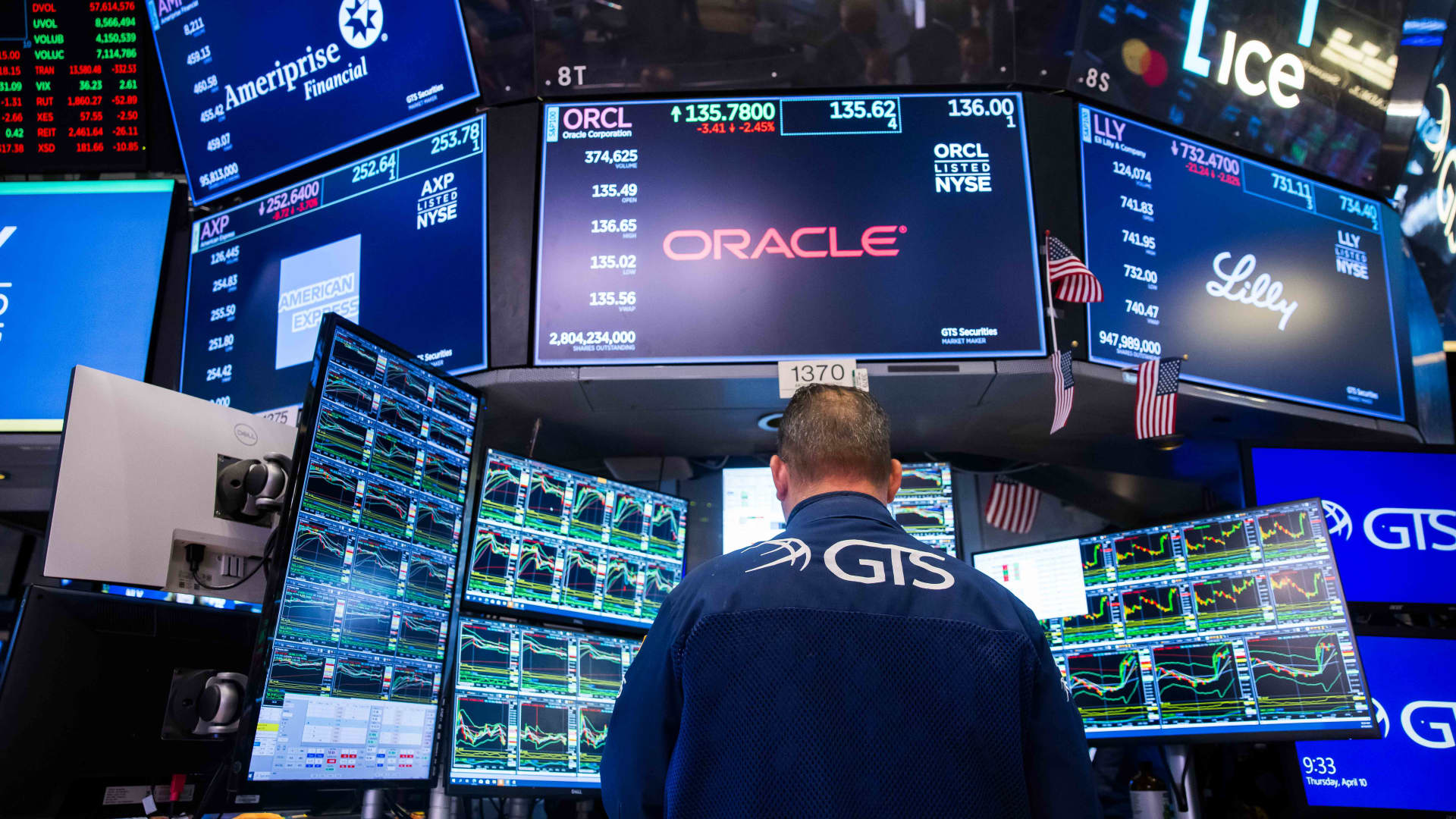
Broad AI trading is back in the spotlight thanks to Oracle. That can’t be true. Oracle shares were plunging on Thursday after a disappointing quarterly revenue, disappointing guidance and higher spending outlook. The magnitude of the stock price decline was further exacerbated by management’s failure to address OpenAI’s ability to follow through on its large commitment to purchase AI computing power from Oracle on Wednesday night’s conference call. This omission, combined with reported earnings and outlook, is putting pressure on AI stocks. Although Investing Club does not own Oracle, its importance to the AI ecosystem should be noted. Much of Oracle’s future revenue will depend on whether OpenAI can actually grow its business fast enough to fulfill the $300 billion, five-year contract it signed. Oracle didn’t mention it on Wednesday night’s call, and OpenAI CEO Sam Altman did little to allay those concerns on CNBC Thursday morning. Mr. Altman deflected a direct question about Oracle by saying that OpenAI is growing its business rapidly and that future growth depends on increasing the kind of computing power it has promised to buy from Oracle and others. “Without this computing enhancement, we cannot drive this revenue growth,” Altman explained. “We think there is much more reason to be optimistic than to be pessimistic.” Altman hinted at future models in development, and OpenAI announced the new model just hours after appearing on CNBC. Another part of Oracle’s equation is the need to continue building out its AI infrastructure capabilities. To continue this, the company has raised its full-year 2026 capital spending outlook to approximately $50 billion from $35 billion in September. Capital expenditures for fiscal year 2025 were $21.2 billion. “Oracle has to be able to borrow to build,” Jim Cramer said during a Thursday morning meeting. “(But) they don’t have the capital to invest $50 billion,” he said, adding, “Oracle has bitten off a little more than it can chew.” That’s especially true given that its reported second-quarter fiscal 2026 revenue of $16.06 billion fell short of analysts’ expectations, at a time when demand for the kind of AI infrastructure capabilities Oracle provides is surging. Not to mention, Oracle’s second-quarter free cash flow burn was nearly $10 billion, nearly twice as much as expected. There’s no doubt that Oracle is anticipating significant demand, as it added $69 billion to its remaining performance obligations (RPO) during the quarter. As a result, Oracle’s RPO, which again relies heavily on OpenAI, surged more than 430% year over year to $523 billion. RPO tells a story about future revenue. Current street forecasts are for fiscal 2027, 2028, and 2029 revenues to total just under $388 billion. Doug Koehring, Oracle’s chief financial officer, said on a conference call that RPO growth was “driven by agreements with companies like Meta and Nvidia as we continue to diversify our customer backlog.” Meanwhile, Koering downplayed concerns about Oracle’s debt. “Various sources of financing are available across our debt structure, including public debt markets, bank markets, and private debt markets. Additionally, we also have other financing options, including customers who bring their own chips to install in our data centers, and through suppliers who lease chips rather than sell them. “Both of these options allow Oracle to synchronize payments and receipts and borrow significantly less than many assume. As a fundamental principle, we expect and will strive to maintain our investment grade debt rating.” Conclusion Oracle’s situation is concerning and requires additional monitoring. That’s because the company is not in the same position as the tech giants. Many of these are in our portfolio and generate significant positive free cash flow, allowing us to fund our investments without the need for significant borrowing. But what we heard on the conference call with Oracle is no reason to change our view of AI trading more broadly. Oracle may have to get creative with its funding, but we think that’s a challenge for Oracle and not indicative of a change in the AI landscape. It is clear that the demand for AI computing power is real, and the likes of Meta Platform, Microsoft and Amazon can meet their financial obligations. Consider Thursday’s news that Disney will invest $1 billion in OpenAI. The entertainment giant will also license 200 characters across the Disney, Marvel, Pixar, and Star Wars franchises to enable users of OpenAI’s short-form video generator Sora to create content. This type of arrangement further strengthens our view that demand for AI products, and therefore additional computing power, will increase significantly in the coming years. This could be a big reward for companies that can finance infrastructure development without hurting their balance sheets in the process. So while Thursday’s AI trade may be under pressure for sentiment reasons, sustained weakness in either stock could ultimately become a buying opportunity. (The Jim Cramer Charitable Trust is long: AMZN, MSFT, META, MSFT. See here for a complete list of stocks.) As a subscriber to Jim Cramer’s CNBC Investment Club, you will receive trade alerts before Jim makes a trade. After Jim sends a trade alert, he waits 45 minutes before buying or selling stocks in his charitable trust’s portfolio. If Jim talks about a stock on CNBC TV, he will issue a trade alert and then wait 72 hours before executing the trade. The above investment club information is subject to our Terms of Use and Privacy Policy, along with our disclaimer. No fiduciary duties or obligations exist or arise from your receipt of information provided in connection with the Investment Club. No specific results or benefits are guaranteed.
