

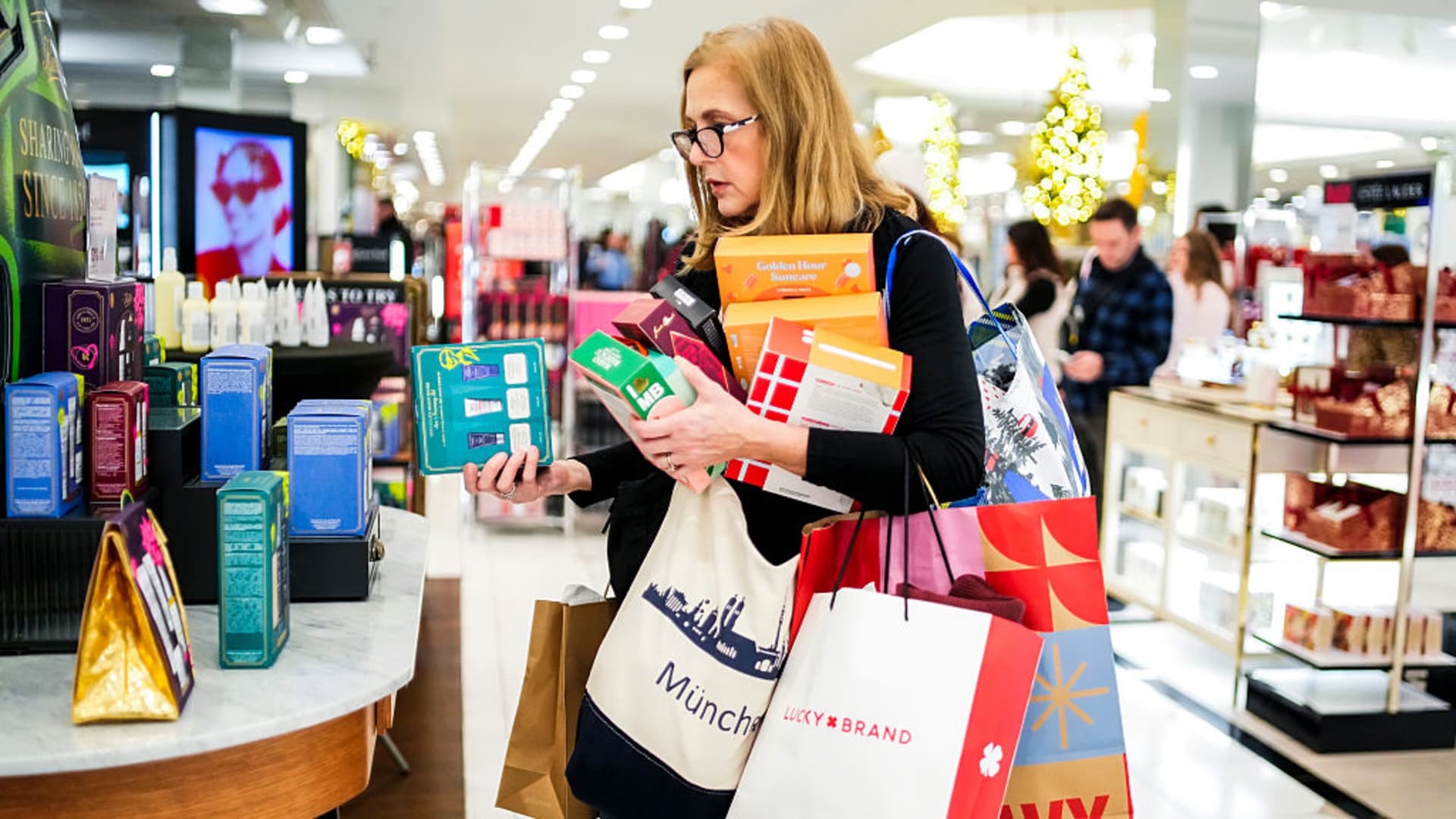
A person carries shopping bags during Black Friday shopping at Garden State Plaza on November 28, 2025 in Paramus, New Jersey.
Eduardo Muñoz Alvarez | Getty Images
A desire for deep discounts led 202.9 million U.S. consumers to shop in the five-day period between Thanksgiving and Cyber Monday, according to research released Tuesday by the National Retail Federation and Prosper Insights & Analytics.
This estimated total exceeded expectations from major industry groups that 186.9 million people would shop during the five-day period. That’s up from 197 million shoppers in the same period last year.
This number of shoppers is the highest since NRF began tracking five-day totals in 2017, surpassing the previous high of 204 million shoppers on the same day in 2023. The trade group did not estimate the total amount spent over the extended Thanksgiving weekend.
In a call with reporters, NRF CEO Matt Shea described the shopping period as a “psychological kickoff to the holiday season.” He said the number of shoppers indicated a “very strong start” to the season.
“One of the key factors here is that for many Americans and many families, holiday spending and holiday shopping is an important part of the budget,” he said.
Even if consumers are pulling back and making trade-offs, they may still shop as December approaches. Hsieh said the holiday season can be a “very emotional shopping experience.”
Retailers and economists are closely monitoring spending during the peak shopping season while trying to make sense of conflicting indicators about the outlook for national and U.S. households. Even as consumer sentiment slumps and more major companies lay off thousands of employees, retail sales data remains strong.
Even during a time of year when store foot traffic increases, retailers have been looking for ways to manage one of their biggest costs: labor. Holiday hiring by retailers is expected to total between 265,000 and 365,000 positions this year, the NRF said, the lowest number of seasonal workers in at least the past 15 years.
Nevertheless, NRF predicts that U.S. consumers will continue to spend freely on gifts, trinkets, and other items. The industry group announced in early November that it expects holiday spending from Nov. 1 to Dec. 31 to hit a record high of $1.1 trillion to $1.2 trillion, with the total topping $1 trillion for the first time.
This represents an increase of 3.7% to 4.2% compared to the previous year’s holiday period. This is a slight decline from last year’s holiday sales growth rate of 4.3%. NRF’s projections do not include car dealerships, gas stations or restaurants.
Hsieh said Thanksgiving weekend spending gives the trade group confidence it is on track to meet its forecasts. At the end of Cyber Monday, shoppers told NRF they had about 53% of their holiday shopping left, which is on par with a year ago.
A package is placed on a conveyor belt at an Amazon fulfillment center during Cyber Monday, Monday, December 1, 2025, in Robbinsville, New Jersey, USA.
Michael Nagle | Bloomberg | Getty Images
Phil Rist, executive vice president of research firm Prosper Insights and Analytics, which conducts the annual NRF study, said consumers in the survey said sales and promotions, such as free shipping and limited-time sales, were motivating them to make a five-day purchase. The poll was conducted from November 26th to November 30th among approximately 3,100 adults.
“There’s a moat for this type of spending” for families of all income levels, said Mark Matthews, NRF’s chief economist. He said it was common for households with less financial means to prioritize holiday spending, cutting back on other areas such as recreation and travel.
He added that he expects shoppers to fill larger shopping carts this season, including non-holiday items, because they “want to take advantage of these great deals.”
Clothing and accessories were the top gifts purchased over the five-day period, with 51% of consumers surveyed saying they purchased items in this category, followed by toys at 32% and books and other media at 28%. Gift cards are 26%.
Even though more Americans have shopped online on Black Friday in recent years, a total of 129.5 million consumers shopped in-store over the five-day period, the study found, an increase of 3% from a year ago. Online shopping participation increased even more, with 134.9 million people shopping on a retailer’s website or app, up 9% year over year.
Other studies also show that online spending is on the rise. According to Adobe Analytics, U.S. consumers spent a total of $14.25 billion online on Cyber Monday, an increase of 7.1% year over year. The company analyzes online direct transactions, covering more than 1 trillion visits to U.S. retail sites, 100 million individual items, and 18 product categories.
According to Adobe, in the five days between Thanksgiving and Cyber Monday, consumers spent $44.2 billion online overall, an increase of 7.7% year over year. A significant portion of this was due to online spending on Black Friday, which totaled $11.8 billion, an increase of 9.1% year-over-year, as shoppers sought early sales.
