

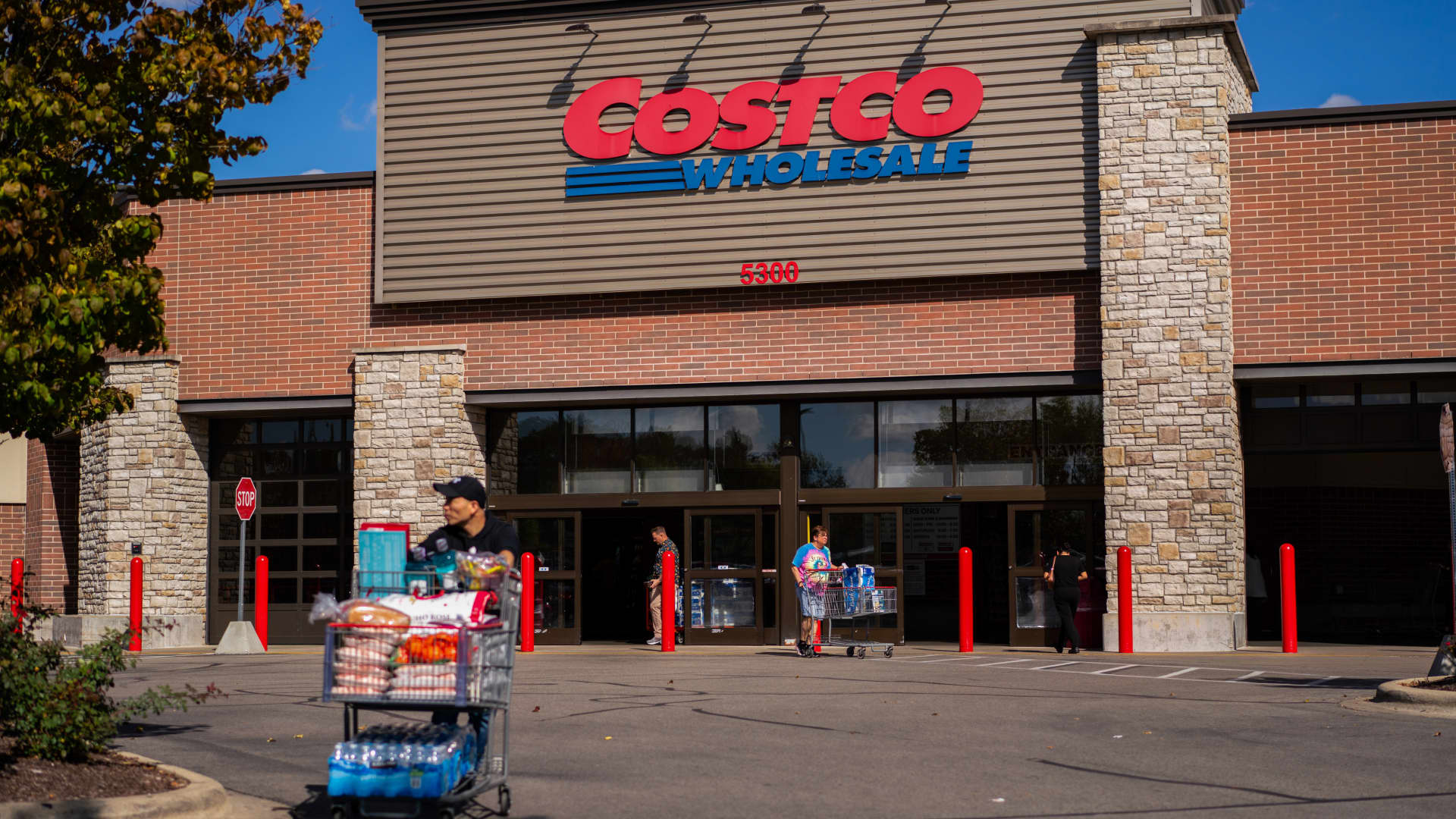
Shoppers exit a Costco store on Tuesday, October 21, 2025, in Centerville, Ohio, USA.
Kyle Grillot | Bloomberg | Getty Images
costco As the Supreme Court’s decision progresses, the company has filed a lawsuit against the Trump administration seeking a full refund of new tariffs paid so far this year and an injunction to stop it from continuing to collect import duties from major retail warehouse clubs.
Costco said in a lawsuit filed Friday that it risks losing money it has already paid to meet the tariffs even if the Supreme Court ultimately upholds an earlier lower court ruling that found President Donald Trump lacked the legal authority to impose the tariffs.
The company noted that the Dec. 15 deadline is approaching and that customs duties already paid based on the estimated amount may not be refunded. Costco has not said how much it believes the company should be refunded.
Costco’s lawsuit filed in the U.S. Court of International Trade alleges that U.S. Customs and Border Protection denied the company’s request for an extension of Dec. 15, the so-called settlement date for the final calculation of duties on imported goods.
Importers have six months to file a protest challenging a liquidation, but “not all liquidations are subject to appeal,” the complaint states.
Dozens of other companies have filed similar lawsuits to protect their rights to potential refunds in case the Supreme Court rules against so-called reciprocal tariffs that President Trump has imposed on imports from many of the United States’ trading partners, as well as so-called fentanyl tariffs on products from Canada, China and Mexico.
President Trump has invoked the International Emergency Economic Powers Act, often imposing high tariffs.
In August, the U.S. Court of Appeals for the Federal Circuit, in a 7-4 decision, upheld an earlier ruling by the Court of International Trade that found President Trump did not have that authority.
“Congress’s core power to impose taxes, such as tariffs, is vested exclusively in the Legislature by the Constitution,” the Federal Circuit said in its decision. “Tariffs are a core power of Congress.”
During oral arguments on Nov. 5, a majority of the Supreme Court’s nine justices expressed skepticism about Trump administration lawyers’ claims that the president has the authority to impose tariffs.
The Supreme Court quickly accepted the regime’s appeal of the lower court’s ruling, but it is unclear when or how the court will rule on the dispute.
“This separate action is necessary, however, because even if the IEEPA tariffs and the underlying Executive Order were found to be illegal by the Supreme Court, importers who paid the IEEPA tariffs, including Plaintiffs, would not be guaranteed a refund of their illegally collected duties absent a judgment or judicial remedy of their own,” Costco said in its lawsuit.
“This court and the Federal Circuit have cautioned that importers may lack a legal right to recover duty refunds on cleared imports, even if the underlying legality of the duties is later determined to be illegal,” the complaint states.
“The economic consequences of not honoring President Trump’s lawful tariffs are significant, and this case highlights that fact,” White House Press Secretary Khush Desai said in a statement about the Costco lawsuit.
“The White House looks forward to the Supreme Court’s prompt and appropriate resolution of this matter,” Desai said.
CNBC has reached out to Costco for comment.
The Trump administration has warned that it may have to pay back hundreds of millions of dollars in tariffs if the Supreme Court upholds a lower court’s ruling that Trump did not have the authority to unilaterally impose tariffs under IEEPA.
