

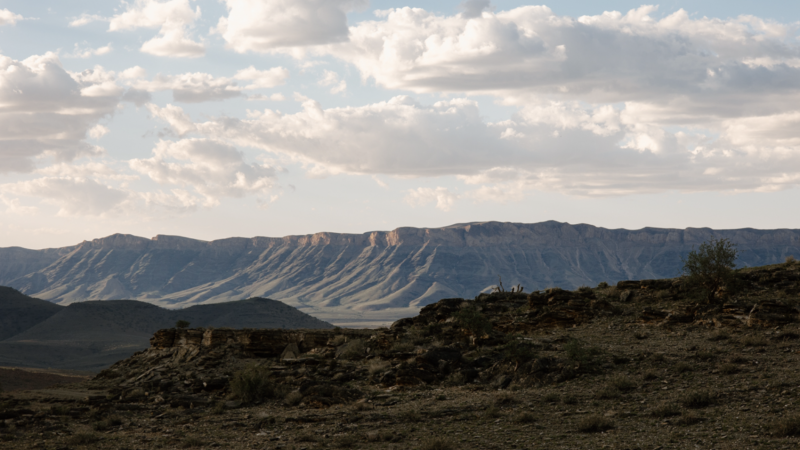
Getting into the winemaking business is not for the faint of heart. Without experience, it may seem reckless to do this on the edge of the desert, where temperatures reach 50 degrees Celsius (122 degrees Fahrenheit). But for Rudy Van Vuuren, the gamble paid off.
Mr Van Vuuren is Managing Director of Neuras Wine and Wildlife Estate, located 220 miles south of Windhoek, Namibia. Located at the foot of the Naukluft Mountains on the edge of the Namib Desert, this boutique operation is said to be the driest vineyard outside of Chile’s Atacama Desert. Battling a hostile climate and hungry baboons, Neuras engineered a journey from amateur enthusiasm to award-winning winemaking that put this remote corner of Africa on the viticulture map.
In recent years, this small vineyard has won international medals such as Gold and Double Gold for red wine, ruby dessert wine and ‘nappa’ (a spirit similar to grappa).
The winery manager says none of this would have happened without the unexpected help of a leopard called Lightning.
Van Vuuren lived multiple lives before pursuing winemaking. A doctor and member of Namibia’s national cricket and rugby teams, and a World Cup participant in both sports, he became a conservationist.
In 2009, Van Vuuren was in a helicopter tracking Lightning, a leopard that had been rescued and released into the wild. Suddenly, a desert oasis appeared below him. The land turned out to belong to a retired Shell executive who had been growing grapes in a small area of the 14,500 hectare property. Mr. Van Vuuren came down to announce the presence of a big cat on his property and fell in love with the vineyard and its wine.
“I went back and told Marlis[Van Vuuren, Rudy’s wife]about the place, and she just said, ‘Is there water? What’s the camp like? What’s the roads like?'” he recalled. “I said, ‘I’m not looking at anything like that, I’m only looking at wine. And I’m going to buy a Neuras.'”

In 2011, the vineyard and surrounding land became part of the couple’s conservation program, the Naankse Foundation.
“It was perfect,” Van Vuuren said. The site could be used as a release point for animals into the adjacent Namib-Naukluft National Park, “plus there is an economic engine for winemaking”, with the proceeds potentially funding animal conservation efforts.
Without winemaking expertise, Van Vuurens’ engine would never have had a chance of reaching top gear. It took the couple more than a decade to hire the right people to grow their part-time operation into a full-fledged business. That person was South African winemaker Braam Gericke.
Gericke speaks of winemaking in mystical terms (“It’s not a job, it’s an art form”; “You don’t change the vineyard based on what you want, the vineyard changes you”), but his deft touch paid off. “He was the one who cracked the code,” Van Vuuren said.
The grapes are grown under netting to avoid the hungry baboons and kudu (large antelope) that roam the area. Gericke said that every January, precisely six employees hand-pick the grapes between 6 a.m. and 7:30 a.m., before the heat of the day sets in. After 12 to 18 months of barrel fermentation, a “really old-fashioned” manual bottling line is installed, where fewer than 200 bottles of a particular wine are produced per season.
“I like to think of this as Old World winemaking meets New World winemaking,” he added.
The secret here is how the vines are watered. An area with only 5 mm (less than half an inch) of annual rainfall, Newras is fortunate to be located in a basin with five underground freshwater springs.
“This is the purest water available,” Gericke says. He said the water has been carbon dated and will take 1,800 years to be harvested and used in the drip irrigation system.
“When we started having success, we considered expanding our vineyards, but then we came to our senses,” Van Vuuren said. In fact, he explained, a water test on the property revealed that the available resources would not allow for expansion of the vineyard.
“We now respect what nature has decided for us. We will keep the vineyards small, keep the quality as it is now and improve it even more,” he added.

The skills of Gericke and his team, as well as time and weather, will have a huge impact on the vineyard’s future success.
Climate change is making the winemaking business increasingly precarious. Many wine-growing regions around the world could become unsuitable for growing grapes if the Earth exceeds 2 degrees Celsius (3.6 degrees Fahrenheit) of human-induced climate change, according to a 2024 report. Competition for wine producers continues. Vineyards are tearing out vines to replace them with hardier varieties, and some European producers are looking for land in the north with similar growing conditions to secure the future of their businesses (see: Champagne house buys part of Kent, UK).
Does Neuras provide a blueprint for success?
“We grow and produce wine in extreme conditions: intense heat, little rain… (and) climate change will only amplify that,” Van Vuuren said. “So instead of resisting, we’re trying to learn to adapt.”
“Our water management approach takes into account all factors such as variety, temperature, soil composition and vine root depth. It is a science in itself,” he added. “You have to listen to the vines. They tell you what they need and when.”
That said, Neuras sees the changes that are needed. Van Vuuren said the vineyard is considering growing Pinotage, a red grape known for its resilience and low water requirements, in an unconventional trellis system suited to dry conditions.
“Water limits physical expansion but stimulates smarter viticulture,” he added.
