

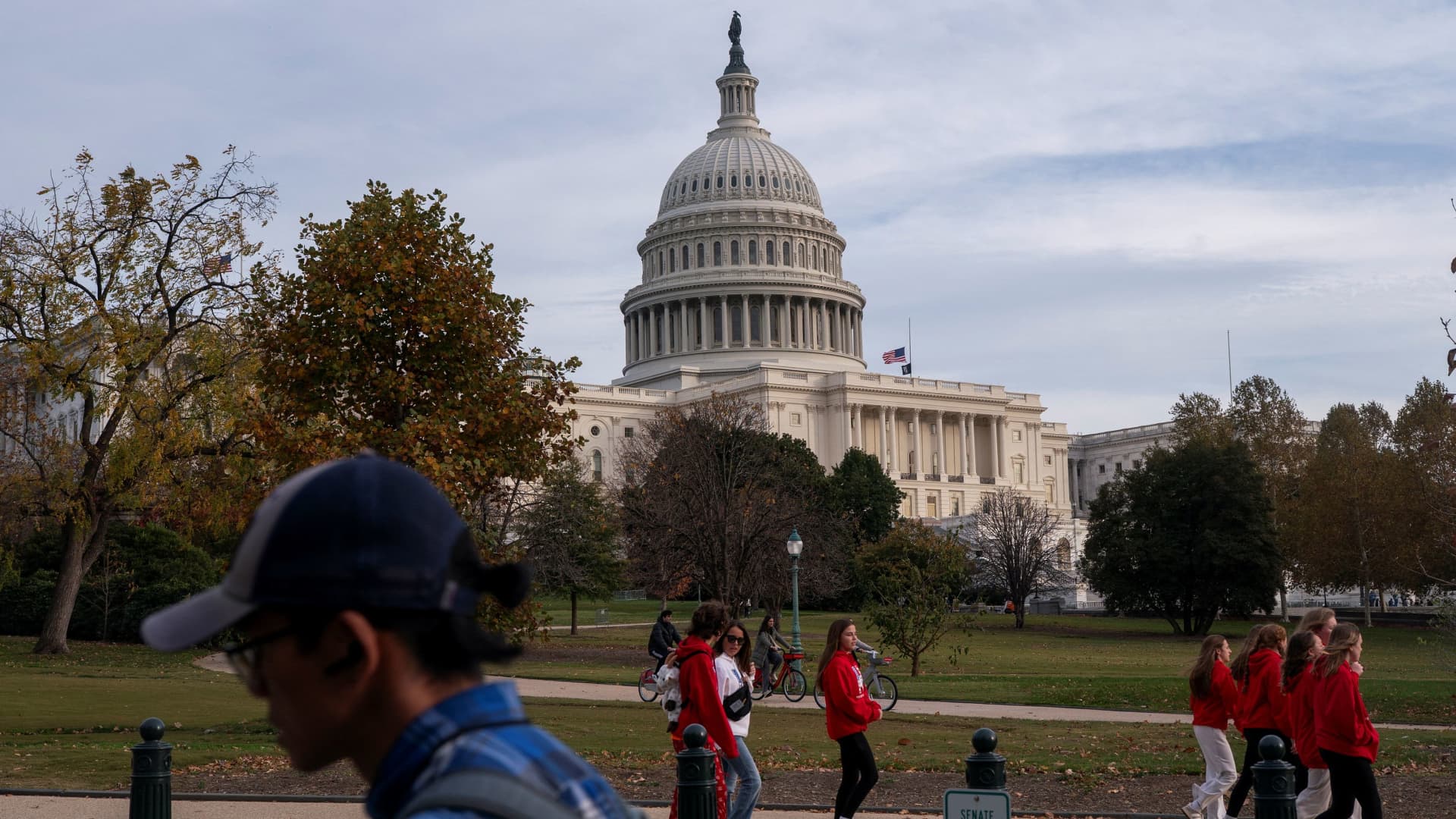
Tourists walk past the U.S. Capitol Building in Washington, D.C., on November 7, 2025, more than a month into the U.S. government shutdown.
Nathan Howard | Reuters
The Senate late Sunday night passed the first phase of a deal to end the U.S. government shutdown that began on October 1.
The procedural measure to allow other votes essential to the deal starting Monday was approved with a minimum of 60 votes after eight senators in the Democratic caucus broke with party leadership in favor of the deal. Forty senators voted against it.
Voting took place on the Senate floor for more than two hours, pending the arrival of the final “yes” vote cast by Sen. John Cornyn (R-Texas), who flew to Washington, D.C., for proceedings Sunday night.
Sen. John Cornyn (R-Texas) is shown after the Senate luncheon at the U.S. Capitol on Tuesday, June 3, 2025.
Tom Williams | Cq-roll Call Inc. | Getty Images
Senators erupted in applause as Cornyn appeared to vote in favor of the bill just before 10:50 p.m. ET.
The agreement was reached after 24 hours of negotiations last weekend and will provide funding to the U.S. government until the end of January.
The deal does not include an extension of expanded Affordable Care Act tax credits that are set to expire at the end of December, a key demand from Democrats.
But the deal includes a guarantee that, for the first time since the shutdown began, Republicans will vote in December on a bill chosen by Democrats to extend subsidies that more than 20 million Americans rely on to reduce the cost of health insurance plans purchased on the ACA marketplaces.
The deal must be approved by the House of Representatives and signed by President Donald Trump before the shutdown ends.
The agreement calls for eliminating all permanent layoffs of public employees during the government shutdown and protecting so-called layoffs that occur through the end of fiscal year 2026.
It would also ensure that all federal employees were paid their regular salaries during the shutdown, when many federal employees were not allowed to work.
The package includes provisions to establish a bipartisan budget process and prevent the White House from using continuing resolutions to fund the government.
It will also fund the SNAP program, which feeds 42 million Americans through food stamps through September.
The Trump administration announced last week that it would not pay out SNAP benefits in November, citing the government shutdown, and on Friday won a preliminary Supreme Court order blocking a federal judge’s ruling that would have required full payments of SNAP benefits to recipients this month. The administration said it would only pay a portion of food stamp benefits.
With Cornyn absent from the chamber, the vote stalled for more than 25 minutes, 56 to 40, and three other Republican senators, Rick Scott of Florida, Ron Johnson of Wisconsin and Mike Lee of Utah, also did not vote for unclear reasons.
In the end, after meeting with Senate Majority Leader John Thune, all three voted in favor of the bill in quick succession.
One Republican, Rand Paul of Kentucky, voted against the bill.
“I’m hopeful that after 40 long days, we can end the shutdown,” Thune said before the vote.
Thune’s effort to pass a continuing resolution to reopen the government had been defeated in 14 preliminary votes by Sunday night.
Senate Majority Leader John Thune, R.S., speaks with reporters at the U.S. Capitol on Wednesday, Oct. 8, 2025, the eighth day of the government shutdown.
Tom Williams | CQ-Roll Call Inc. | Getty Images
Mr. Thune negotiated the deal with the White House and three members of the Democratic caucus, New Hampshire Democrats Sens. Jeanne Shaheen and Maggie Hassan, and independent Sen. Angus King of Maine.
Other Democrats who voted in favor of the deal were party whip Dick Durbin of Illinois, Catherine Cortez Masto and Jacky Rosen of Nevada, John Fetterman of Pennsylvania, and Tim Kaine of Virginia.
Sen. Bernie Sanders, an independent from Vermont who caucuses with Democrats, called the deal “horrible” and said Republicans’ agreement to schedule a vote on ACA credits next month was “an absolutely pointless move.”
King said at a news conference while the vote was still in progress that he would tell voters he agreed to drop his main request to extend the ACA credit “because it’s not working.”
“It’s been six weeks,” King said. “Republicans have made it clear that they will not debate the Affordable Care Act tax credits until the government shutdown is over.
“Will it change in a week or another week or after Thanksgiving or Christmas? And there’s no evidence that it will change,” he said. “What we have evidence of is the damage the government shutdown is doing to the country.”
“This was the only agreement we had in the negotiations,” Shaheen said at the same news conference.
“This was our best chance to reopen the government and immediately begin negotiations to extend the ACA tax credits that tens of millions of Americans rely on to save money,” Shaheen said.
Senate Minority Leader Chuck Schumer of New York spoke angrily on the Senate floor, saying he would not vote for the deal.
Democratic Senate Minority Leader Chuck Schumer of New York speaks during a press conference at the U.S. Capitol on October 29, 2025, in Washington, DC.
Jim Watson | AFP | Getty Images
Schumer criticized Republicans and Trump for refusing to agree to an ACA financing extension, which he said would result in huge increases in health insurance premiums for millions of people in 2026.
“This health crisis is so serious, so urgent, so devastating to families back home that I cannot in good faith support this (continuing resolution) that fails to address the health crisis,” Schumer said.
“I’ve said for years that to win votes, we need to fix the Republican health care mess and move toward protecting federal workers,” Kaine said before voting for the deal.
“This deal guarantees a vote to extend the Affordable Care Act’s premium tax credit, which Republicans did not want,” Kaine said.
“Lawmakers know that voters expect them to vote yes, and if they don’t vote, there’s a good chance they’ll be replaced at the polls by someone who will.”
A majority of Americans support expanding subsidies introduced during the coronavirus pandemic.
